|
Teksten van
het ARS NOVA concert / texts and translations of three
isorhytmic compositions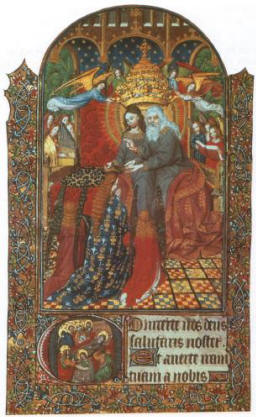
Ars Nova teksten
Anon.
(Nicosia/Cyprus): Sanctus
in eternis / Sanctus et ingenitus
SOURCE
Text and
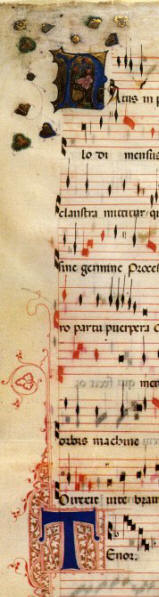
music are only found in one source, a famous codex
with repertory linked to the Court of Cyprus, probably
compiled between 1413 and 1436. It belonged to the
library of the Duke of Savoy and is now preserved in
Turin. Cyprus (i.e. Nicosia) was then one of Europe's
Cultural Capitals. It's king, Janus (Jean de
Lusignan), was married to Charlotte de Bourbon. The
codex survived the terrible fire of 1904 (not without
damage and shrunk a little bit). It is shelf-marked
"ms. J.II.9" (Codex Taurensis) and consists of 159
folios containing over two hundred polyphonic
compositions both sacred and secular, all unique, all
anonymous, and many polyphonic masterpieces.
This isorhytmic motet is n° 35, fol(s) 075v-076.
The general
theory about the provenance of this manuscript is that
Janus's daughter Anne took the codex with her when she
married Louis, Duke of Savoy (see image
>). This explains (but beware: the explanation
is invented to explain, so it is speculation) why the
codex was in the Duke's Library (The Duke of Savoy
later transferred his seat from Chambéry to Turin).
However, even in this scenario she is not the only
candidate. Her uncle, Hugh de Lusignan, also resided
in the Duchy of Savoy (bishop of Geneva). Based on
iconographical and paleographic evidence, it seems
more plausible to suggest that the manuscript was
commissioned in Italy with a link to (or for) the
court of Cyprus. Connections between Northern Italy
and Cyprus abound
(1). The presence of the coat of arms of the
Avogrado family in the manuscript provides a strong
link to this wealthy family from Brescia. Perhaps they
commissioned it. The manufacturing of the manuscript
and the compositions in it are now often linked to
'Jean Hanelle' who arrived as a petit vicaire in
Cyprus in the retinue of Charlotte de Bourbon in 1411
(King Janus' second wife). Hanelle originated from
Cambrai (hometown of Dufay). He was chapel Master of
the King of Cyprus in 1434-1436 and in Savoy during
the festivities of Anne's wedding (1434). At that time
the Grant chapelle of Savoy was placed under
the direction of a certain Guillaume Dufay...
Producing beautifully ornamented Music manuscripts to
show off was quite common in those days.
TEXT
Both texts
are 'tropes' (extending official texts by
interpolation) on the liturgical chant of the
"Sanctus" .
The Latin
text below differs in some points from booklets
provided with CD's. It is based on the critical text
edition of Clemens Blume & Guido M. Dreves
ANALECTA HYMNICA MEDII AEVII (vol. XLVII. TROPI
GRADUALES. Tropen des Missals im Mittelalter (Leipzig,
1905), p. 315-316.
Not only
their interpunction is very helpful to come to a
beginning of an understanding (I do not claim more)
but also their transcription sometimes differs. Both
poems consist of 20 hexameters, with internal rhyme
and (in Cantus I) some odd final rhymes in the last
part, which breaks the stanzas.
One pertinent
mistake, reproduced in many concerts and recordings
(based on the official edition of this manuscript in
CMM): Cantus II, 4.2: Many musicians sing (&
textbooks print & translators do their best to
make sense of it) 'Laus amor o
Danielis vox gloria reboat huius'. Quite
a common transcription error ("ni" is read instead of
"m" (recognize the 'OCR error!). The original seems
to read 'amor odor'. It should be I think - following
Blume/Dreves - Laus amor oda
meli vox gloria..."
The
translation is mine, substantially differing from but
still based on David Seward's (booklet Music from
the Court of King Janus of Nicosia. Huelgas
Ensemble)
26-09-2013
Dick Wursten
(1) Source Karl Kügle, 'Glorious
Sounds for a Holy Warrior: New Light on Codex Turin
J.II.9', Journal of the American Musicological
Society, Vol. 65, No. 3 (Fall 2012), pp.
637-690.
 |
Cantus
I (in ms.: Tenor)
1. Sanctus
in eternis regnans, pater
inque supernis
Summaque
natura naturans summa datura
Maximaque
ternis personis omnia cernis,
Res sine
factura, generans sine qua genitura,
2. Sanctus
et aequalis genitus, qui
cum patre talis
Abs
defectura patris exples omnia iura,
Qui
personali distans patre proprietate
Et
integrali constans es idem deitate,
3. Sanctus
et una quoque procedens res ab
utroque,
Quae par
gignenti similis substantia pura,
Par
quoque nascenti, caritas, amor et pia cura,
Munus et
amborum, largitio, pignus amorum,
4. Tu Sabaoth
Dominus, caelorum rex quoque dignus,
Tu terrenorum,
tu gloria plena polorum,
Vivis in
excelsis, [rex] qui sine tempore
celsis.
5. Hosanna,
dignos tecum regnare benignos
Fac tibi
cum sanctis regni solio dominantis.
6. O benedicte,
venis Domini qui nomine plenis,
Subtrahe
nos poenis, hosanna, semper amoenis
Excelsis
digne, salva nos, Christe, benigne.
|
Holy
Father, ruling forever and above;
Producing
the essence of nature itself,
the
very best, you - threepersonally - sift
everything
generating
things without making, without any begetting,
Holy and equal Son, who with the
father
without defect fulfills all the father's laws,
who, in persona distinct but with the
same nature
and
completely agreeing, art the same god,
Holy and also One who proceeds from both (= Spirit),
Equal to the Begetter, alike in pure
substance.
And equal too to the Begotten, charity, love,
pious care,
Reward and generous pledge of the love of
both,
Thou , Lord Sabbaoth, also worthy King of
heavens,
Thou full glory of the earth and of the sky,
dwellest on high, who forever is sublime.
Hosanna! Let the worthy and benign reign with
you
together with the saints who rule on the
throne of power,
O Blessed, who comes with a name full of the
Lord.
Take away our punishments, Hosanna! Always
worthy of
heavenly
joys, save us, o Christ, benignly.
|
In Cantus I,
3.3: Blume/Dreves read 'cantas
amor...' and suggest constas. I
prefer 'caritas'
(as does CMM) - also a common transcription (and OCR)
error: n - ri
|
Cantus II (in ms.
Contratenor)
1.
Sanctus et ingenitus pater atque
carens genitura,
Sanctus
et ac genitus, patri par gloria pura,
2.
Sanctus par pneuma patri, genito
quoque neuma.
Fili,
sancte pater, sanctum quoque pneuma
character,
3.
Tu Sabaoth Dominus, redimens nos
a nece, pignus,
Tu
Deus aeternus, clemens, pius atque
benignus.
4.
Tu, cuius caeli sunt pleni terraque,
cuius
Laus,
amor, oda, meli,
vox, gloria
reboat huius
5.
Celsis, Hosanna, mortis quoque
comprime damna,
Nos caelis foveas caelestes ante
choreas.
6.
Qui, benedicte, venis divino matre
Maria
Nomine,
prole pia, damni nos detrahe
poenis.
7.
Nobis patre datus, ut nos a morte piares,
Nobis
celsa dares, pro nobis virgine natus,
8.
Mortuus et passus, crudeli verbere
quassus,
Qui venis in Domini pro nobis nomine
trini,
9.
Qui Deus es dictus et homo, pius et
benedictus,
Qui
cibus et panis credentibus es tibi sanis,
10.
Semper in excelsis, Hosanna,
redde beatis
Fine
frui celsis, salva nos, fons pietatis.
|
Holy and unborn, Father without a
parent; Father
Holy and born, Equal to the Father in pure
glory; Son
Holy 'breath' equal To the Father and
'breathing' to the Son; Spirit
O Son, holy Father, holy Ghost as well,
(the divine) imprint.
Thou, Lord Sabbaoth, our pledge, redeeming us
from death,
Thou eternal God, merciful, faithful and
beneficent.
Thou, of whom the heavens are full and the
earth is filled of whom
the praise, love, hymn, melody,
voice, and glory resound ...
...in the high, Hosanna, also suppress the
pains of death,
Cherish us in heaven in the presence of the
heavenly choirs/dances.
Blessed art Thou, who comes as a child to
the pious mother Mary, with
a divine name, detract us from the
punishments of the damned.
Given to us by the Father, to expiate us
from death,
to give us heaven, Thou, born for us from a
virgin,
who has died and suffered, beaten with the
cruel lash,
who comes for us in the name of the Triune
Lord,
Thou, who art called God and man, faithful
and blessed,
Thou who art food and bread to true
believers,
Always in the highest Hosanna, give the
blessed that they
may enjoy forover on high, save us, source
of piety/mercy.
|
In Cantus
II, 6.2: Blume/Dreves suggest 'pia
damni nos', in CMM it is : pia
damnosis. The original seems to be
(according to Dreves) pia
damnos.
Written on
the occasion of the installation of the new bishop of
Padua Pietro Marcello november, 16th, 1409.
Marcello was born in Venice. Translations in English
and Dutch. Alternative readings from the transcription
by Susanne Clercx in 1960. In 1985 a new modern
edition appeared: Polyphonic Music of the
Fourteenth Century vol XXIV: The works of Johannes
Ciconia, edited by Margaret Bent and Anne
Hallmark, Volume 24, Éditions de l'Oiseau-Lyre, 1985.
I was not able to consult it.
|
|
translation
|
|
translation
|
|
Petrum Marcello
Venetum
Romano cretum
sanguine,
Pastorem nostrum
carmine*
Laudemus bene
meritum.
Exultet urbs
Euganeae
Adventu tanti
presulis
Exultet plausu
jubilis
Voves sonent
ethereae.
Stirps leteris**
Marcellina
Tali alumno
decorata,
Cuius gradu
sublimata
Illi tota te***
declina.
Plaudat Patavinus
chorus
Laudes Iovi summo
pangant
voce leta celum
tangant
venit enim pastor
verus.
Suz.
Clercx:
*
curiem
** litteris
***
re
|
Let
us praise Peter from Venice
born
from the Roman Marcelli (1)
our
Pastor with a song
well
deserved.
Exult, city of the Euganei (2)
at
the coming of such a prelate,
Exult and applaud joyfully
let
your vows resound to heaven.
Enjoy lineage of the Marcelli
adorned with such offspring:
because of his elevation
proternate
yourself fully for him.
Applaud, Paduan choir,
Compose praises for the highest
with
joyful voice touch the sky
for a
true Pastor is coming.
1.
Marcelli = an old Venetian family,
what's the reference to Rome ?
2.
Euganei = semi-mythical proto-Italic ethnic
group
|
O Petre, antistes
inclite
Vere virtutis
speculum
Quo nostrum inter
seculum
Nos mina recto
limite.
O pater
amantissime,
Nos oves tuas
dirige
Et aberrantes
corrige
Judex cunctis
justissime.
O cleri primas
Padue
Nos tuos rite
regula
Peccantes coge
ferula
Sordida cuncta
dilue.
Sint laudes regi
gloriae
Qui nos te dignos
red[i]dit;
Qui melon istud
edidit
Adesto tuo Cyconie.
|
O Peter,
famous bishop,
truly, mirror of virtue
with which (i.e. virtue) during our age,
lead us on the right path.
O most loving father,
direct us, your sheep,
and correct those who err,
judge of all, most just.
O primate of the Paduan clergy
rule duly over us, who are yours,
with your staff compell the sinners,
wash us from all that is sordid.
Honour be the King of glory
who made us worthy of you;
and to the writer of this song
give heed, your Ciconia.
|
|
|
vertaling
|
|
vertaling
|
|
|
Laat ons Pietro
Marcello van Venetië,
uit Romeins bloed
gesproten,
onze Herder, onze
Pastor
prijzen met een
welverdiend lied.
Jubel stad der
Euganei
om de komst van
deze prelaat.
Jubel, klap in de
handen, zing
himmelhochjauchzend.
Verheug u, geslacht
van Marcello,
met zulk een telg
getooid.
Buig bij zijn
troonsbestijging
eerbiedig voor hem
neer.
Applaus ! koor van
Padua,
lofzingt voor de
hoogste god
laat uw blijde stem
ten hemel rijzen
want hij komt, de
ware herder.
|
|
O Pietro, vermaarde
bisschop,
echt, de spiegel
der deugd,
waarmee in dit
tijdsgewricht:
u ons moet leiden op het
rechte pad.
O
allerliefhebbendste vader,
leid ons, uw
schapen
corrigeer hen die
dwalen
allerrechtvaardigste
rechter.
O primaat der
clerus van Padua,
bestuur ons, de
uwen, zoals het hoort,
bedwing zondaars
met uw staf,
was alle smetten
van ons af
Eer aan de koning
der glorie,
Hij maakte ons u
waardig.
En op hem die dit
liedje schreef
sla welwillend
acht: ’t is uw Ciconia.
|
Written on
the occasion of the coronation of Gabrieli Condulmieri
(from Venice) as pope Eugenius IV, 1431, 11 March. At
least that is the 'received opinion'.
However,
especially the text of the Motetus is hardly
thinkable on that occasion. It is so... militant,
openly referring to bad times. At least as far as we
can understand this text. The first stanza 1 and
stanzas 4 and 5 of the Motetus are hardly
translatable, or if translated remain cryptical. So,
one is inclined to search for a different setting
(context) which might help to illuminate these parts
of the text.
There is a
daring hypothesis: The reference to a 'shield'
(stanza 4) given to the pope should be understood as a
reference to an episode a few years after his
coronation, when pope Eugenius hastily had to leave
Rome in a boat, while revolting roman citizens threw
stones at him. (It is the time of the Western Schism
and Rome becomes the bulwark of the conciliarists
(Council of Basle). Venice and Florence are Rome's
enemies and they rescue the pope. During this exile
(1434-1443) he lived in Florence (at that time an
enemy of Rome). If Ecclesiae militantis does
date from this period and refers to it (remember: this
is private music!) then Du Fay tries to transform the
Pope's retreat into an act of heroism. If read from
this perspective both the beginning in which so
emphatically the election by the conclave and its
legitimacy is mentioned and the way the Pope's
personal virtues of asceticism and purity are
highlighted become telling. Even the first lines might
shift in meaning: No oblique reference to ecclesia
militans / triumphans but a call on Rome “the
militant and triumphant church's seat” to offer praise
to the true pope. The lamento (contratenor)
also gets a proper meaning: This specific war is
lamented...
The text tradition used by musicians is quite
confused. On the internet a version dominates which is
quite faulty. The one presented below seems more in
order. I compared it - with my humble paleographic
skills - to the manuscript version, consultable here
(Codici Trentini 87-93, folios 85v-86r +
95v-96r) and the official edition of Dufay's Opera
Omnia in the CMM.
I transcribed
the medieval Latin to make it more familiar (the "ae"
written as "e" in medieval Latin is a constant source
of confusion (so, in Motetus 1,4 there is no horse
'equum', but simply the adjective 'aequum'). Most
pertinent differences I printed in blue.
I don't claim perfection in translation. Some
parts I translated but I don't grasp the meaning. I
tried not to interfere too much, even when I didn't
get it. Often one has to rephrase the sentence
completely in order to get something which sounds like
English. In Latin the placement of the words in a
sentence is almost entirely free. It is the
gender, conjugation, declination etc. which
links words.
|
Triplum
|
|
Motetus
|
|
|
Ecclesiae
militantis
Roma sedes
triumphantis
patri sursum sidera
tamen* cleri
resonantis
laudem summi pontificis
promat
voce libera.
Gabrielem quem
vocavit
dum paternum crimen
lavit
baptismatis sumptio
Eugenium revocavit
bonum genus quod
notavit
pontificis lectio.
Quod consulta contio
qua nam sancta
ratio
sic deliberavit
ut sola devotio
regnet in palatio
quod Deus beavit.
Certe Deus voluit
et in hoc
complacuit
venetorum proli
sed daemon indoluit
quod peccatum
defuit
tantae rerum moli.
Dulcis pater populi
qui dulcorem poculi
crapulam perhorres
pone lento consuli
rem gregis
pauperculi
ne nescius erres.
Pater haerens filio
spiritus confinio**
det prece solemni
gaudium Eugenio
perfecto dominio
in vita perenni.
Amen.
* carmen is suggested
as emendation in CMM.
** or consilio ?
|
Rome,
seat of the militant
Church, which is triumphant
above the stars, bring forth
when
the clerics sing for the Father
at
least* the praise of the Pope
with
a liberated voice.
Who was called Gabriel
when cleansed of original sin
in baptism
was renamed Eugenius,
'well-born' as the
Papal election declared.
Which, the prudent assembly
- for she was led by holy reason -
thus decided
that
only devotion
should reign in the palace
that God had blessed.
Certainly it was God's will
And in this he has gratified
The offspring of the Venetians;
But the Devil did grieve
because sin had not part
in
this important matter.
Sweet father of the people,
You who abhorr the sweet
intoxication of the cup (= drinking)
Entrust to a mild councillor
the case of your poor flock,
that
you may not err unknowingly.
May the Father united with the Son
with the Spirit alike
give through solemn prayer
joy to Eugenius,
in the eternal life
once
his dominion completed.
Amen.
* with carmen: a song that praises
|
Sanctorum arbitrio
clericorum* proprio
corde meditanti
aequum genus
atrio
accedit
ludibrio
umbrae petulanti.
Nam torpens inertia
longa quaerens otia
nescivit Eugenium
sed juris peritia
cum tota justitia
sunt ejus ingenium
Hinc est
testimonium
pacem quaerit
ommium
exosus piaculi
et trinum
dominium**
daemonis et carnium
pompam vincit
saeculi.
Quam color ipse
poli
dic scutum, quod
attuli
tibi, pater optime
dscrum dat, quod oculi
instar tui speculi
cernunt
nitidissime!
Eya pulcherrime
querimur
tenerrime
moram longi
temporis
ducimur asperrime
nescio quo ferrime
ad fulmentum
corporis.
Una tibi trinitas
vera Deus unitas
det coeli fulgorem
quem linea bonitas
argentea castitas
secernit in morem.
Amen.
* the ms.
says cleri canor - but ?
** MS: daemonium. I
prefer to correct the reading:
The triple dominion is traditionally linked
to the papacy (cf. Tiara).
|
through the decision of the saints
a fair and just group of clerics
who look into their own heart,
enters the hall (of the palace)
(once the place) of mockery
of
shadowy insolence.
For languid indolence
That seeks longlasting leisure
is unknown to Eugenius;
But the juridical expertise
full of justice,
is his natural dispostion.
Here is the proof:
He seeks peace for everyone,
hates crime and
and the triple dominion
overcomes the pomp of the devil,
the flesh and the world.
Say how the color of the sky
gives the shield I brought you,
most kind father,
that sacred (aspect), that your eyes
like through a mirror
discern most clearly.
Alas, most illustrious one
we bemoan, most tender one,
that it took so long.
we were led very harsly,
I don't know how, fiercely
to corporeal support.
May the Trinity in One,
God, the true Unity,
Grant you the splendor of heaven
who by linen-white goodness,
and silverlike chastity,
is set apart in morals.
Amen.
|
Contratenor
Bella canunt gentes, querimur,
pater optime, tempus:
Expediet multos, si cupis, una dies.
Nummus et hora fluunt
magnumque iter orbis agendum
Nec suus in toto noscitur orbe Deus. |
The people sing of
war, and we lament,
Most kind father,
our times:
One day, if you
wish, things will go well for many.
Money and time flow
away,
And the world still
has a long way to go;
Yet its God is not
known in all parts of the globe.
|
De volken bezingen de oorlog, maar wij
beklagen, goede vader, de tijd.
Geld en tijd vloeien heen
en er is nog een lange weg te gaan
voor een wereld, die wereldwijd
haar eigen God niet kent.
|
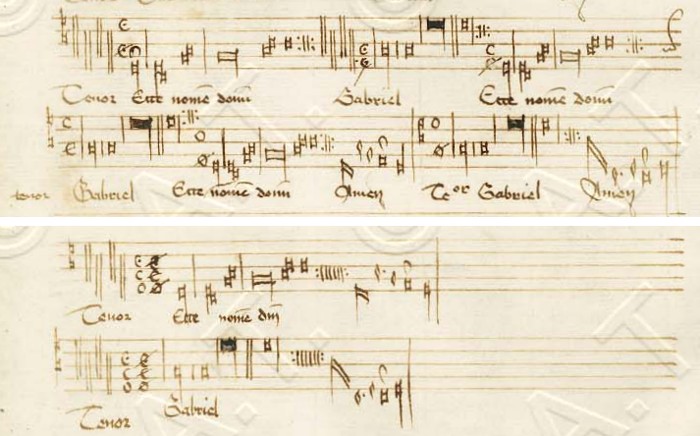
The cantus firmi:
"Ecce
nomen Domini" (Antiphone of the Vespers for Saturday
preceding the first Sunday of Advent ad Magnificat)
"Gabriel"
(= God is my strength) (Antiphone of the Matins of
Sundays in Advent & Vespers of the Annunciation ad
Magnificat)
|