music studies
Lambert de Sayve: Sacrae Symphoniae (1612)
Latin–English
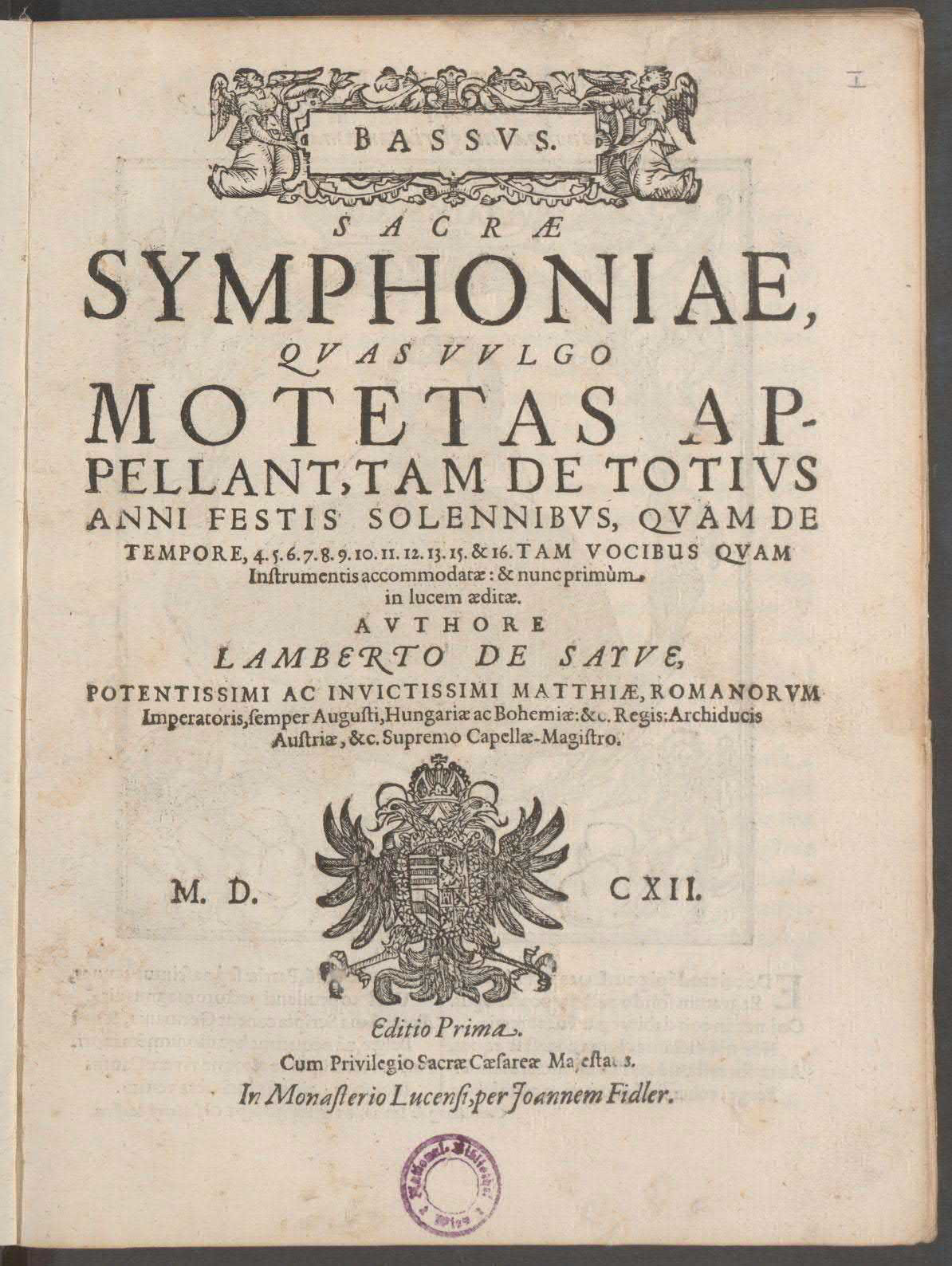
The 1612 book of motets features a beautiful portrait of Lambert de Sayve (1548/9-1614), chapel master at the Habsburg court in Austria. At the time, he was in the service of Matthias, who was crowned emperor of the ‘Holy Roman (Roman) Empire’ at Frankfurt aM (June 1612). The volume is dedicated to this monarch (in whose service the Liègeois had been for well over 30 years). Judging by the preface, it is Lambert’s gift to his sovereign. The more remarkable: he himself, Lambert, figures in it with a stately portrait, directly after the preface. The poems surrounding the portrait don’t lie either. Lambert is a great composer in the eyes of his contemporaries. See below the image for the text/translation. Or should we see it in a somewhat different, much more down-to-earth way: Being the court composer of the great emperor, he must be a great composer. It’s a matter of perspective. The author/poet is Conrad Georg de Loncin (a learned man given the abbreviated titles following his name – he was also a tenor in the court chapel). Like Lambert, he originated from the region of Liège. This also explains why the ‘Belgae’ figure distinctively in the second stanza.
Portrait
Lambert, 63, poses self-consciously in ‘court dress’, with chain of honour, surrounded by a laurel wreath and music-making angels. Are we bearing witness to the birth of the artist’s ego, the composer as ‘auctor’? Below the image the transcription of the texts with translation.
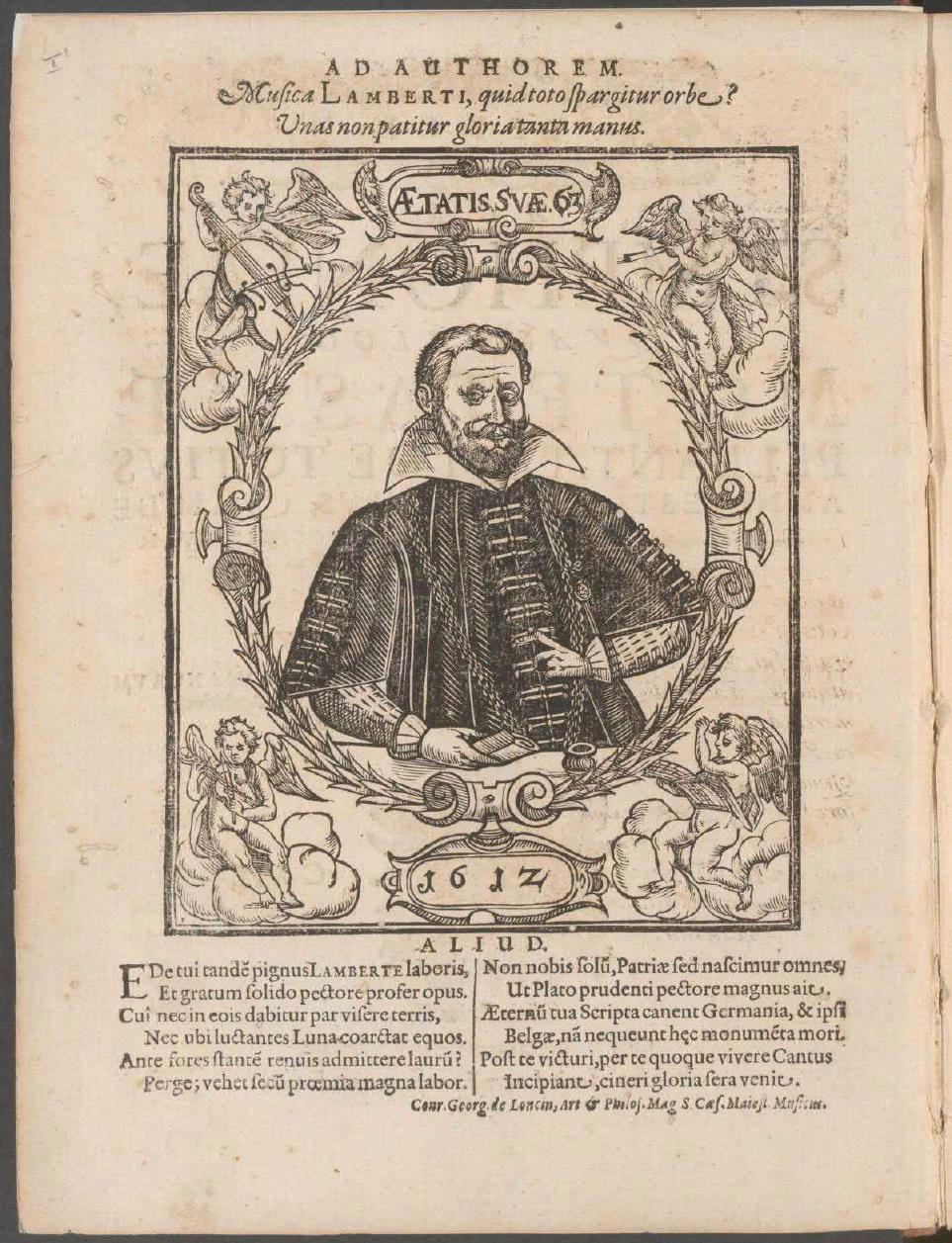
Texts (Latin – English)
| AD AUTHOREM Musica LAMBERTI, quid toto spargitur orbe ? Unas non patitur gloria tanta manus. |
To the author (creator) Music by Lambert, why are you scattered all over the world? Such glorious (music) does not tolerate being confined to a few hands. |
| Aetatis suae. 63 1612 |
at the age of 63 1612 |
| ALIUD | another one (i.e. eulogy) |
| Ede tui tandem pignus LAMBERTE laboris, et gratum solido pectore profer opus. Cui nec in eois dabitur par visere terris, nec ubi luctantes Luna coarctat equos. Ante fores stantem renuis admittere laurum? Perge; vehet secum proemia magna labor. |
Publish the result of your labour, at last, Lambert, publish the work that sprouts from a solid mind. There is no such thing in lands of Eos (East) nor where the moon tries to restrain its horses (West) The laurel wreath is at the door: do you refuse to let it in? Forward! This work will bring ‘great distinction’. |
| Non nobis solum, Patriae sed nascimur omnes, ut Plato prudenti pectore magnus ait. Aeternum tua scripta canent Germania, et ipsi Belgae, nam nequeunt haec monumenta mori. Post te victuri, per te quoque vivere Cantus incipiant, cineri gloria sera venit. |
Not for ourselves alone, but for the fatherland we all are born as the great Plato with his wise mind once said. Germany, and the Belgians themselves, will sing your lyrics forever, for these monuments cannot die. Let the songs that will outlive you also begin to live through you, Fame comes too late when you have already turned to ashes. |
Martialis epigram I, 25 (Faustinus)
Note: the second poem of praise is a variation on an epigram by Martialis (Liber I, xxv)
| ede tuos tandem populo, Faustine, libellos et cultum docto pectore profer opus, quod nec Cecropiae damnent Pandionis arces nec sileant nostri praetereantque senes. ante fores stantem dubitas admittere Famam teque piget curae praemia ferre tuae? post te victurae per te quoque vivere chartae incipiant: cineri gloria sera venit. |
Give at length to the people, Faustinus, your books, and send forth a work, polished by your learned skill, which Pandion’s Cecropian heights would not condemn, nor our sages dismiss in silence and pass by. Do you hesitate to admit Fame that stands before your doors, and shrink from winning the reward of your care ? Let writings that will live after you by your aid also begin to live now ; to the ashes of the dead glory comes too late. |
(English translation: WALTER C. A. KER / Loeb Classical Library, 1919)