The music from the Llibre Vermell of Montserrat
Revised text edition, based on the original manuscript
Text and Translation of the Songs
Note on the Text and Translation
After a concert in Brussels and Antwerp, I re-examined the original manuscript of the Llibre Vermell (the Red Book of Montserrat) to verify the Latin text used in almost all performances (both live and on CD). A number of recurring errors—perpetuated from edition to edition—needlessly obscure the sense of the text.
The most striking example occurs in the final stanza of Mariam matrem virginem. The last lines become virtually untranslatable if one follows the conventional transcription: to whom does quem refer? The preposition per requires an accusativus (which famulis is not), and what does percussus agree with? When one consults the original manuscript, however, the reading becomes straightforward:
Usual version: Pugnare quem viriliter per famulis percussus duris iaculis atrociter.
Corrected version: Pugnare quam viriliter pro famulis percussis duris iaculis atrociter.
Quam requires no antecedent, pro governs the ablative famulis, and percussis agrees directly with it. While the passage remains concise, it yields good sense (see the translation and paleographical note at no. 7).
I also checked the current translations, often copied uncritically from one source to the next. Most translators appear unaware that iocalibus ornantes (in Stella splendens) does not mean “full of joy”, but “adorning it [= the shrine or church] with jewels” — a crucial distinction for the Marian shrine at Montserrat. The revised translations are presented below. The Catalan (and/or Occitan) texts lie outside my expertise and are reproduced from standard online editions, with the seven joys of Mary numbered for convenience in Los set goytxs.
The musical fascicle of the Llibre Vermell spans fols. 21v°–27r° of this 14th-century parchment codex.* The non-musical rubrics and prayers on these pages are likewise transcribed and translated below. The entire codex is digitized in the Biblioteca Virtual Miguel de Cervantes. [Editorial note: Scribal abbreviations have been silently expanded, and medieval e has been rendered as ae (or oe) where it aids comprehension.]
Llibre Vermell [click to enlarge]

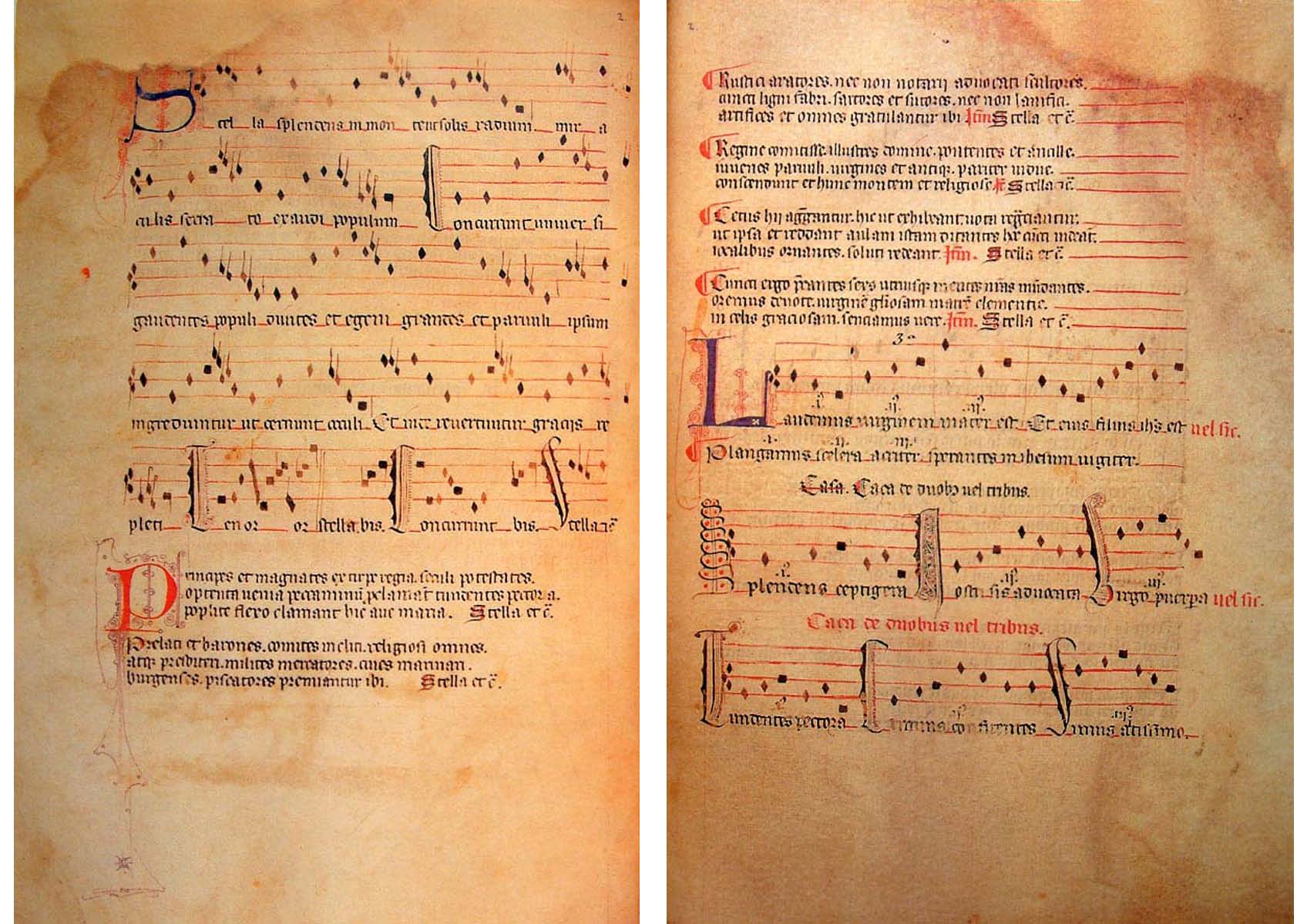

Antiphona dulcis armonia dulcissime virginis Mariae de Monte serrato.
Sweet
antiphonal melody for the most sweet virgin Mary of Montserrat.
Written in margine: « Caça de duobus
vel tribus? » (two- or threefold canon?)
[1. O Virgo splendens]
| Original Text | Translation |
|---|---|
| O Virgo Splendens hic in monte celso Miraculis serrato fulgentibus ubique Quem fideles conscendunt universi, Eya pietatis oculo placato, Cerne ligatos fune peccatorum Ne infernorum ictibus graventur Sed cum beatis tua prece vocentur. |
O Virgin, shining brightly, on this high serrated mountain, with splendid miracles all around, where the believers from everywhere ascend, Ah, with your gentle loving eye behold those caught in the bonds of sin, that they not be vexed by the blows of hell but be called among the blessed by your prayer. |
Follows a prayer to the virgin Mary (black ink), of
which I transcribe the beginning and the end:
Ora pro nobis mater […] per Christum dominum nostrum. amen.
And then in red again:
Sequitur
alia cantilena ad trepudium rotundum
follows another song for a round dance

Quia interdum peregrini quando vigilant in ecclesia Beate Marie de Monte Serrato volunt cantare et trepudiare, et etiam in platea de die, et ibi non debeant nisi honestas ac devotas cantilenas cantare, idcirco superius et inferius aliquae sunt scriptae. Et de hoc uti debent honeste et parce, ne perturbent perseverantes in orationibus et devotis contemplationibus, in quibus omnes vigilantes insistere debent pariter et devote vaccare.
Because sometimes pilgrims keeping vigil in the church of the Blessed Virgin of Montserrat want to sing and dance - and similarly on the square during daytime – and since it is not appropriate to sing there anything else than honourable and pious songs, above and below some have been written. They should be used neatly and frugally in order not to disturb those who persevere in prayers and pious contemplations, things all people who keep vigil should concentrate on and piously apply themselves to.
>[2. Stella splendens in monte]
| Latin | Translation |
|---|---|
| R. Stella splendens in monte ut solis radium miraculis serrato, exaudi populum. |
Splendid star on the serrated mountain (Montserrat), shining with wonders like a sunbeam, hear the people. |
| Concurrunt unvisersi gaudentes populi, divites et egeni, grandes et parvuli, ipsum ingrediuntur, ut cernunt oculi, et inde revertuntur gracijs repleti. |
From all around they rally, rejoicing, rich and poor, young and old, they assemble here to see with their own eyes, and return from it filled with grace. |
| Principes et magnates ex stirpe regia, saeculi potestates optenta venia peccaminum proclamant tundentes pectora. Poplite flexo clamant hic : Ave Maria. |
Rulers and magnates of royal stirpes, the mighty of the world, having obtained indulgence for their sin, they cry out and beating their breast they kneel and cry here: Ave Maria. |
| Prelati et barones, comites incliti, religiosi omnes atque presbyteri, milites, mercatores, cives, marinari burgenses, piscatores praemiantur ibi. |
Prelates and barons, famous counts, all kinds of monks and priests, soldiers, merchants, citizens, sailors, burgers and fishermen are recompensed here. |
| Rustici, aratores, nec non notarii, Advocati, scultores, cuncti ligni fabri, sartores et sutores, nec non lanifici, artifices et omnes gratulantur ibi. |
Peasants, ploughmen and also scribes, advocates, stone-masons and all carpenters, tailors and shoemakers, and weavers as well, all kinds of craftsmen rejoice here. |
| Reginae, comitissae,illustres dominae, potentes et ancillae, juvenes, parvulae virgines et antiquae, pariter viduae conscendunt et hunc montem, et religiosae. |
Queens, countesses, illustrious ladies the mighty and the handmaidens, teenagers and girls, virgins, old women and widows equally, climb this mountain; so do nuns. |
| Coetus hii aggregantur hic ut exhibeant vota regratiantur : ut ipsa et reddant aulam istam ditantes hoc cuncti videant iocalibus ornantes, soluti redeant. |
All these groups assemble to present themselves here. May their vows be granted, so that they return (repay them) enriching this shrine - visible for all - decorating it with jewels, may they return home released. |
| Cuncti ergo precantes sexus utriusque, mentes nostras mundantes oremus devote virginem gloriosam matrem clementiae, in coelis gratiosam, sentiamus vere. |
Therefore, everybody, male and female, beseeching and cleansings our minds, let us devoutly pray: that we may really experience that the glorious virgin, the merciful mother in heaven, is gracious. |
[3a. Laudemus virginem]
Caça de duobus vel tribus (canon à 2 or 3)
| Latin | Translation |
|---|---|
| Laudemus virginem mater est Et eius filius Ihesus est. Plangamus scelera acriter Sperantes in Ihesum iugiter. |
Let us praise the virgin Mother and her son Jesus. Let us bewail our sins bitterly, constantly hoping in Jesus. |
>[3b. Splendens ceptigera]
Caça de duobus vel tribus (canon à 2 or 3)
| Latin | Translation |
|---|---|
| Splendens ceptigera Nostri sis advocata Virgo puerpera, Tudentes pectora Crimina confitentes Simus altissimo. |
Shining sovereign, Be our advocate, Virgin Mother, Beating our breast Confessing our guilt Let us be in the highest [= let us stand accepted before the Highest = God] |
>[4. Los set goytxs recomptarem]
Ballada dels goytxs de Nostre
Dona en vulgar cathallan a ball redon
(Ballad of the Joys of Our Lady in vernacular Catalan, for a round
dance)
| Catalan | Translation |
|---|---|
| Los set goytxs recomptarem et devotament xantant humilment saludarem la dolça verge Maria. |
We tell you of the 7 joys and sing with devotion, humbly greeting the sweet Virgin Mary. |
| R: Ave Maria gracia plena Dominus tecum Virgo serena. |
Hail Mary, full of grace, the Lord may be with you, serene Virgin. |
| Verge fos abans del part pura e sens falliment en lo part e prés lo part sens negun corrumpiment. Lo Fill de Déus Verge pia de vós nasque verament. |
Virgin, before your labour you were pure and faultless, from your labour and after it you remained uncorrupted (1); The son of God was truly born of you, pious Virgin. (2) |
| Verge tres reys d’Orient cavalcant amb gran coratge al l’estrella precedent vengren al vostré abitatge. Offerint vos de gradatge Aur et mirr’ et encenç. |
Virgin, three Kings from the Orient, riding with great
courage, following the star, they arrived at your house. They offered you - one after the other - gold and myrrh and incense. (3) |
| Verg’estant dolorosa per la mort del Fill molt car romangues tota joyosa can lo vis resuscitar. A vos maire piadosa prima se volch demostrar. |
Virgin, being grieved by the death of your beloved son, you are now full of joy, having seen him revive. (4) He wanted to appear first to you, merciful mother. |
| Verge lo quint alegratge que’n agues del fill molt car estant al munt d’olivatge al cel l’on véès pujar. On aurem tots alegratge si per nos vos plau pregar. |
Virgin, the fifth joy that you received from your beloved
son happened when, on Mount Olive, you saw him ascend to Heaven. We will be full of joy if you pray for us. (5) |
| Verge quan foren complitz los dies de pentecosta amb vos eren aunits los apostols et de costa. Sobre tots sens nula costa devallà l’espirit sant. |
Virgin, after the days of Pentecost, the apostles and the others were united by you. Above all came the Holy Spirit. (6) |
| Verge’l derrer alegratge que’n agues en aquest mon vostre Fill amb coratge vos munta al cel pregon. On sots tots temps coronada Regina perpetual. |
Virgin, the last joy you is not found here; your son takes you to heaven with great courage, where you will remain crowned for all time, perpetual queen. (7) |
>[5. Cuncti simus concanentes]
A ball redon (for a round dance)
| Latin | Translation |
|---|---|
| Cuncti simus concanentes : Ave Maria. | Let us all sing together: Hail Mary. |
| Virgo sola existente en affuit angelus, Gabriel est appellatus atque missus celitus Clara facieque dixit : Ave Maria. |
When the Virgin was alone, lo, an angel appeared, Gabriel was his name and he was sent from Heaven. With a shining face he said: Hail Mary. |
| Clara facieque dixit : audite karissimi. En concipies Maria, Ave Maria. |
With a shining face he said (listen my dear ones): You will conceive, Mary. |
| En concipies Maria : audite karissimi. Pariesque Filium : Ave Maria. |
You will bear a son. |
| Pariesque Filium : audite karissimi. Vocabis eum Jhesum : Ave Maria. |
You will call him Jesus. |
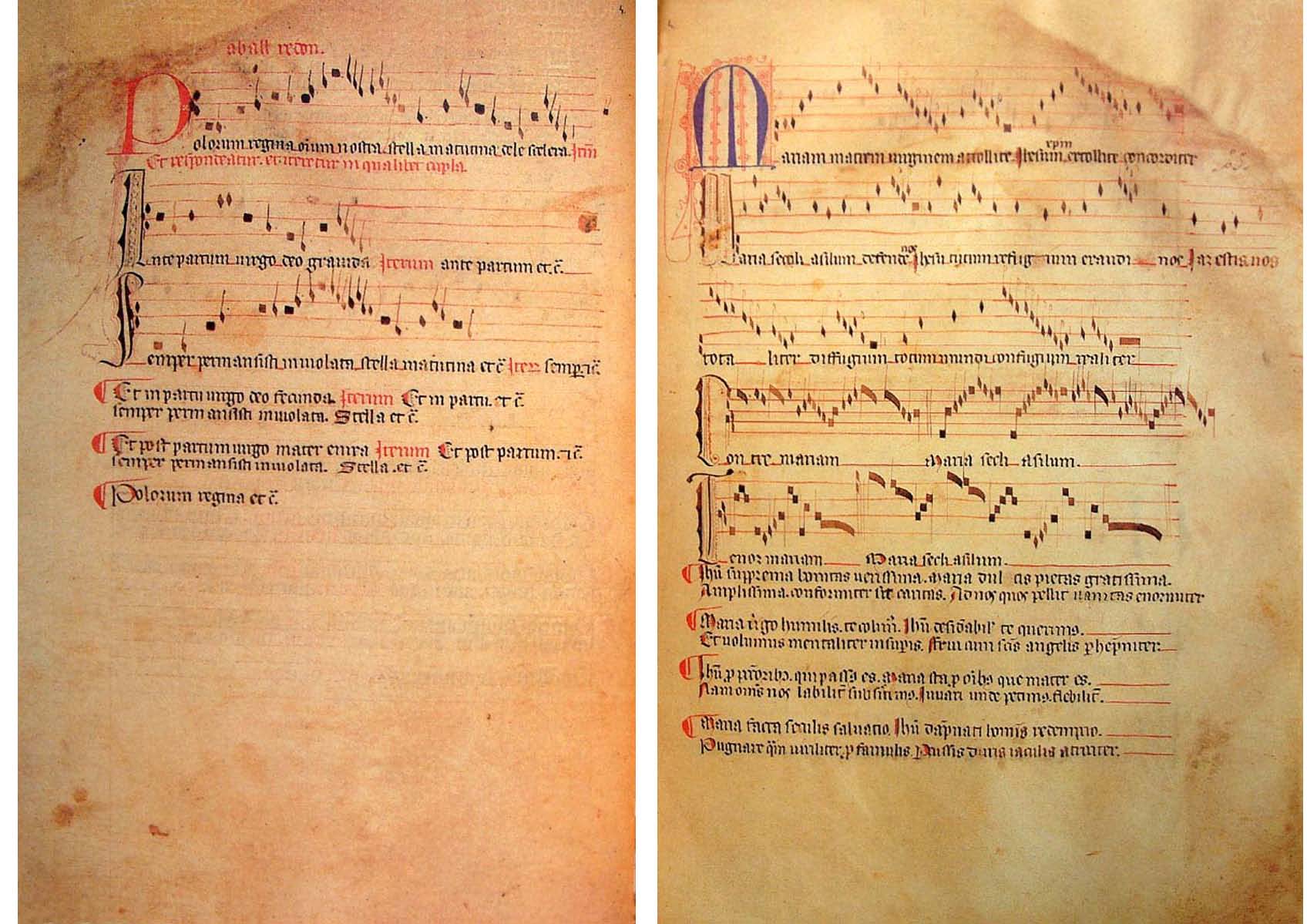
[6. Polorum regina]
A ball redon (for a round dance)
| Latin | Translation |
|---|---|
| Polorum regina omnium nostra Stella matutina dele scelera |
Our queen encompassing all of heaven, morning star, take away our sins. |
| Ante partum virgo deo gravida. Semper permansisti inviolata Stella matutina dele scelera |
Before birth, Virgin, pregnant by God, you remained always inviolate. |
| Et in partu virgo deo fecunda. Semper permansisti inviolata Stella matutina dele scelera |
And in labour, Virgin, fertile by God, you remained always inviolate. |
| Et post partum virgo mater enixa. Semper permansisti inviolata Stella matutina dele scelera. |
And after birth, Virgin, child-bearing mother you remained always inviolate. |
[7. Mariam matrem virginem]
(... live recording with barking dogs as intro.)
| Latin | Translation |
|---|---|
| R. Mariam Matrem Virginem attollite Ihesum Christum extollite concorditer. |
Mary, the Virgin Mother, exalt her, and extol Jesus Christ, in harmony. |
| Maria seculi asilum defende nos. Ihesu totum refugium exaudi nos. Iam estis nos totaliter diffugium totum mundi confugium realiter. |
Mary, asylum of the world, defend us. Jesus, our total refuge, hear us. Now that we are totally dispersed, you are truly the complete safe haven of the world. |
| Ihesu suprema bonitas verissima. Maria dulcis pietas gratissima. Amplissima conformiter sit caritas Ad nos quos pellit vanitas enormiter. |
By Jesus, the supreme and truest goodness, and Mary, sweet and most welcome mercy, may similarly superabound the love towards us, whom vanity strikes enormously. |
| Maria virgo humilis, te colimus, Ihesu desiderabilis, te querimus, Et volumus mentaliter in superis Frui cum sanctis angelis perenniter * * the text reads: "perhepniter" |
Mary, humble virgin, we honour you. Desirable Jesus, we long for you. And we desire with heart and mind on high to delight with the holy angels for ever. |
| Ihesu, pro peccatoribus qui passus es, Maria, sta pro omnibus, quae mater es, Nam omnes nos labiliter subsistimus, Iuvari unde petimus flebiliter. |
Jesus, who for sinners did suffer, Mary, stand for us all as you are a mother, Because our existence is fragile, therefore we beg for help, weeping. |
| Maria facta saeculis salvatio. Ihesu dam[p]nati hominis redemptio. Pugnare quam viriliter pro famulis Percussis duris jaculis atrociter. |
Mary, made for the ages our salvation. Through Jesus, the redemption of condemned man. Fight so valiantly for your servants, fiercely struck by cruel darts.* |
* The duris iaculis ("cruel darts" or "arrows") is a classic medieval theological trope, echoing Ephesians 6:16 ("the flaming arrows of the evil one"), representing sudden temptations, sins, or demonic attacks that "fiercely" (atrociter) wound the faithful 'servants of the Lord' (famulis).

Comment 1 (quem or quam):
Two dots above a character indicate the presence of the vowel “a”;
hence q̈m = quam.
Comment 2 (per or pro):
Both per and pro are abbreviated in the
manuscript. The difference is the place and direction of the
stroke: A straight horizontal line through the tail of the “p”
suggests: per.. par.. por; an oblique line: pro. 
(image from: Lexicon Abbreviaturarum by
Adriano Cappelli. The best there is!)
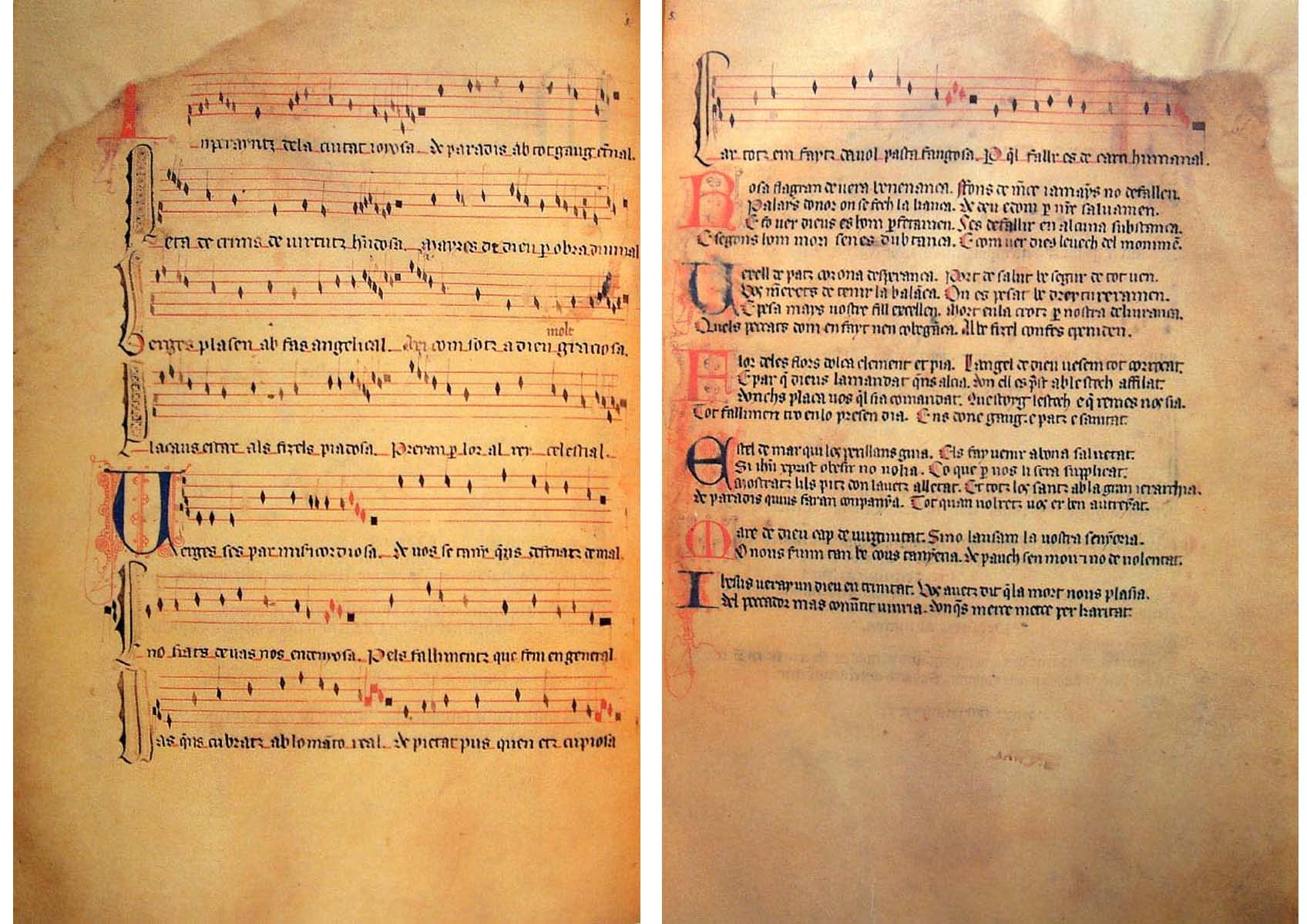
[8. Imperaytritz de la ciutat joyosa]
| Occitan / Catalan | Translation |
|---|---|
| discantus : 1. Imperaytritz de la ciutat joyosa de paradis amb tot gaug eternal neta de crims de virtutz habundosa mayre de Déu per obra divinal verges plasent amb fas angelical axi com sotz a Déu molt graciosa plaçaus estar als fidels piadosa preyan per lor al rey celestial. |
Empress of the joyous city of paradise, eternally happy, purified of sin, abounding in virtues, Mother of God, by divine order; pleasing Virgin with angelic face, because you are so gracious for God, be pityful with the faithful, pious one, praying for them to the celestial king. |
| 2. Rosa flagran de vera benenança fons de mercè jamays no defallent palays d’onor on se fech l’aliança de deu e d’hom per nostre salvament e fo ver Déus es hom perfetament sens defallir en alcuna substança e segons hom morí sens dubtança e com ves Déus llevech del moniment. |
Fragrant rose of true goodness, source of virtues which never failed, palace of honour, where the alliance was made, between god and man, to save us. Who saw God become a perfect man without any failing, and - according to man - died without any doubt and rised from the tomb as the true God. |
| 3. Flor de les flors dolça clement et pia l’angel de Déu vesem tot corroçat e par que Déus lamandat qu’ens alcia don elles prest amb l’estoch affilat. Dons plaça avos que’l sia comandat qu’estoyg l’estoch e que remès nos sia tot falliment tro en lo presen dia ens done gaug e patz e sanitat. |
Flower of flowers, sweet, merciful and pious, we see the grim angel of God, and because God sent him to punish, he is ready for it, with raised sword. Let it be your will that he is ordered not to raise the sword, and that our failings may be forgiven to the present day, and that we may receive joy, peace and health. |
| tenor : 1. Verges sens par misericordiosa de vos se tany quens defentas de mal é no siats devas nos endenyosa pels fallimentz que fem en general. Mas quens cubratz amb lo manto real de pietat pus quen etz cupiosa car totz som faytz d’avol pasta fangosa per que’l fallir es de carn humanal. |
Virgin out of mercy, trusted by those who are to be defended from evil. And do not be enraged by the failures which we always commit, but give us shelter under your royal coat of mercy, because who is abounding in virtues can improve ordinary mud, since failure is of human flesh. |
| 2. Vexell de patz corona d’esperança port de salut bé segur de tot vent vos merexets de tenir la balança on es pesat bé dreyturerament. E pesa mays vostre fill excellent mort en la crotz per nostra deliurança quels peccats d’om en fayt nen cobejança al be fidel confes e penident. |
Vessel of peace, crown of hope, port of health, certain for all, you merit to hold the scale on which virtue is weighed, and your excellent son, who died on the cross for our deliverance, weighs more than the sins commited amongst those, who confess and do penance. |
| 3. Estel de mar qui los perillans guia e’ls fay venir a bona salvetat si Jesu Christ obesir no volia ço que per vos li sera supplicat mostratzli els pitz don l’avetz alletat et totz los santz amb la gran jerarchia de paradis qui us faran companya tot quan volretz vos es ben autreyat. |
Star of the sea, who guides us through perils, so that we can safely reach the harbour, if Jesus Christ does not wish to obey what is requested through you, show him the breasts that suckled him, and all the saints from the great hierarchy of paradise who are with you: Everything you wish will be granted, and more. |
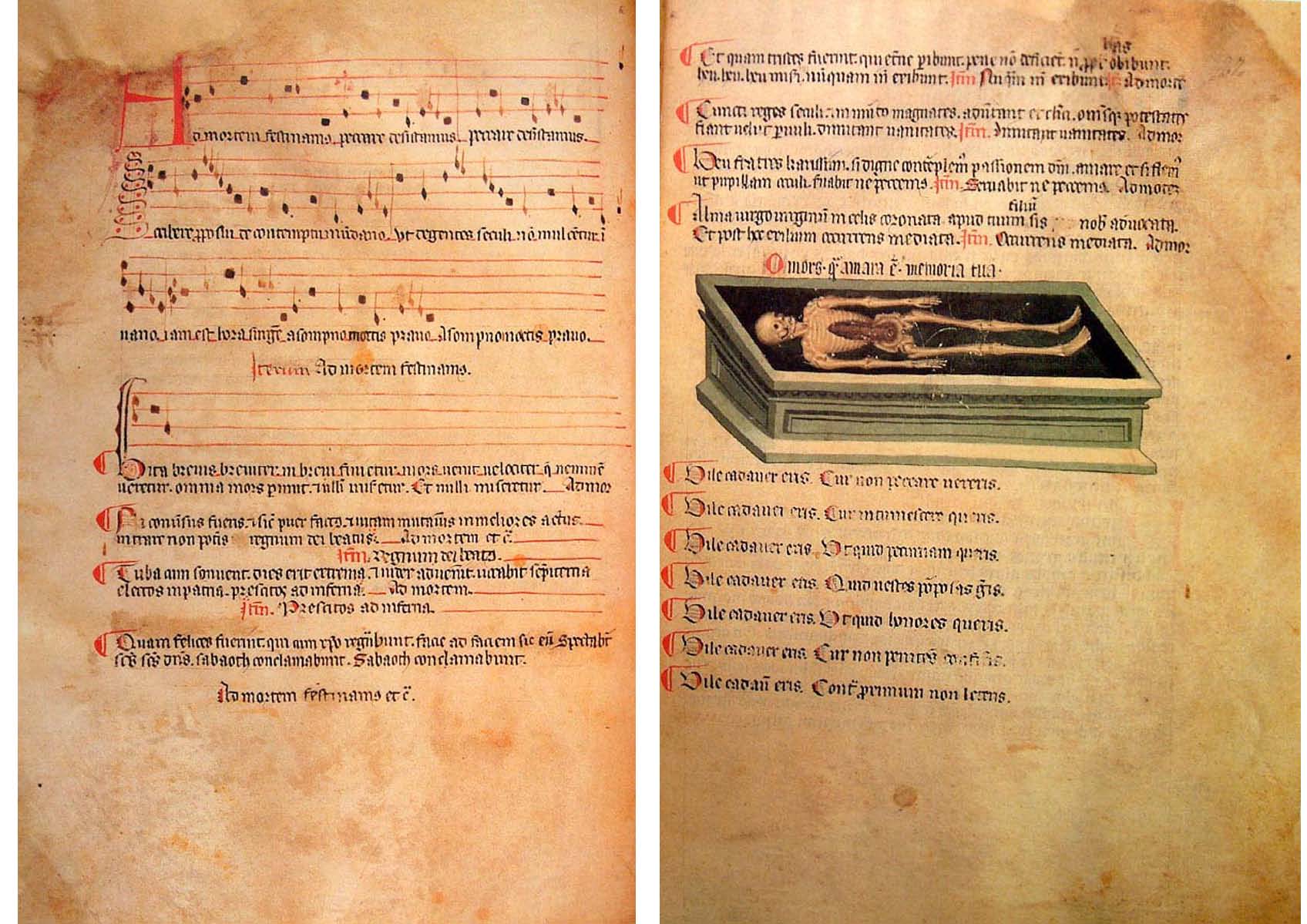
[9. Ad mortem festinamus]
R. Ad mortem festinamus peccare desistamus.
We hurry towards death, let us desist from sin.
| Latin | Translation |
|---|---|
| Scribere proposui de contemptu mundano, ut degentes seculi non mulcentur in vano. Iam est hora surgere a sompno mortis pravo. |
I have resolved to write about the contempt of the world, that the now living may not delight themselves in vanity. Now is the hour to rise from the evil sleep of death. |
| Vita brevis breviter, in brevi finietur, mors venit velociter quae neminem veretur. Omnia mors perimit et nulli miseretur. |
Life is short, and shortly it will end; death arrives swiftly, respecting no one. Death annihilates all and pities none. |
| Ni conversus fueris et sicut puer factus, et vitam mutaveris in meliores actus, intrare non poteris regnum Dei beatus. |
If you don’t convert and become pure as a child, And change your life by doing better deeds, you can not as a blessed one enter the kingdom of God. |
| Tuba cum sonuerit dies erit extrema et judex advenerit, vocabit sempiterna electos in patria praescitos* ad inferna. |
When the horn sounds the last day will be there, And the Judge will appear, and he will forever call the chosen home, and the reprobate* to hell. |
| Quam felices fuerint qui cum Christo regnabunt, facie ad faciem sic eum adspectabunt, Sanctus, Sanctus Dominus Sabaoth conclamabunt. |
How happy will those be, who will reign with Christ, they will see him face to face and Holy, holy is the Lord Zebaoth, they will shout. |
| Et quam tristes fuerint qui aeterne peribunt, pene non deficient nec propter has obibunt: Heu, heu miseri numquam inde exibunt. |
And how miserable will the eternally damned be; no escape from retribution, they will perish. Woe, the wretched will never get out from there. |
| Cuncti reges seculi et in mundo magnates advertant et clarici omnesque potestates fiant velut parvuli dimitant vanitates. |
All earthly kings, all mighty men of this world must
change, And the clerics and all powerful officials have to become like children, renouncing vainglory. |
| Heu, fratres karissimi, si digne contemplemus passionem Domini, amare et si flemus, ut pupillam oculi servabit ne peccemus. |
Alas, dearest brothers, let us so worthily contemplate the Lord’s passion, and also bitterly weep and ask, that he will guard the apple of his eye, that we sin no more. |
| Alma Virgo virginum, in caelis coronata, apud tuum filium sis nobis advocata, et post hoc exilium occurrens mediata. |
Nourishing virgin among virgins, crowned in heaven, be our advocate with your son, and after this exile meet us as mediator. [clearly a paraphrase of the "Salve Regina"] |
* Electos
(the chosen) vs. Praescitos
(the foreknown): In medieval theology (e.g., Augustine, Peter
Lombard), a strict distinction was maintained to avoid making God the
author of evil: God actively elects
and predestines the blessed to glory (electi
in patria), whereas the lost are not actively predestined to
sin, but eternally foreknown
to merit damnation (praesciti
ad inferna).
[The next part is sometimes sung as well, although the text is separated from the song by the image of a cadaver, headed by the words:]
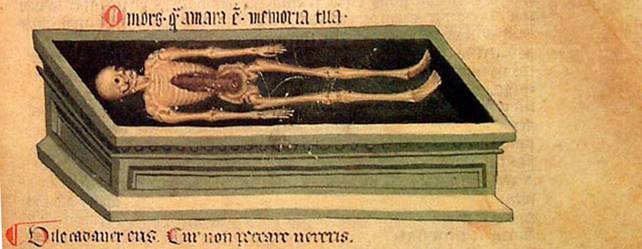
O death, how bitter is your memory
| Latin | Translation |
|---|---|
| Vile cadaver eris, cur non peccare vereris. Vile cadaver eris, cur intumescere quaeris** Vile cadaver eris, ut quid peccuniam quaeris. Vile cadaver eris, quid vestes pomposas geris. Vile cadaver eris, ut quid honores quaeris. Vile cadaver eris, cur non paenitens confiteris. Vile cadaver eris, contra proximum non laeteris. *** |
You will be a vile corpse: Why not avoid sinning? ... Why seek to puff yourself up with pride ... Why want money? ... Why wear splendid clothes? ... Why look for signs of glory? ... Why not confess, doing penance? ... Do not rejoice at your neighbour's expense. |
** Intumescere literally means "to swell up".
In medieval moral treatises it exclusively denotes swelling with pride
/ conceit / arrogance (tumor cordis). Notice how this text
systematically targets worldly vanities and capital vices: Superbia
(swelling with pride), Avaritia (money), Luxuria
(pompous dress), Ambitio (honors), and Invidia
(malice toward others). Amidst these indictments, line 6 (cur
non paenitens confiteris) highlights the pastoral turning
point: the memento mori is not mere fatalism, but
an urgent call to the sacrament of penance and confession.
*** Line 7 breaks the interrogative pattern (cur / ut quid...)
with a direct moral prohibition: contra proximum non laeteris ("do
not gloat / rejoice against your
neighbour"). Overcoming the
sin of Invidia
(envy manifesting as laetitia
de adversis proximi / Schadenfreude) serves as the ultimate ethical litmus test of genuine
conversion.
- Dick Wursten, 28 september 2010 / 2019 (minor corrections in Latin transcription, and some new translations) / 2026 improved the Latin translation, and added some notes, new layout.
- For more ars nova texts and translations (iso-rythmic motets), click here
- * The Llibre Vermell is a collection of manuscripts bound together. 137 folios of the original 172 are preserved. The book has been dated (in the past) to the year 1327; but the terminus post quem has to be advanced at least to 1397 as a consequence of the miracles mentioned in the text that bear this date. The present opinion considers the oldest part of the codex having been copied in the year 1399 because of the indication on folio 56, where, in speaking of the sixth age of the world inaugurated by the incarnation of Jesus Christ, it is said that it has already lasted 1,399 years. The fact that the texts mention very close dates, such as the years 1382 and 1397 - three times - makes this assumption quite convincing. Moreover, it was probably finished in the year 1400, the year in which the new privilege of Pope Boniface IX allowed the possibility of acquiring the indulgence of the Portiuncula during the whole octave of the patron saint's feast of Montserrat on the 8th of September, privilege granted on 3rd of August of the eleventh year of his pontificate - that is to say, in 1400. This corresponds to the privilege (mutilated) on f. 41, referring to the previous concession of the Portiuncula to Montserrat. It is preceded by the heading Privilegium pro indulgentiis impetrandis.