Ars Novatexts and translations (and some background) of [ook in het Nederlands]
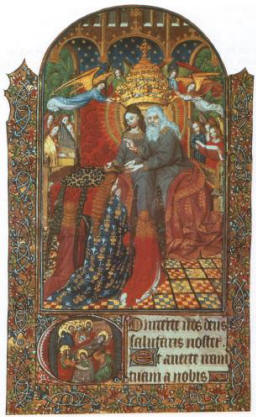
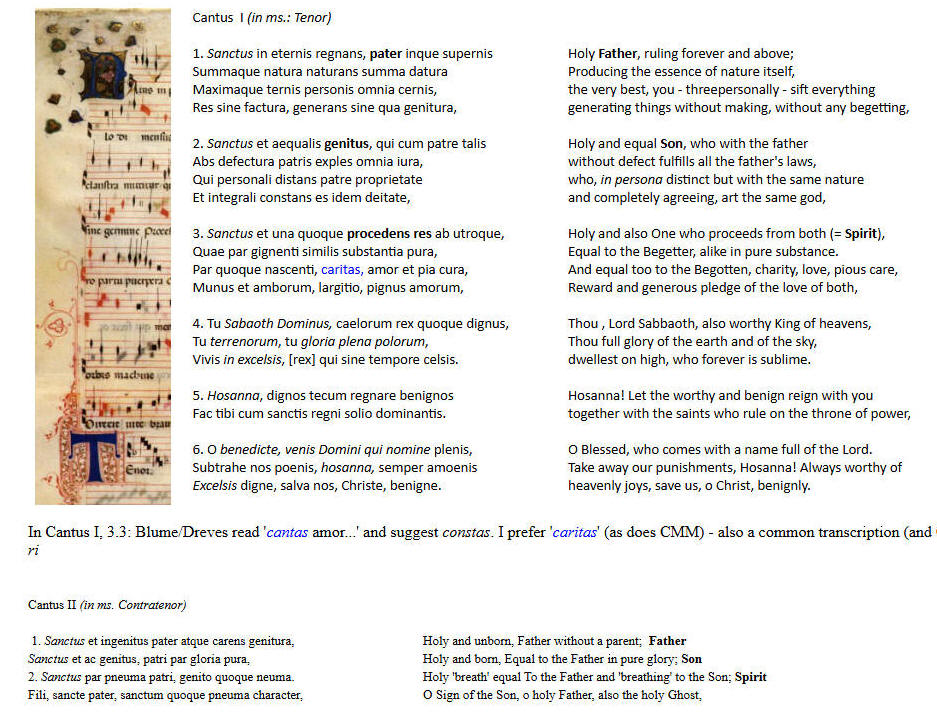
Anon. (Nicosia/Cyprus): Sanctus in eternis / Sanctus et ingenitusSOURCE Text and music are only found in one source, a famous codex with repertory linked to the Court of Cyprus, probably compiled between 1413 and 1436. It belonged to the library of the Duke of Savoy and is now preserved in Turin. Cyprus (i.e. Nicosia) was then one of Europe's Cultural Capitals. It's king, Janus (Jean de Lusignan), was married to Charlotte de Bourbon. The codex survived the terrible fire of 1904 (not without damage and shrunk a little bit). It is shelf-marked "ms. J.II.9" (Codex Taurensis) and consists of 159 folios containing over two hundred polyphonic compositions both sacred and secular, all unique, all anonymous, and many polyphonic masterpieces. This isorhytmic motet is n° 35, fol(s) 075v-076. The general theory about the provenance of this manuscript is that Janus's daughter Anne took the codex with her when she married Louis, Duke of Savoy (see image >). This explains (but beware: the explanation is invented to explain, so it is speculation) why the codex is part of the Duke's Library (The Duke of Savoy later transferred his seat from Chambéry to Turin). However, even in this scenario she is not the only candidate. Her uncle, Hugh de Lusignan, also resided in the Duchy of Savoy (he was Bishop of Geneva). Based on iconographical and paleographic evidence, it seems more plausible to suggest that the manuscript was commissioned in Italy with a link to (or for) the court of Cyprus. Connections between Northern Italy and Cyprus abound (1). The presence of the coat of arms of the Avogrado family in the manuscript provides a strong link to this wealthy family from Brescia. Perhaps they commissioned it. The manufacturing of the manuscript and the compositions in it are now often linked to 'Jean Hanelle' who arrived as a petit vicaire in Cyprus in the retinue of Charlotte de Bourbon in 1411 (King Janus' second wife). Hanelle originated from Cambrai (hometown of Dufay). He was chapel Master of the King of Cyprus in 1434-1436 and in Savoy during the festivities of Anne's wedding (1434). At that time the Grant chapelle of Savoy was placed under the direction of a certain Guillaume Dufay... Producing beautifully ornamented Music manuscripts to show off was quite common in those days. TEXT
Both texts are 'tropes'
(extending official texts by interpolation) on the liturgical chant of
the "Sanctus" . (1) Source Karl Kügle, 'Glorious Sounds for a Holy Warrior: New Light on Codex Turin J.II.9', Journal of the American Musicological Society, Vol. 65, No. 3 (Fall 2012), pp. 637-690.
The translation is mine, substantially differing from but still based on David Seward's (booklet Music from the Court of King Janus of Nicosia. Huelgas Ensemble) (click on the images below to access the texts )
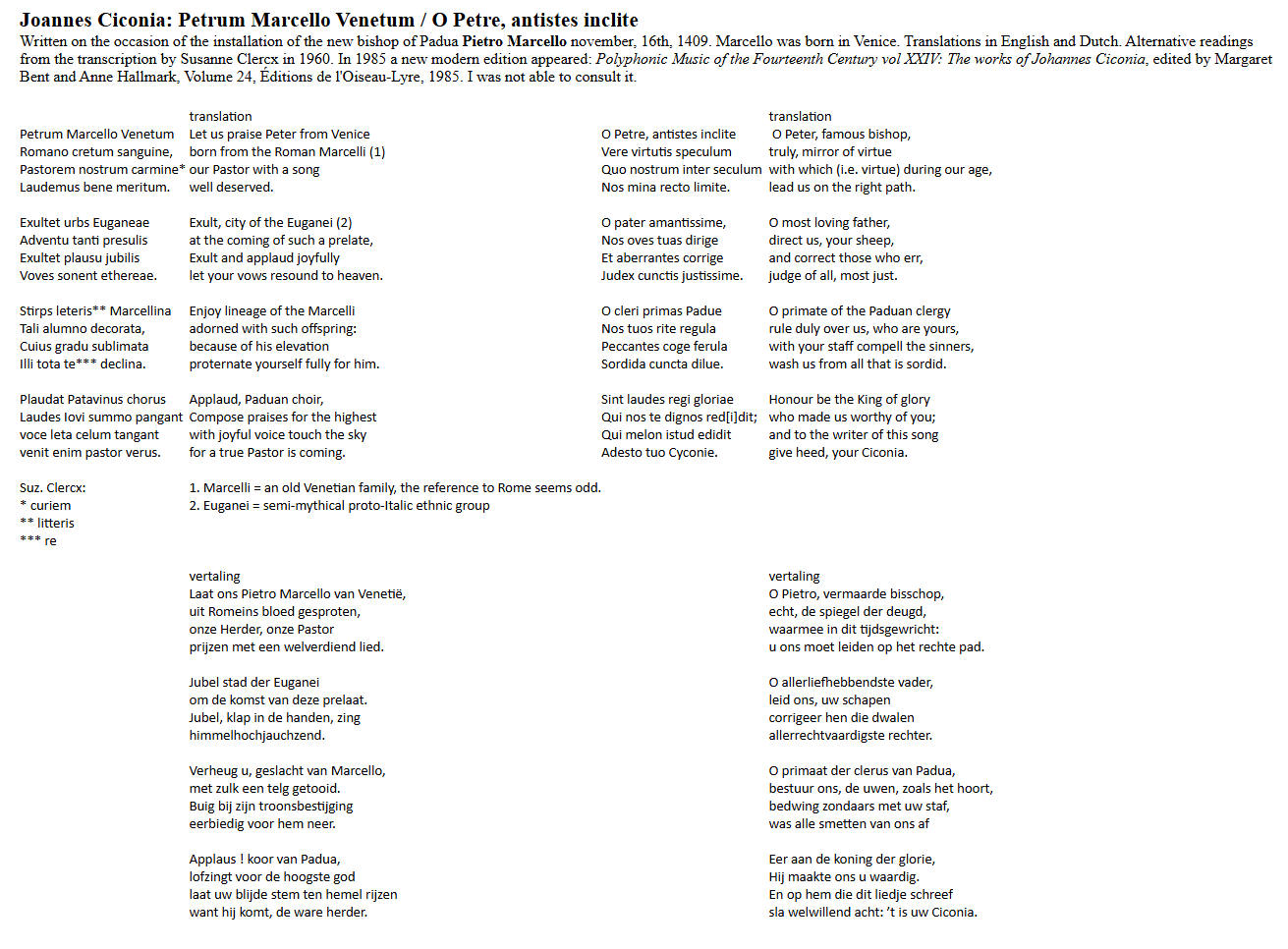
Joannes Ciconia: Petrum Marcello Venetum / O Petre, antistes incliteWritten on the occasion of the installation of the new bishop of Padua Pietro Marcello november, 16th, 1409. Marcello was born in Venice. Translations in English and Dutch. Alternative readings from the transcription by Susanne Clercx in 1960. In 1985 a new modern edition appeared: Polyphonic Music of the Fourteenth Century vol XXIV: The works of Johannes Ciconia, edited by Margaret Bent and Anne Hallmark, Volume 24, Éditions de l'Oiseau-Lyre, 1985. I was not able to consult it.
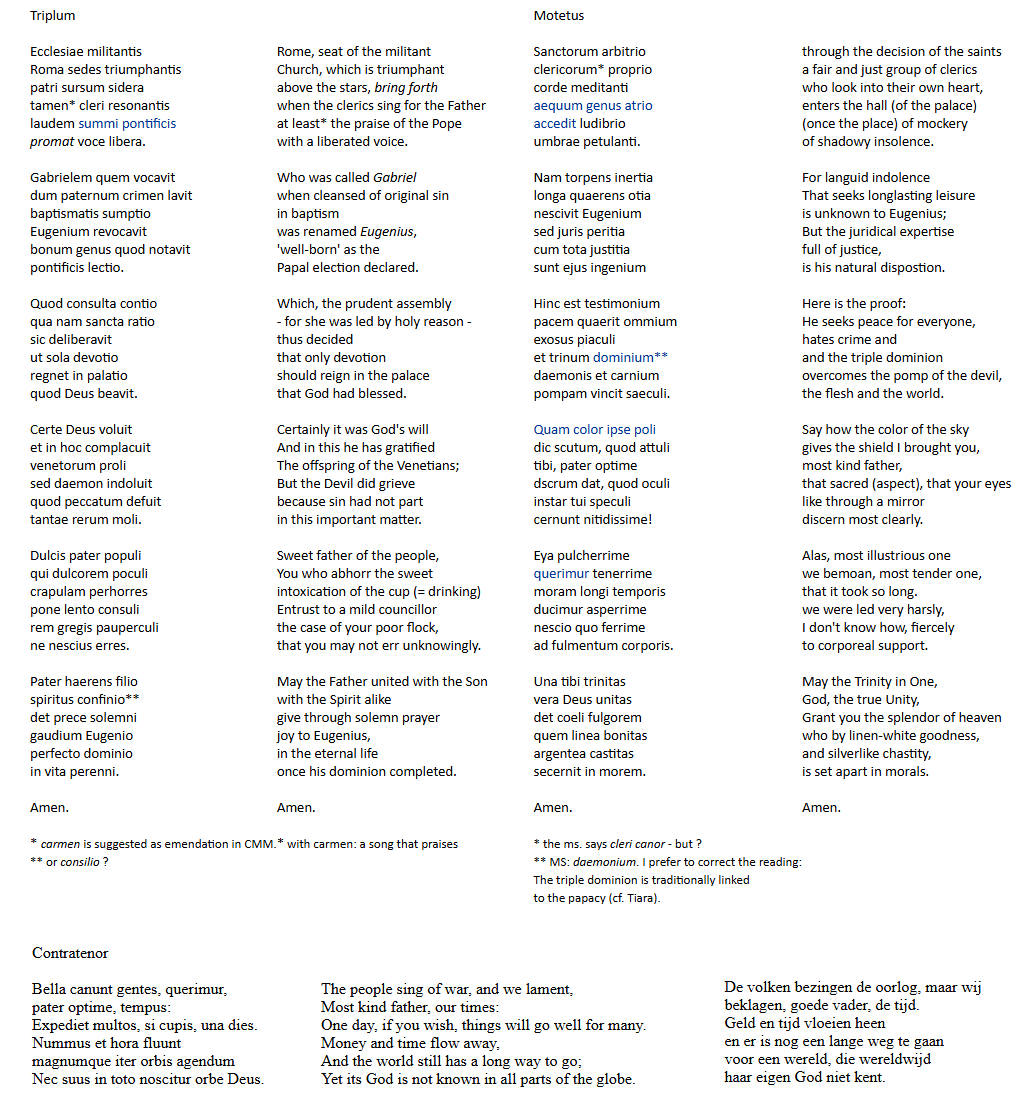
Guillaume Dufay: Ecclesiae militantis (1431, or perhaps 1434)
Written on the occasion of
the coronation of Gabrieli Condulmieri (from Venice) as pope Eugenius
IV, 1431, 11 March. At least that is the 'received opinion'. The text tradition used by musicians is quite confused. On the internet a version dominates which is quite faulty. The one presented below seems more in order. I compared it - with my humble paleographic skills - to the manuscript version, consultable here (Codici Trentini 87-93, folios 85v-86r + 95v-96r) and the official edition of Dufay's Opera Omnia in the CMM. I transcribed the medieval Latin to make it more familiar (the "ae" written as "e" in medieval Latin is a constant source of confusion (so, in Motetus 1,4 there is no horse 'equum', but simply the adjective 'aequum'). Most pertinent differences I printed in blue. I don't claim perfection in translation. Some parts I translated but I don't grasp the meaning. I tried not to interfere too much, even when I didn't get it. Often one has to rephrase the sentence completely in order to get something which sounds like English. In Latin the placement of the words in a sentence is almost entirely free. It is the gender, conjugation, declination etc. which links words.
|