Le cheval
Mes durs rêves formels sauront te chevaucher,
Mon destin au char d’or sera ton beau cocher
Qui pour rênes tiendra tendus à frénésie,
Mes vers, les parangons de toute poésie.
|
Het paard
Mijn harde vormelijke dromen zullen je weten te berijden,
Mijn lot is de de gouden karos, en als knappe koetsier
houd hij als teugels razend strak gespannen,
mijn verzen, toonbeelden van poëzie.
vrij, associatief:
Met vormvereisten zal ik je temmen
je voor mijn gulden karretje spannen
En in een uitzinnige galop
gaan wij dichtend naar de wereldtop.
|
 |
Horse
My hard, formal dreams will know just how to ride you,
My destiny in a chariot of gold, will be your handsome
driver,
Who will take for reins, drawn in tight frenzy,
My verses, paragons of all poetry.
tr. Lauren Shakely
This sounds like a statement on the art and craft of poetry
... See below Apollinaire's his own explicatory note, which
however obscures as much as it clarifies.
Some tensions : The 'gold chariot' refers to Apollo, leader
of the Muses and bringer of light (Phoebus Apollo,
identified with Helios, the Sun). It is also an image of a
triumphal procession. Apollo's chariot, however, is drawn by
four horses, not by Pegasus.
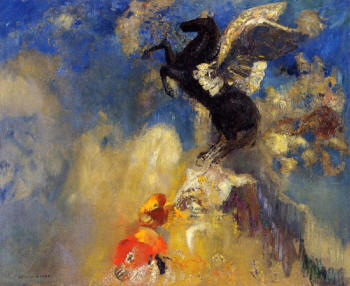
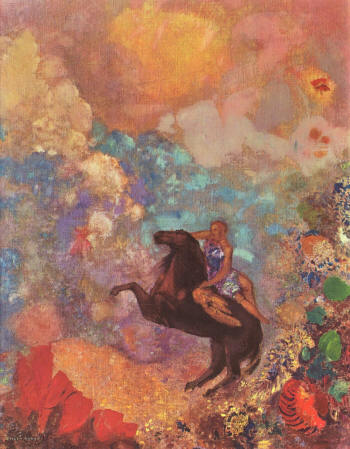
Pegasus is the Poet's Horse: His
hooves touched Mount Helicon (or Parnassus) where Muses
dwell, and Hippocrene (litt: Horse's Fountain)
sprung. The water from that well is the source of poetic
inspiration. The young hero Bellerophon got the
idea/hint to use a gold bridle to bridle the
untamable Pegasus, while sleeping in the temple of Athena.
In short: both Pegasus and Apollo are closely connected to
Art and Poetry (the Muses). Their myths were still quite
common pictorial themes in Apollinaire's days, e.g. the
symbolist etcher/painter Odilon Redon (link
to two pictures of Pegasus below).
|