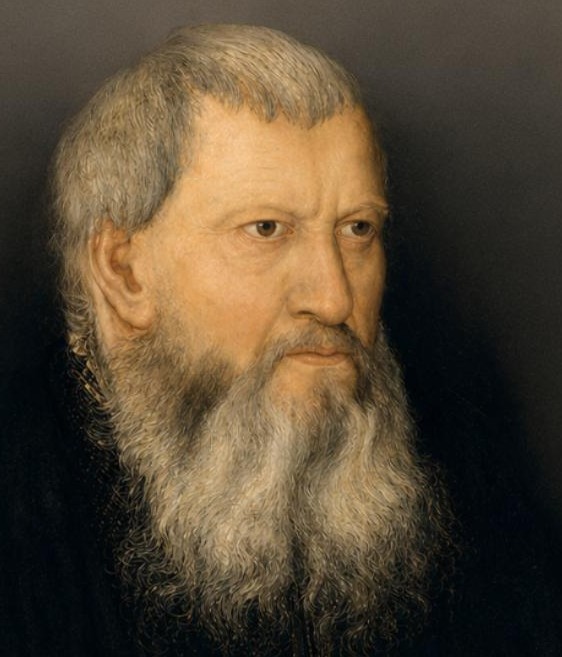
Niclas Herman (1500-1561)
« After Luther, Nikolaus Herman was by far the most widely sung poet of spiritual songs in the sixteenth century. The lucid simplicity of his texts, their childlike yet nowhere childish tone, their human warmth—all this gave them a far more universal significance than Nikolaus Herman himself could ever have expected. In other words, he was a much better poet and composer than he himself ever realized »*
His best known songs on a separate page (only German texts and some translations).
I have transcribed and (partly) translated (into Dutch) the highly revealing prefaces from his two principal works together containing 178 songs.
-
Die Sontags-Evangelia (vnd von den fürnemsten Festen) über das gantze Jar, in Gesenge gefasset ... 1560
Wittenberg, (G. Rhau Erben)
The Sunday Gospels and the main Feasts, rendered into Christian Songs. .. (1560) -
Die Historien von der Sindfluth, Joseph, Mose, Helia, Elisa ud der Susanna sampt etlichen Historien aus den
Euangelisten, Auch etliche Psalmen und geistliche Lieder, in Reyme gefasset...
1562 Wittenberg (G. Rhau Erben)
Biblical Histories ... some Psalms and spiritual songs ... in rhyme (1562)- Preface by Nic. Herman
- Preface by Johann Mathesius
- Nic. Herman: Poem of thanksgiving (addressed to Florian von Griespeck, his patron and imperial councillor)
By reading these texts, one gains a picture of sixteenth-century pedagogy and didactics, especially of how the humanist-biblical reform of schooling was carried out. Luther formulated the principle (everyone should learn to read, count, and sing). Melanchthon conceived the curriculum (together with several other humanist scholars). Herman composed the accompanying handbooks: songs through which the liturgy could be understood and biblical stories learned, so as to come to know God through his Word and to give direction to one’s life—while at the same time learning to read, write (above all in Latin), and to practice music and mathematics, both related to the fundamental structure of being.
* Ad den Besten, Een compendium van achtergrondinformatie bij de de 491 gezangen uit het Liedboek voor de Kerken, (Van der Leeuwstichting, 1977), col. 1183 (English translation: Dick Wursten)