Click a plate for the larger image. The images
are — as far as I know — in the public domain, mostly found in the Web Gallery of Art. Where a plate
carries a background link, it leads to the corresponding
passage in the essay The
popularity of a fallen woman.
The biblical figures (The Magdalene)
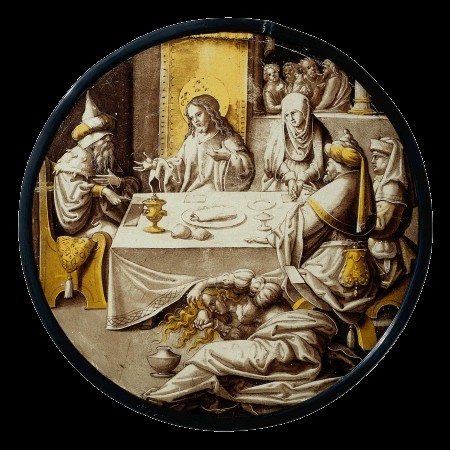
N.N.The
sinner at the banquet at Simon's, who anoints Jesus' feetStained glass window, ø 25 cm · ca. 1520 ·
Rijksmuseum, Amsterdambackground
→Rogier van der WeydenMary with her precious spikenard ointmentOil on panel, ca. 1450 · Musée du Louvre, ParisMaster of the Life of the
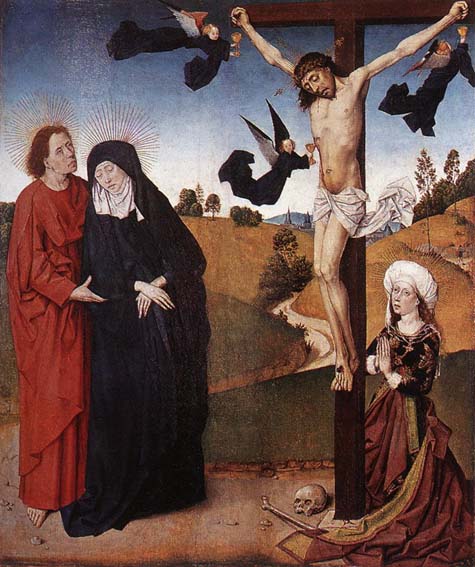
VirginCrucifixion with Mary, John
and Mary MagdaleneOak, 1465–70 ·
Wallraf-Richartz-Museum, CologneMary,
as a wealthy disciple of Jesus, is the only one richly dressed.
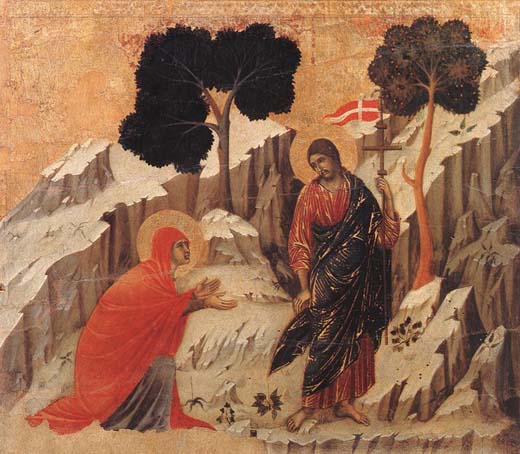
Vanitas symbolism is already present at the foot of the cross.Duccio di BuoninsegnaJesus appears to Mary Magdalene (Noli me
tangere — do not touch, or hold, me)Tempera
on wood, 1308–11 · Museo dell'Opera del Duomo, SienaThe classic Noli me tangere scene: Mary
wants to hold Jesus and is rebuked. Jesus appears as the risen
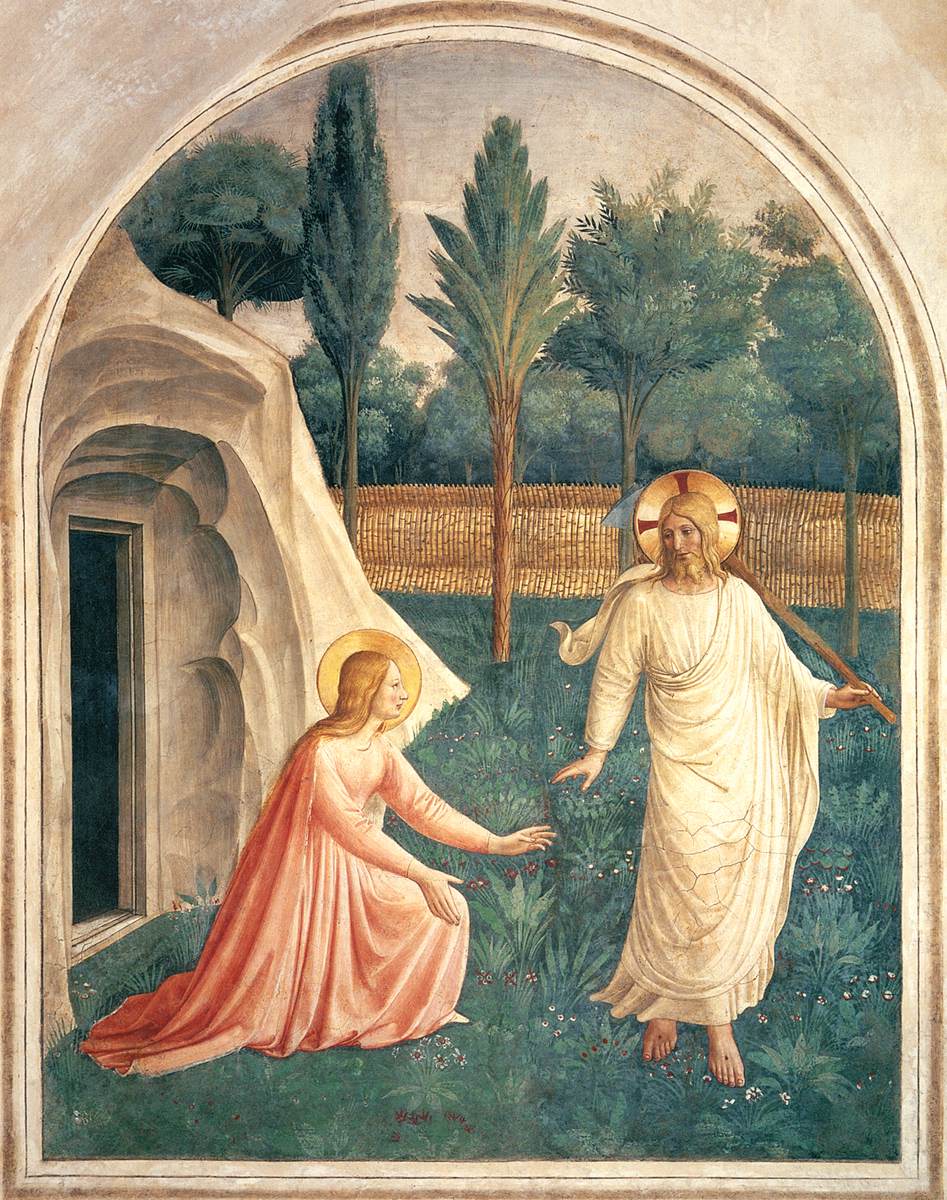
Lord, with the victory banner on his cross-staff.background →Fra AngelicoNoli
me tangereFresco (former convent of
San Marco, first floor, cell 1), 166 × 125 cm, ca. 1450 ·
FlorenceFra Angelico (= the angelic
franciscan frater), who ornated the cells of his convent with
wonderfull frescos, serene and expressive, ant theologically
richt —as only he can. NB note the spade Jesus hides behind his
halo: hortulanus est.background →CaravaggioMartha
scolds her sister Mary (of Bethany).This Mary of Bethany is already merged with the
penitent Magdalene, because Martha does not scold her for not
assisting her in serving Jesus (as the story in the Bible says),
but for her vanity (notice the mirror).background →
Mary the
Penitent
Titian (Tiziano Vecellio)The
Penitent Mary Magdalene (the artist's own copy of a lost
original)Oil on canvas, ca. 1560 ·
Hermitage, St PetersburgA
trend-setting painting for the genre of the penitent Magdalene.
The skull, as a vanitas symbol, rests on her knees. See the next
image for a domestic variant.background
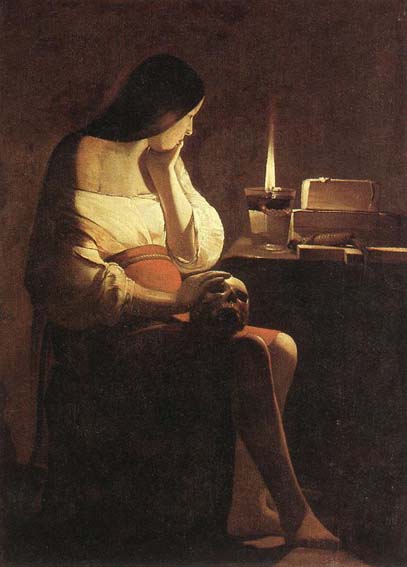
→Georges de La TourThe Magdalene with the LampOil
on canvas, 1630–35 · Musée du Louvre, ParisThe
"penitent Magdalene" genre piece, hugely popular in
seventeenth-century France.Gregor ErhartSaint Mary MagdalenePolychrome
wood, ca. 1500 · AugsburgAlso known
as La belle Allemande, the "German beauty". Her nudity
and her long hair betray the influence of Mary of Egypt.background
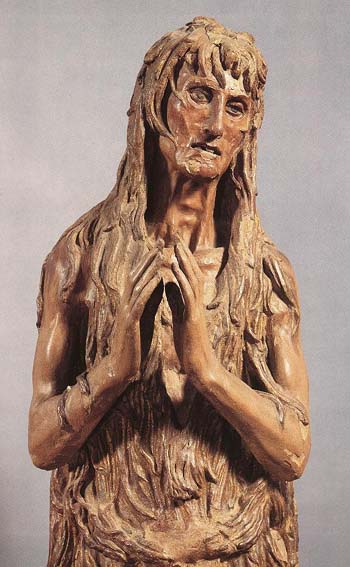
→DonatelloMary
Magdalene (detail)Wood, 188 cm, ca.
1457 · Museo dell'Opera del Duomo, FlorenceThe
old Magdalene, careworn, still clad only in her hair. During
restoration it was discovered that the statue was originally
polychrome.
Mary of Egypt
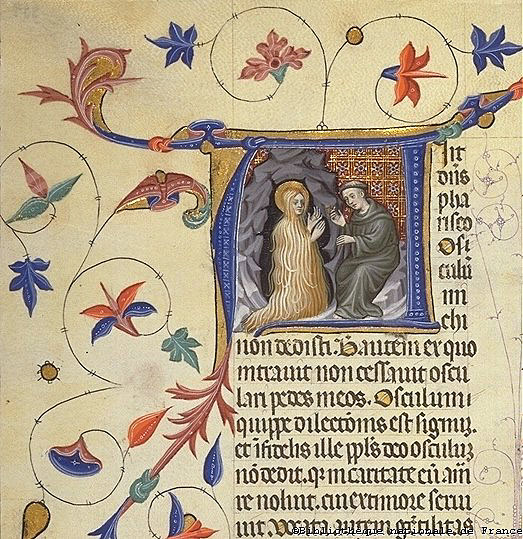
N.N.The
"Egyptian" and abbot ZosimusInitial
(60 × 60 mm), Catalonia, 15th century · Breviary of Martin of
Aragon, Bibliothèque nationale de France, Paris (ms. Rothschild
2529, fol. 354v)background
→GiottoAbbot
Zosimus gives his cloak to MaryFresco,
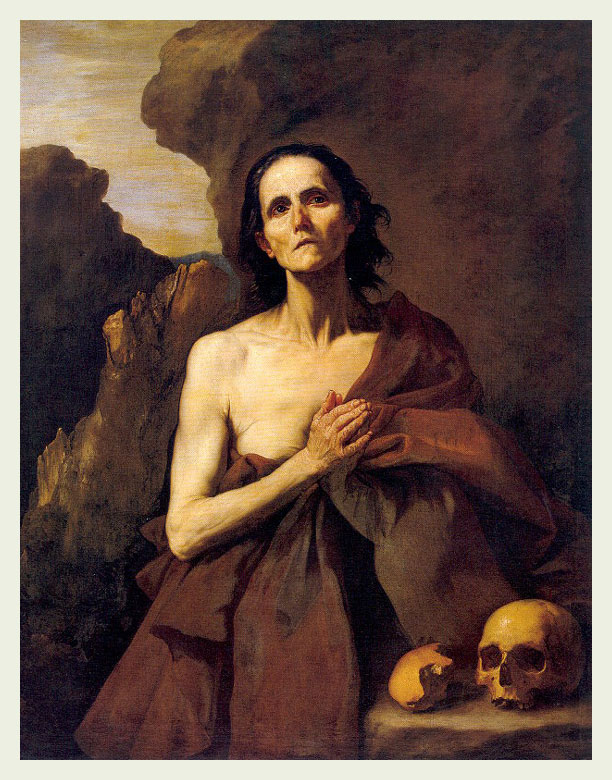
1320 · Magdalene Chapel, Lower Church of San Francesco, AssisiJusepe (Giuseppe) de RiberaMaria Aegyptiaca1641
· Musée Fabre, MontpellierThe old
hermit, dressed in the cloak of Zosimus.
The voyage to Marseille
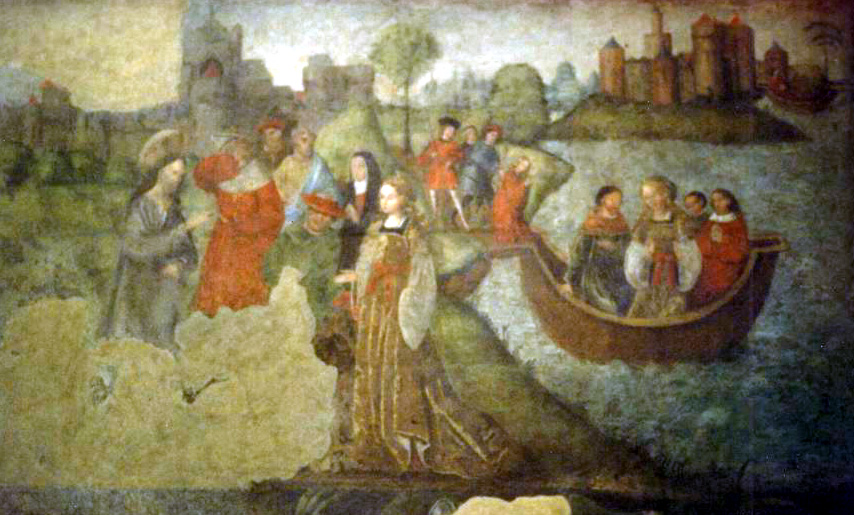
AnonymousMary,
with Martha and Lazarus, lands at Marseille and converts the
local populationMural, 16th century
· basilica of Saint-Quentin, France (own photograph)Note: as in a graphic novel, there is more than one
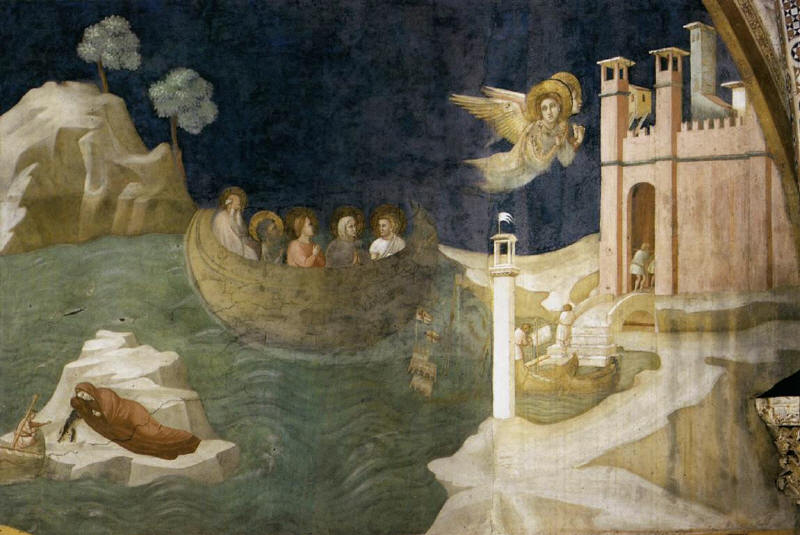
scene to see.background
→GiottoMary
Magdalene's journey to MarseilleFresco,
1320 · Magdalene Chapel, Lower Church of San Francesco, Assisi
The Holy Cave at Sainte-Baume
GiottoMary
Magdalene in "levitation"Fresco,
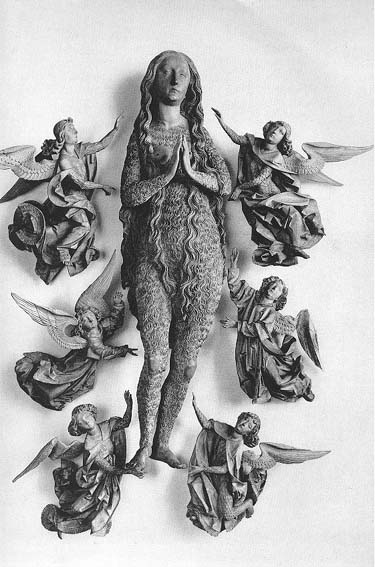
1320 · Magdalene Chapel, Lower Church of San Francesco, AssisiTilman RiemenschneiderMary Magdalene surrounded by angelsWood, 187 cm, 1490–92 · Bayerisches Nationalmuseum,
MunichNote how Mary, like the
Egyptian, is completely covered with hair. The next image
depicts the same scene from the legend.background →Lorenzo di CrediThe angels bring Holy Communion to Mary MagdaleneTempera on wood, 51 × 38 cm, ca. 1510 ·
Christian Museum, Esztergom, HungaryNote
how Mary is fed from heaven, and how her attribute — the bottle
of oil — remains on earth.
The whole legend on one altarpiece
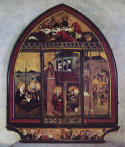
Lucas Moser (?)Altarpiece in the church of Mary Magdalene,
Tiefenbronn15th century ·
TiefenbronnAll the relevant stories
of the composite Mary are gathered here, except the Noli me
tangere. Top: Bethany — Mary washes Jesus' feet while
Martha works. Left: the arrival at Marseille. Centre, below: the
saints asleep; above, Mary appears in a dream to the princess,
promising her a child. Right: the last communion of Mary at St
Maximin, dressed only in her hair — the Penitent and the
Egyptian at once. Click through for the details.