The composite Magdalene
The popularity of a fallen woman
Mary of Magdala in the imagination of the church: the merger of three (or even four) women
The images belonging to these women are on a separate page. As the essay proceeds, small plates in the margin point to the relevant image there.
Contents
- Biblical data
- The Magdalene — archetype of sin, guilt and penance
- L'Égyptienne, a mysterious recluse
- La Madeleine de Marseille
- Mary Magdalene in Burgundy
- Mary Magdalene today
- Encore: and what about the Da Vinci Code?
- Sources and links
Biblical data
 image
image
About the true or real Mary Magdalene we know nothing, except what the Gospels tell us: that she (1) followed Jesus from Galilee to Jerusalem, after her 'liberation experience' (Luke 8:2); (2) that she remained with him to the very last and was thus present at the Crucifixion, the Deposition from the Cross and the Entombment; (3) that her name comes first in all the Gospels when it comes to witnesses of the Resurrection. She is the apostle of the apostles.
A supposed past as a prostitute is not mentioned, neither is the anointing with oil connected with her name. Her origin and later life remain in limbo. Very old traditions point to Ephesus for her grave. Why then did 'La Madeleine' become the prototype of the penitent sinner? Why is she so often depicted in a cave, naked, and with extremely long hair? What about that omnipresent bottle of anointing oil — or perfume? The answer is simple: the image of Mary Magdalene in the church's tradition is a complex idea, literally a composite portrait. She is the merger of three biblical women, afterwards supplemented with an extra-biblical hermit: the Egyptian.
The three biblical women are:
1. Mary Magdalene
That is, of Magdala, El Mejdel, a prosperous town on the Sea of Galilee, legendary — the question being: before or after the legend started to spread? — because of the loose manners supposed to have been common there. Magdala was destroyed by the Romans in 75 CE. Mary Magdalene is mentioned as one of the women who followed Jesus and stuck to him, after he had liberated her from 'seven devils' (Luke 8:2). She is put down extremely lifelike by John, who depicts her roaming in the graveyard on Easter morning before dawn, passionately seeking 'her lord', weeping. When she finds him she mistakes him for the gardener (what a wonderful error) but — after Jesus calls her by her name — she throws her arms around his neck, or falls at his feet, just as you like, whereupon Jesus utters the famous words Noli me tangere — in Aramaic of course, or Greek, meaning either do not hold me or do not touch me; which translation is to be preferred is still discussed by scholars. It became a stock image at Easter.
Also important: Jesus commands Mary to go to the apostles and tell them the Gospel. She is the first and the only 'preacher' ordained by Christ himself: apostola apostolorum. This story always plays a legitimising role when women, too, try to say something in the male conversation that church history is.
2. An anonymous 'sinner'
 image
image
Barging in at a posh dinner at Simon-the-Pharisee's place, she kissed Jesus' feet, then dried them with her hair, and anointed them. Luke tells the story in chapter 7, and uses the term 'sinner'. In the discussion she evokes — in that venerable company of men — Jesus defends her against the criticism of the host. That she was a prostitute is not said in so many words, but the term 'sinner' and her loose hair are suggestive. After a parable about the forgiveness of sins, Jesus speaks the famous words: "Her sins, which are many, are forgiven; for she loved much: but to whom little is forgiven, the same loveth little" (v. 47). Ominous words, because so often misinterpreted: of course Jesus does not refer to her practice as a prostitute, because prostitution has nothing to do with love. A few verses later the name of Mary Magdalene is mentioned (Luke 8:2) as one of the women who followed Jesus after he had liberated her from 'seven devils'.
The identification of the first two women is at hand. Both the Eastern and the Western Church have accomplished it.
3. Mary of Bethany
She "sat at the feet of Rabbi Jesus" to learn — the sister of Lazarus and Martha. She anoints his feet in the Gospel of John (chapter 12), very similar to the sinner in Luke 7, also wiping his feet with her hair. An identification of woman 2 with woman 3, and through woman 2 also with woman 1, is impossible if we take seriously the varying chronology and geography of the Gospels — but literarily it is of course very enticing. The Eastern Church has never done it: Mary of Bethany and Mary of Magdala are two different female saints. In the Western Church, by contrast, Gregory the Great accomplished this identification in a famous sermon on Mary Magdalene, turning it into a very powerful homiletical scheme (sermon XXXIII, late 6th century). Only in the 16th century (humanism and Reformation) were the different Marys — not without a great deal of fuss — disassembled again. The French theologian, philosopher and philologist Jacques Lefèvre d'Étaples wrote a highly controversial essay, De Maria Magdalena et triduo Christi disceptatio (1517). It remained the talk of the town well into 1519, but was finally condemned as heretical by the Paris theologians of the Sorbonne. It did not end the artistic and rhetorical representation of the composite Magdalene, the merger Mary. On the contrary: after the Council of Trent, moral preaching about sexuality began once more to exploit the possibilities of the Penitent Magdalene.
"With the perfume that once shamefully made her body smell so sweetly, she now anointed the feet of the Lord; her eyes, once coveting worldly affairs, were now filled with tears of penance; with the hair that previously served to enhance her attractiveness, she now dried her tears; her lips, previously pronouncing only proud words, now humbly kissed the feet of the Lord."
Gregory the Great on Mary Magdalene, sermon XXXIII — own paraphrase/translation. This is the section in which he links the seven devils to the seven mortal sins, her conversion (through love for and of Jesus) making her an example of how the seven gifts of the Holy Spirit can cleanse anyone.

The result was that the pious Mary — who had chosen the 'better part', sitting at Jesus' feet — now has a "past", and not a positive one. The seven evil spirits were equated with the seven deadly sins. The "old" Mary was a rich, desirable, lustful, proud and haughty woman. Some paintings, like this one by Caravaggio, depict scenes from that period, in which her sister Martha admonishes her for looking into the mirror too often.
The famous French historian Georges Duby does not hesitate to call the merging of these three female figures "a stroke of genius of the Latin Fathers". The portrait of the (imaginary) woman which emerges is so incredibly rich that she has become one of the most influential female individuals of European history. A "complement" to the always chaste virgin-mother Mary, this complex person expresses and visualises a large part of the church's view on women and the female.
Georges Duby, Women of the 12th Century, vol. 1. Mary Magdalene is in it, and rightly so: she is no. 2, between Eleanor and Heloise.
Penitent sinner
 image
image
Mary Magdalene, as such a 'composite woman', is perfectly fit as an object lesson on sexuality and sin. She evokes the "forbidden" and averts it at the same time. There are tears, there is her hair, there is the smell of the precious spikenard. She is completely physical, she is 100% woman. Her "past" as a prostitute — officially to be condemned — combined with her great love for Jesus made her very exciting. She became a genre piece entitled the penitent Magdalene. From Titian onwards she is depicted with a languishing, penitent upward gaze and an almost (or completely) bare breast. She often sits in a cave, usually with a vanitas symbol: at the least a skull.
Add to this the praise and protective words of Jesus towards the anonymous sinner, that "she loved so much", and to Mary of Bethany, that her anointing act would be mentioned wherever the gospel of Christ would be proclaimed, because she alone understood the goal of his mission; and that she never abandoned or betrayed Jesus at his Passion, and was the first to recognise him at Easter, becoming the apostolorum apostola — and you understand why Georges Duby called this merging a stroke of genius.
This duality makes Mary a remarkable woman, and also opens the gates for much ambiguity. With her the "male church" tried to classify the seductive woman and the sexual impulse, at the same time channelling "sensuality": it was a hindrance, but one to be overcome if repented. Of course visual artists enjoyed painting and sculpting Mary Magdalene. Of course they paint her as an example of a fallen woman — but, as with so many paintings of evil, the effects are often counterproductive. Many penitent Magdalenes are painted or sculpted so temptingly that looking at them arouses the spectators rather than admonishing them to repent. Even the worship of the ever chaste virgin Mary could not escape this ambiguity; but this aside.
Mary of Egypt
 image
image
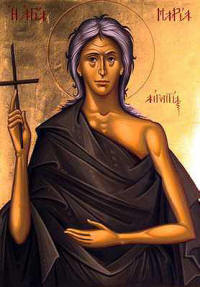
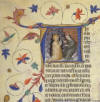
At this point a fourth woman enters the scene and completes the imagery of Mary Magdalene: the ascetic Mary of Egypt, a legend known since the 7th century. This lady, a hermit, a recluse, spent 30 years in the desert in a cave. She had been a prostitute — ah, there she is! — and once decided to go to Jerusalem by boat, paying the fare with her body. She wanted to take part in the celebrations of Holy Week; but when she wanted to enter the Church of the Holy Sepulchre, with the Holy Cross, something stopped her, literally. Whatever she tried, she did not get inside. This is how she tells it herself in the Legenda Aurea:
"But when I trod on the doorstep which everyone passed, I was stopped by some force which prevented me from entering. Meanwhile I was brushed aside by the crowd and found myself standing alone in the porch. Thinking that this had happened because of my woman's weakness, I again began to work my way into the crowd, trying to elbow myself forward. But in vain I struggled. Again my feet trod on the doorstep over which others were entering the church without encountering any obstacle. I alone seemed to remain unaccepted by the church. It was as if there was a detachment of soldiers standing there to oppose my entrance. Once again I was excluded by the same mighty force, and again I stood in the porch. Having repeated my attempt three or four times, at last I felt exhausted and had no more strength to push and to be pushed, so I went aside and stood in a corner of the porch. And only then, with great difficulty, it began to dawn on me, and I began to understand the reason why I was prevented from being admitted to see the life-giving Cross. The word of salvation gently touched the eyes of my heart and revealed to me that it was my unclean life which barred the entrance to me. I began to weep and lament and beat my breast, and to sigh from the depths of my heart. And so I stood weeping when I saw above me the ikon of the most holy Mother of God..."
For the entire story, see the links below.
She understood that she had to repent and do penance, and thanks to the intercession of Mary the mother of God she finally entered the church. She was ordered to cross the river Jordan with three loaves, and spent the next 30 years of her life feeding on herbs. So she overcame the desires of her beautiful but sinful body, until there was no beauty left: she was blackened, exposed to the merciless desert sun. No one knew of her existence. When Father Zosimus was commissioned to cross the Jordan to found a monastery, he met her. To cover her nakedness he gave her his cloak. And when they had prayed, he looked on adoringly as she levitated. She asked for Holy Communion. On Maundy Thursday he returned and she "communicated". A year later he returned again, and found her deceased, but not decayed. He had to bury her, but had no shovel or spade with him. A lion appeared and dug her grave with his claws.
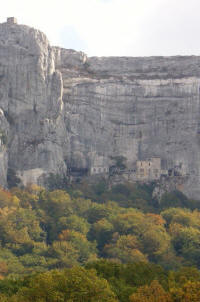
Mary Magdalene, the merger of four women, is now set to start her career. The one thing remaining odd is the starting point: not Palestine, not Ephesus, not the desert, but the south of France, in Provence, near Marseille. There one points to a cave in the mountainside where Mary is supposed to have spent the last part of her life, and where she died: the Massif de la Sainte-Baume ("baume" = provençal for "cave"!). How did she get there — according to previous legends she died near Ephesus and her remains were transferred to Constantinople? And what are some of her bones doing in Vézelay, in Burgundy?
Mary, the "Marseillaise"
 image
image
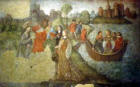
Boundless is the medieval legendary imagination. One day Mary — says the Legenda Aurea — together with her brother Lazarus and her sister Martha, and accompanied by a Roman youth Maximinus (in other versions Maximinus is one of the 72 disciples of Acts 1, and Sidonius, another of the 72, is present too), was put on a small boat which was set afloat at sea by some unbelievers, that is: to be drowned. This boat then miraculously — without sail and rudder! — floated the length of the Mediterranean and was finally stranded in southern France, near Marseille. At Les-Saintes-Maries-de-la-Mer, indeed the site of the religious festival of the Roma, the illustrious company set foot ashore. Mary evangelised the residents of the neighbouring city, Marseille. And after having overcome the opposition of the prince and princess of that town — among other things by killing a dragon and prophesying the birth of a child — Marseille converted, and chose Lazarus as its first bishop (St Lazare). Maximinus became bishop of Aix-en-Provence (St Maximin), and Martha converted Tarascon.
Remaining particularly committed to the release of prisoners — was she herself not freed from seven demons? — she withdrew voluntarily from public life and retired to a cave to pay further for her sins, renouncing the world and thus gaining heaven.
 image
image
This legend blends with the story of Mary of Egypt. Every day, according to the legend, angels came from heaven to feed her with heavenly food and drink. In many paintings we see Mary Magdalene dressed in her hair, sitting in a cave, a jar of oil beside her, often staring at a skull — the tested symbol of the transience of all earthly things ('vanitas'). Scattered jewellery and other attributes that make a woman feel beautiful underline the same motif. The anointing oil that the 'real' Mary used — wasn't it perfume, after all? Iconographically the most striking is the influence of the legend of Mary the Egyptian, when Mary Magdalene is supposed to levitate heavenwards to receive food and drink, surrounded by angels.
One version of the legend even reports that, after a frivolous worldly life, the Egyptian Mary had to punish herself by becoming wholly unattractive. Not easy for such a beautiful woman. The solution is found: she does not only grow lush hair on her head, but her entire body is covered with hair, seriously reducing her attractiveness. Even this motif can be found in the Magdalene's iconography, in one of the images of her angelic levitation and heavenly dinner.
Mary in Burgundy
This Mary becomes a real hype in France in the middle of the 11th century, when the abbot of the monastery of Vézelay — founded in 860 in honour of Mary Magdalene, or is the dedication to her of a later date? — claims that the bones of Mary are actually buried below that church, the Ste Madeleine. How is that possible, one might ask? While the Saracens were conquering Provence, so the story goes, a monk had a dream in which Mary herself ordered him to collect her bones from her sarcophagus in a small church, Saint-Maximin in Provence, and bring them to Vézelay. So he did. In 1058 Pope Stephen IX granted a pilgrimage privilege to the monastery, and the small village of Vézelay was flooded by pilgrims, including a remarkable number of released prisoners — from their shackles a chain was forged that spans the entire choir. A new, larger church had to be built.
When a few centuries later doubts about these bones began to spread, they were discovered below the high altar (1265). However, it was in vain: in 1295 the bones of Mary were discovered in... Saint-Maximin-la-Sainte-Baume, in Provence. The discoverers did not deny that monks from Vézelay had been there, but claimed they had taken the wrong bones with them — how a legitimising legend can backfire! Pope Boniface declared these bones to be the real ones. The story of Vézelay was over... but not the story of Mary Magdalene.
She now has her own place on the church calendar, 22 July, and is part of the collective memory of Western Europe. She is present as idiom in many languages — Magdalenism is old English for prostitution, a 'magdalenarium' is a home for fallen women and girls, and so on — and no "Jesus movie" can do without her. Mary Magdalene, both in her biblical and in her legendary stature, is and remains an important figure for identification.
Mary Magdalene today
In Luke 7 she places the theme of love on the agenda — and not some vague spiritual love, but emotional and physical attachment. This is so real, so physical, that Simon the Pharisee, on behalf of the entire civilised world, shouts: how inappropriate, unheard of! ...Is it?
In John 12, starting from that same love, she unmasks the world of counting and calculating men by wasting a fortune spilling the ointment. En passant, the social indignation about the same is put in a very peculiar light. It is inappropriate, unheard of!, Judas shouts on behalf of all followers of Jesus... Is it?
And in John 20, again starting from that same love — but now emerging from the other side — she throws overboard the only certainty in this life, with the message that the grave is empty, that Jesus is risen: idle tales, girl talk, inappropriate, unheard of, the apostles shout in unison, dead is dead... Is it?
Encore, or post scriptum
Dan Brown's The Da Vinci Code made Mary Magdalene more popular than ever. Well done!
Were Jesus and Mary Magdalene married? Did they have children? We do not know anything, so every statement, pro or contra, is de facto hypothetical. Historically, it is only safe to say that:
- Jesus was a Jewish rabbi;
- Jewish rabbi's were generally married;
- Mary Magdalene was very much attached to this rabbi and went about with him; and
- she occupied a prominent place in the circle of followers.
This is the maximum you can say on the basis of the oldest sources we have — the biblical gospel stories, still half a century older than the extra-biblical gospel traditions.
The rest is phantasy, and die Gedanken sind frei...
The church has developed her image in one direction (you can read about it above); others can do what they like (read Dan Brown).
Mary herself sits in heaven and laughs...
Sources
- Susan Haskins, Mary Magdalen. Myth and Metaphor, HarperCollins, London, 1993
- Eve Duperray (éd.), Marie Madeleine dans la mystique, les arts et les lettres. Actes du colloque international, Avignon 20-21-22 juillet 1988, Beauchesne, Paris, 1988 (the Duby quotation comes from the preface)
- Jan van Laarhoven, De beeldtaal van de christelijke kunst, Sun, Nijmegen, 1992
- Louis Goosen, Van Andreas tot Zacheüs, Sun, Nijmegen, 1992
- Margaret Arnold, The Magdalene in the Reformation, Cambridge (MA), 2018 (much broader than the Reformation alone!)
- Georges Duby, Dames du XIIe siècle 1. Héloïse, Aliénor, Iseut et quelques autres (reprint Gallimard, 2013)
Links
- The full legend of Mary of Egypt in English.
- De Nederlandse versie van dit artikel.