Wenn mein Stündlein vorhanden ist
| Original | English | Nederlands | |
|---|---|---|---|
| 1 |
Wenn mein Stündlein vorhanden ist, und ich soll hinfahren meine Strasse, geleite mich, Herr Jesu Christ, mit Hilf mich nicht verlasse: den Geist an meinem letzten End befehl ich, Herr, in deine Händ; du wirst ihn wohl bewahren. |
If the hour of my death is at hand And I must travel on my way Accompany me, Lord Jesus Christ, With your help do not abandon me: At my final end my spirit I entrust, Lord, in your hands; You will preserve it well. |
Eenmaal, als mijn uur zal slaan en ik vertrekken moet, wil dan op die weg, Heer Jesu Christ, mij geleiden, laat uw hulp mij niet ontbreken: Mijn geest, als ik ten einde ben, leg ik, in uw hand, o Heer,, Gij zult die wel bewaren. |
| 2 |
Die Sünde wird mich kränken sehr, und das Gewissen nagen; denn ihr sind viel wie Sand am Meer; doch will ich nicht verzagen: denken will ich an deinen Tod; Herr Jesu, und deine Wunden roth, die werden mich erhalten. |
My sins will harm me greatly And my conscience gnaw me for they are as many as sand on the shore; but I shall not despair. I shall think of your death, Lord Jesus, and your red wounds, will support me. |
Mijn zonden zullen mij krenken, en mijn geweten zal knagen, want talrijk zijn ze, als het zand der zee; toch zal ik niet versagen: Ik zal denken aan uw dood, Heer Jezus, en uw wonden rood die zullen mij staande houden. |
| 3 |
Ich bin ein Glied an deinem Leib, des tröst ich mich von Herzen; von dir ich ungeschieden bleib in Todes Noth und Schmerzen: wenn ich gleich sterb, so sterb ich dir; ein ewigs Leben hast du mir durch deinen Tod erworben. |
I am a member of your body, this gives me heartfelt consolation from you I shall remain unseparated in the distress and pain of death. If I die now, then I die with you; an everlasting life for me you have achieved through your death. |
Ik ben een lid van uw lichaam, dat geeft mij hartelijke troost, dat ik niet van u gescheiden wordt in doodsnood en lijden, als ik nu sterf, sterf ik met u, een eeuwig leven hebt gij mij door uw dood verworven |
| 4 |
Weil du vom Tod erstanden bist, werd ich im Grab nicht bleiben; mein höchster Trost dein Auffahrt ist, Todsfurcht kann sie vertreiben. Denn wo du bist, da komm ich hin, daß ich stets bey dir leb und bin; drum fahr ich hin mit Freuden. |
Since you have risen from death, I shall not remain in the grave; my greatest consolation is your ascension, it is able to drive away the fear of death. For where you are, there I shall come so that with you I shall always live and be; therefore I go from here with joy. |
Omdat Gij opstond uit de dood, zal ik in 't graf niet blijven; Mijn troost is uw verrijzenis, Doodsangst kan zij verdrijven, Want waar gij zijt, daar ga ik heen, zodat ik steeds bij u ben en leef; daarom ga ik nu heen met vreugde. |
| Niclas Herman (1500-1561) |
Francis Browne (2012) (bach-cantatatas.com) |
Dick Wursten (2025) |
There exists a 5th stanza, which is not part of the original poem/song by Niclas Herman. First time I found this verse attached is in Geistliche Lieder und Psalmen/ nach ordnung der Jahrzeit/ mit Collecten und Gebeten, Leipzig 1582. Although set to music by both Schütz and Bach, in my opinion, it’s not only superfluous but also introduces a body-soul duality that is foreign to the original. The original had an almost perfect ending: “Denn wo du bist, da komm ich hin, dass ich stets bei dir leb' und bin, drum fahr ich hin mit Freuden.”
| 5 |
So fahr' ich hin zu Jesu Christ, mein' Arm tu' ich ausstrecken; So schlaf' ich ein und ruhe fein, kein Mensch kann mich aufwecken denn Jesus Christus, Gottes Sohn, der wird die Himmelstür auftun, mich führ'n zum ew'gen Leben. |
I go then from here to Jesus Christ. I stretch out my arms, I fall asleep and rest well, no man can wake me for Jesus Christ ,God’s son, will open heaven’s door and lead me to eternal life |
Dan ga ik nu naar Christus Jezus mijn armen strek ik al uit; zo slaap ik in en rust gerust, geen mens kan mij opwekken behalve Jezus Christus, Gods zoon, die de hemeldeur zal opendoen en mij zal leiden ten eeuwigen leven. |
You will probably recognize the last stanza: Heinrich Schütz used it in the Musicalische Exequien. And twice it closes a Bach cantata : BWV 31/9 and 95/7.
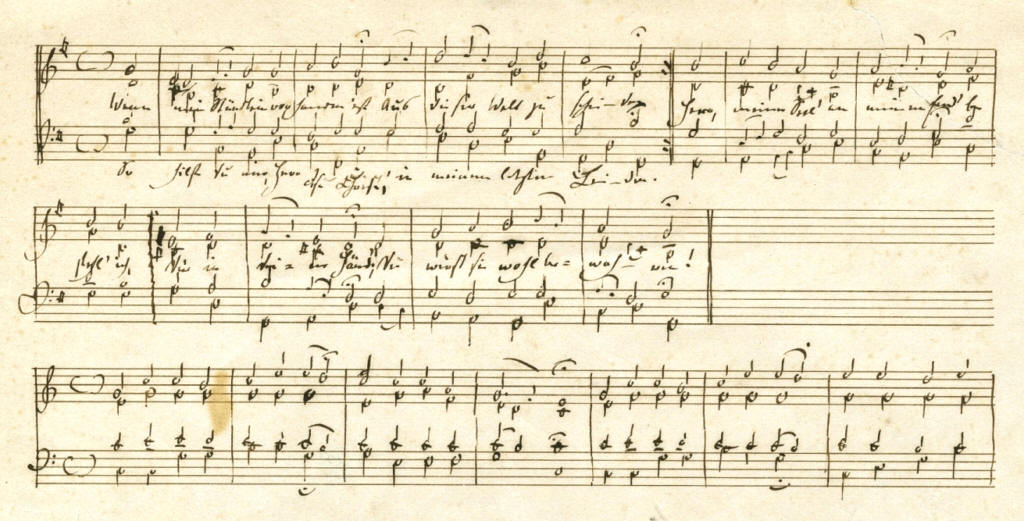
What many people don't know: Robert Schumann made a four-part setting of this chorale (with textunderlay of the first stanza) while in the psychiatric asylum, probably his last 'composition'. the story | het verhaal
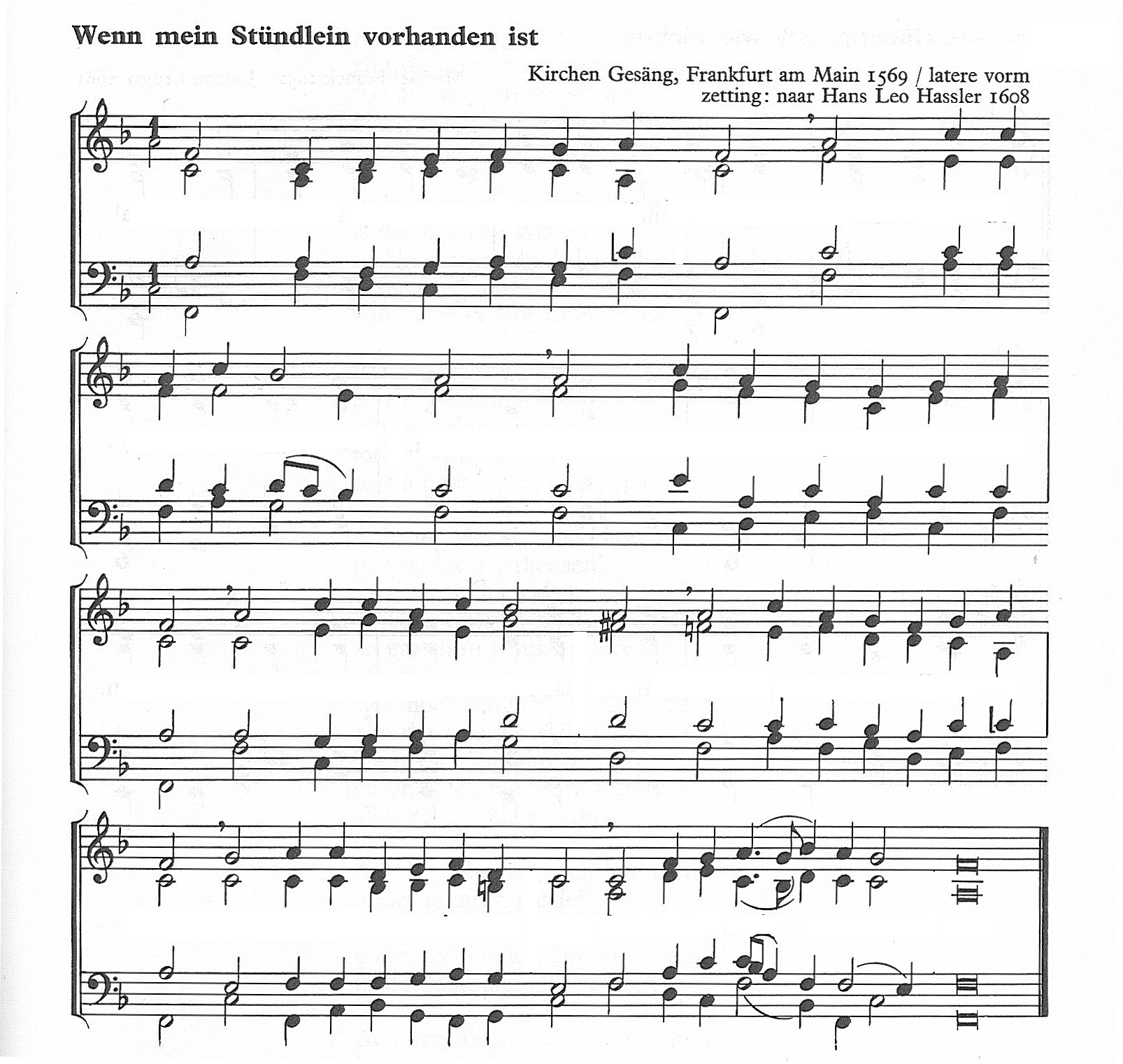
The tune: In the first publication it had no tune of its own, and was sung on existing tune(s). In 1569 the first version of the now familiar tune appears. Below a setting (slightly modified, Hans Leo Hassler)
Nikolaus Herman (ca 1560 - based on the preface)
Source:
(a)
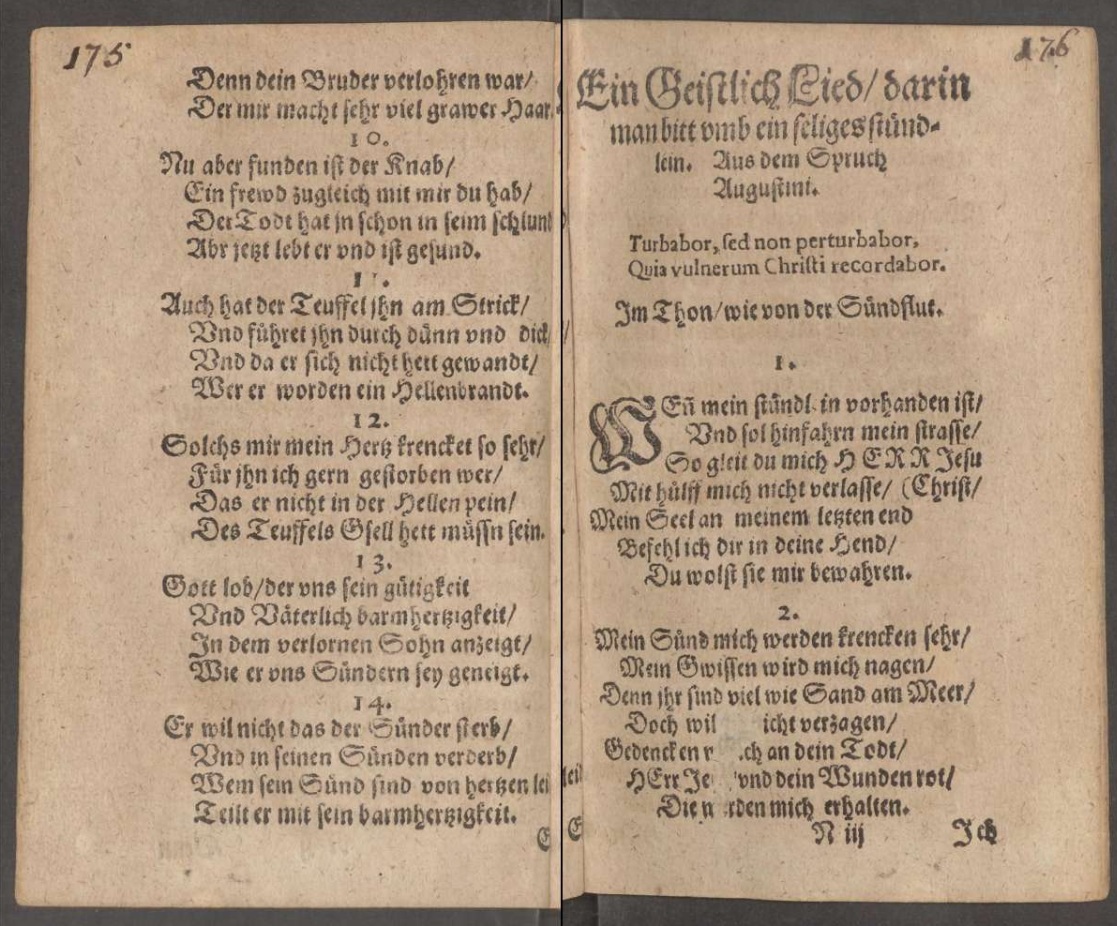
Die Historien von der Sindfludt etc.. (Nikolaus Herman),
Wittemberg 1562 (DKL 1562°3)
Ein geistlichs Lied / darin man bitt vmb ein seliges
Stündlein. Aus dem Spruch
Augustini
Turbabor, sed non pertubabor,
Quia vulnerum Christi
recordabor.
Im Thon / wie von der Sündflut
(b) Drey Schöne Geistlicher Lieder
Wie sich ein Christ in seinem letzren Ende tröste, Köln 1574
Heading
Im thon / Herr Christ der einig Gotres Sohn.