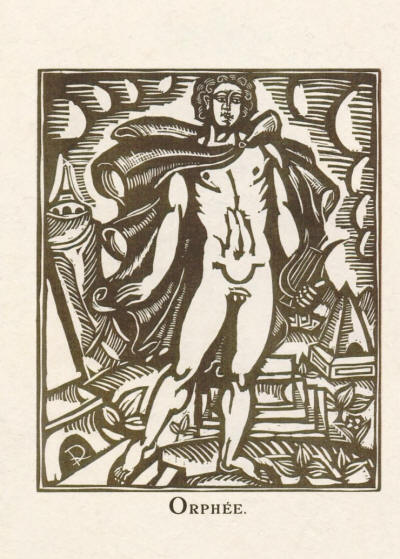
Orpheus
 |
 |
|
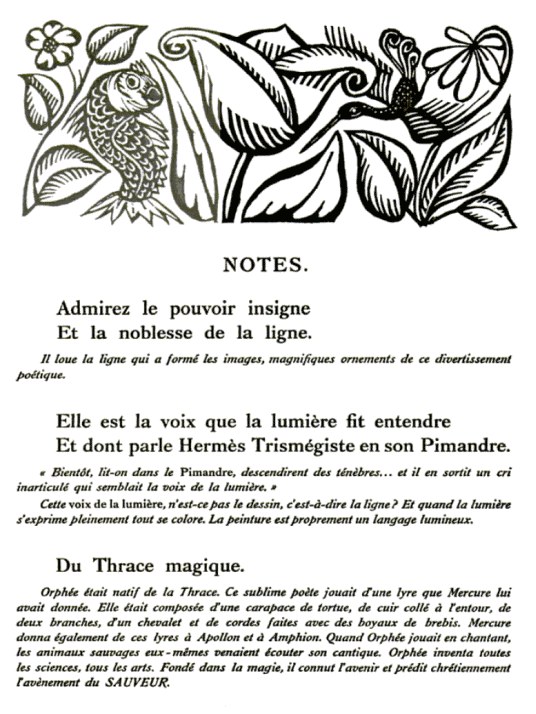
Admirez le pouvoir insigne |
Bewonder de opmerkelijke kracht Admire the remarkable power Apollinaire's note: see below
- there also more context. |
|
Admirez le pouvoir insigne |
Bewonder de opmerkelijke kracht Admire the remarkable power |
|
Elle est la voix que la lumière fit entendre |
Het is de stem die het licht laat horen it is the voice that light made heard, |
Extra backgroundPimandre is the old French name for the Poimandres, the first treatise of the Corpus Hermeticum: Greek religious-philosophical texts from Roman Egypt (first to third century AD), attributed to Hermes Trismegistus, in whom the Greek Hermes and the Egyptian Thoth were merged. The West came to know them through Marsilio Ficino's Latin translation (1463, printed 1471), which carried the title Pimander. In the opening vision Poimandres, the divine Mind, shows the narrator a boundless light; then a darkness descends and turns into something moist and murky, from which an inarticulate cry goes up. Apollinaire quotes the French translation by Louis Ménard (Hermès Trismégiste, Paris 1866), in the shortened form in which Ménard himself cites the passage in his introduction. He then gives the 'voice of light' a turn of his own: it becomes the drawn line, and so a tribute to Dufy. |
Extra achtergrondinformatiePimandre is de oude Franse naam voor de Poimandres, het eerste traktaat van het Corpus Hermeticum: Griekse religieus-filosofische teksten uit Romeins Egypte (eerste tot derde eeuw na Chr.), toegeschreven aan Hermes Trismegistus, in wie de Griekse Hermes en de Egyptische Thoth zijn samengevloeid. Het Westen leerde ze kennen door de Latijnse vertaling van Marsilio Ficino (1463, gedrukt 1471), die de titel Pimander droeg. In het openingsvisioen toont Poimandres, de goddelijke Geest, de verteller een grenzeloos licht; dan daalt een duisternis neer die verandert in iets vochtigs en troebels, waaruit een ongearticuleerde kreet opstijgt. Apollinaire citeert de Franse vertaling van Louis Ménard (Hermès Trismégiste, Parijs 1866), in de verkorte vorm waarin Ménard de passage zelf aanhaalt in zijn inleiding. Daarna geeft hij de 'stem van het licht' een eigen wending: ze wordt de getekende lijn, en zo een eerbetoon aan Dufy. |