
Editions of Clément Marot: A Guide to What Survives
Clément Marot died in 1544, leaving behind poems that had circulated in remarkably varied forms: in manuscript, in collections, in anthologies, in musicprints (chansons). Some of the printed editions werd composed under his direct supervision, others (most) were pirated editions. And the poems themselves. They were not 'stable': some were rejected by him afterwards, others revised etc. And I'm not mentioning copying errors etc. To this already complex textual legacy ons has to add the long afterlife of his Oeuvres in which publishers enlarged their editions with newly discovered poems — often spurious, but attributed to Marot, because his name sold — and in which editors from the sixteenth century onward reorganised and, later, even 'adapted' modernised his texts. So, A reader who picks up an edition of Marot (whether ancient or recent) is therefore not simply reading Marot: they are reading the output of one editor's resolution to three fundamental questions.
1. textual: Marot continually revised his work,
meaning a poem printed in 1532 may differ significantly from its
1538 version, etc., with neither text being a corruption of the
other.
2. arrangement: While Marot worked within
established poetic genres, he innovated by curating part of
his output into a structured authorial collections. So, editors have
to decide whether to preserve the collections as he assembled them,
or sort them otherwise (by genre was the most popular solution)
3. authenticity: Printers (and minor poets, and
some protestant activists) were eager to capitalize on his fame.
They published poems under Marot's name, both during his lifetime
and even more after his death — some were genuine, some apocryphal,
and many of uncertain origin.
What follows outlines the principal editions that were shaped by the
answers to these questions across five centuries.
The authorised editions of Marot's lifetime (1532–1544)
These are the foundational editions against which all subsequent texts are measured. In the early 1530s Marot started to gather his work (part of it circulating for many years, some printed) and organized it in a book (this sounds banal, but was novel). From the result we can infer, that he viewed his poems as an evolving single corpus. Also important: the layout: With one exception it was printed in pocket octavo format, using the refined roman typeface he helped establish in French poetry.
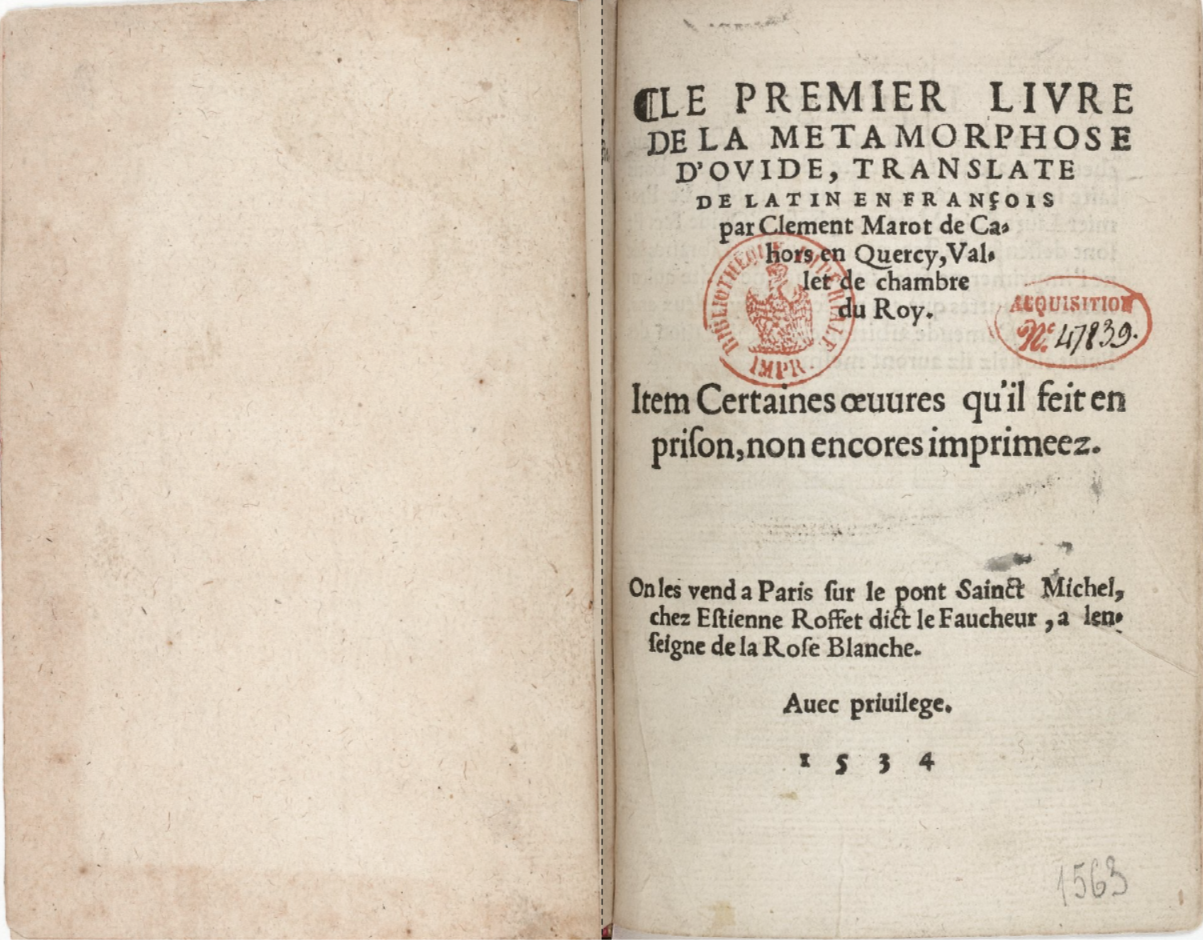
The titles are programmatic.
- L'Adolescence clémentine (1532) and La Suite (1533): Marot's self-curated early collections, conceived as a unified two-part book (the Suite appearing during his exile in Ferrara and Venice). Immediately copied/pirated. After his exile (a poetically very productive periode by the way!), he returned to France, and revisited this edition, and substantially expanded it into:
- Les Œuvres (Lyon, 1538): Printed by François Juste and issued successively under the names of Étienne Dolet and Sébastien Gryphius, this is the definitive edition of Marot's lifetime. Bibliographically complex, it exists in two distinct issues that reflect ongoing corrections made while the sheets were on the press. Uniquely, it was set in a chancery bâtarde rather than Marot's customary roman type — likely an error stemming from Dolet's printing inexperience, which precipitated a rift between the two men (see Defaux 1995, Berthon 2014, 2019).
- Cinquante Pseaumes (Geneva, Jean Girard, 1543): Marot's final authorized collection of psalm paraphrases, exceptionally printed in quarto (to emphasize its gravity? luxus?). While these psalms quickly acquired liturgical utility in Geneva, Marot conceived them primarily as works of literary and devotional poetry (Wursten 2010, 2023).
The posthumous editions (1544-1550)
Following Marot's flight to Geneva in 1542 and his death in Turin in 1544, publishers and booksellers scrambled to capture his market. These early posthumous printings fundamentally altered how his work was read.
- The Rocher Edition (Lyon, 1544/1545): Printed by Sulpice Sabon for publisher Antoine Constantin (« à l'enseigne du Rocher »), this edition was long treated as authoritative but was in fact a posthumous, unauthorized commercial venture. Constantin dismantled Marot's original collections, reordering the entire output by generic category and introducing a full analytical table of contents. As Guillaume Berthon demonstrates in his 2019 bibliography — under the heading « L'édition “à l'enseigne du Rocher” (Lyon, 1544) : le testament trahi ? » — this edition represents a bookseller's restructuring rather than authorial intent, though its generic framework heavily influenced subsequent editors. In Paris the market was flooded with editions, based on Constantin.
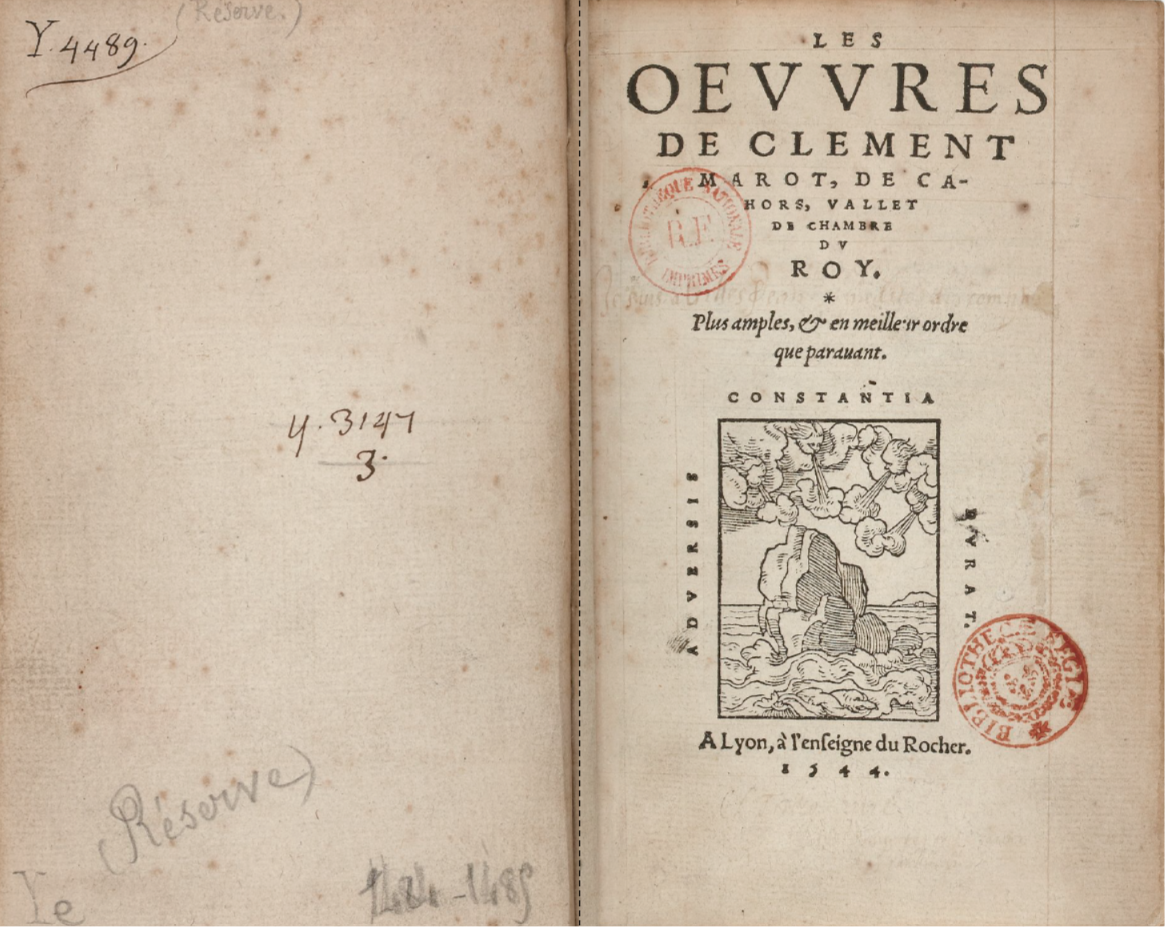
- Jean de Tournes Edition (Lyon, 1546): Textually far more reliable, this edition was prepared by Antoine Du Moulin, a humanist scholar and personal friend of Marot. De Tournes reissued and expanded it (I found: 1553, 1558, and 1573), establishing a high standard of typographical care and textual restraint.
- In a similar vein Guillaume Rouillé (Roville) (Lyon, 1550) published a new edition of Marot's works (including many new poems, see next point). His editor was Marot's friend ("pupil") Charles Fontaine. Their editions are at least also intended to honour their friend and master (and safeguard his legacy against...).Very instructive preface.
Important addition to the corpus: Épigrammes... faictz à l'imitation de Martial (Poitiers, frères Marnef, 1547): A landmark collection gathering Marot's late epigrams written translating/emulating Martial's epigrams, derived from authoritative manuscript copies that circulated late in the poet's life. The epigrams by the way belong to the finest poetry written by Marot. A first collection of them was presented as a gift to the Connetable of France, Montmorency in March 1538 (beautiful manuscript, discovered in Chantilly, Musée Condé, late 19th century. The manuscript was edited by François Rigolot and published by Droz in 2010: Recueil inédit...
These editions (parts/books bound together or sold separately) were often reissued, sometimes in a joint venture of printers; In the 1920's Pierre Villey already counted 60 editions, in the second half of the 16th century. There are more discovered since. Alongside these major editions, Marot's verse also circulated throughout the early modern period via popular anthologies, songbooks, and other florilegia.The Niort edition : where the legend begins (1596)
At the crossroads between the old and the new stands the edition printed at Niort by Thomas Portau in 1596, prepared by a docteur Mizières. Textually it belongs to the sixteenth century; in method it opens what follows. Mizières allowed himself complete freedom in the arrangement of the poems — “en ce qui concerne l'ordre des pièces, Mizières s'accorde toute liberté de le modifier à sa guise” — and his principle was to bring together the pieces that refer to the same person.
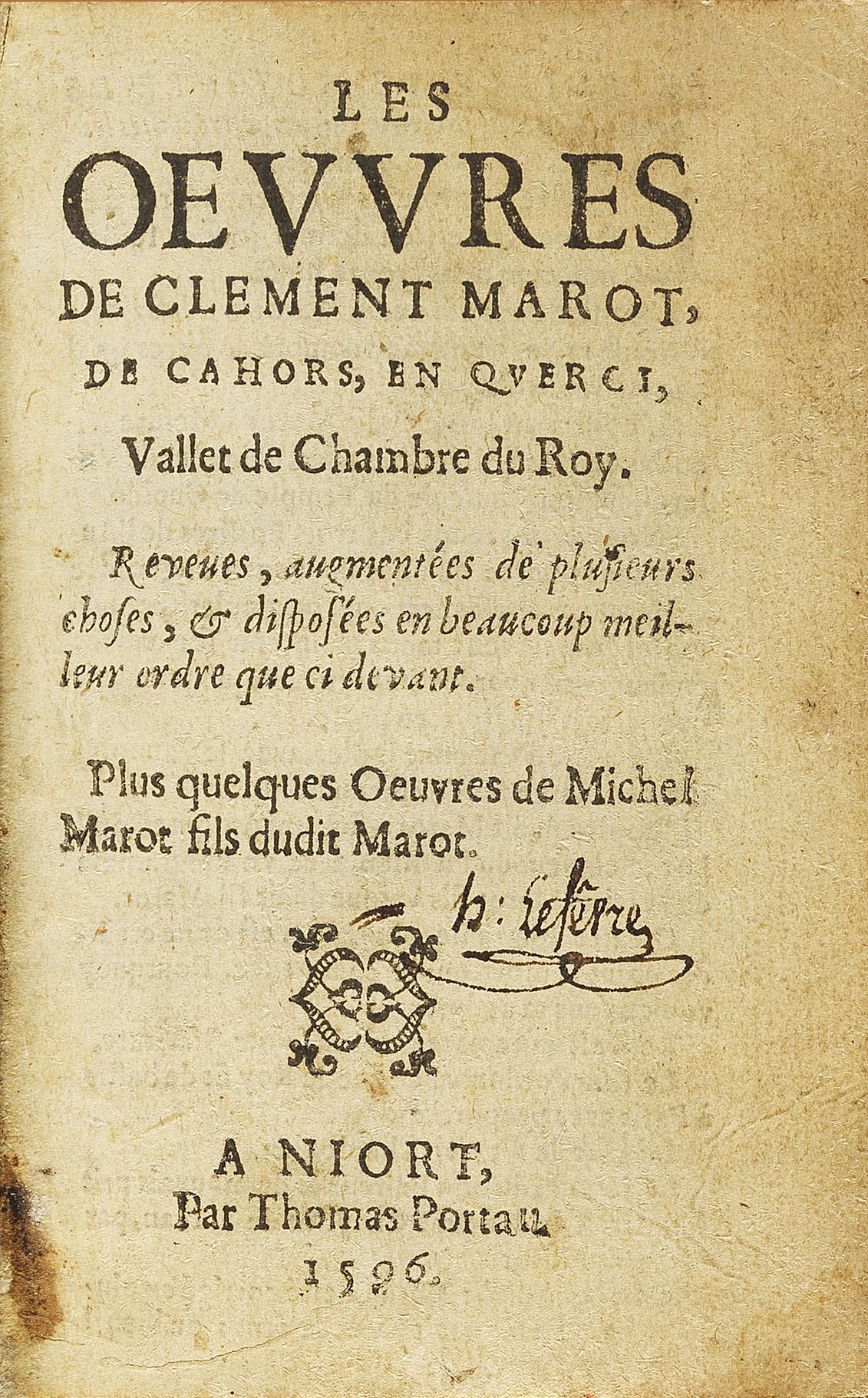
That is a small editorial decision with very long consequences, and it is worth pausing on it. Grouping the poems by their supposed addressee is already an interpretation of the work: it assumes that the poems record a life, and that the first person of the verse is the poet speaking about real people. As Pierre Villey observed, this is where the danger begins. The groupings Mizières created around “Anne” and around “Diane” became the point of departure for the legendary interpretations and fanciful chronologies of the eighteenth century.
The eighteenth century revival
Not much happened during the 17th Century (as far as I can see) at this frond. The 18th Century editions of Marot, though not many, had a long afterlife, and ditto Wirkungsgeschichte :
The first new edition of Marot's works (after almost a century) was published by Adriaen Moetjens (The Hague, 1700/1702): This edition reprinted the 1596 Niort text, preceded by an anonymous Abrégé de la vie de Clément Marot. It marks the first time in print that "Luna" (from L'Enfer) was tentatively identified as Diane de Poitiers. While praising Marot's “grace inimitable”, the Abrégé presented his character as licentious and his religious commitments as volatile.
Excursus: Marot in The Hague around 1700
The Moetjens edition rewards a closer look, because it shows that
Marot's return to print around 1700 came not from Protestant piety
but from a Catholic and diplomatic readership. Adriaen Moetjens
(c. 1651–1717) did not serve the Reformed devotional market: his
Hague shop catered to the international elite of the city of the
States-General, the embassies, and the stadtholderly court,
dealing in luxury French-language publications — court literature,
diplomatic memoirs, history, and classical poetry — and his
premises were a known gathering point for Catholic book
collectors, whose private libraries he regularly auctioned.This
milieu accounts for the character of the anonymous Abrégé.
Where Geneva and the Huguenot refuge honoured Marot above all as
the devout translator of the Psalms, the Abrégé
deliberately withholds that martyr's halo. It views the poet's
religious choices with suspicion and presents him instead as a
fickle, frivolous court poet, casting his flight to Geneva and his
“errors” in religion as the fruit of a dissolute character and
political imprudence. The poems are offered as elegant court
verse, but the reader is quietly warned about the man's unsteady
faith and morals.
The significance for the reception of Marot is considerable. The
1700 edition is the first in which a reissue of the poems is so
emphatically governed by a biographical framing that dictates how
they are to be read — and it is the earliest step toward the
durable habit of presenting Marot as a light, licentious court
poet.
The second eighteenth-century edition, and by far the most consequential, is the annotated edition of (Abbé) Nicolas Lenglet Du Fresnoy (The Hague, Gosse & Neaulme, 1731), published under the pseudonym “chevalier Gordon de Percel” and issued in both a four-volume quarto and a six-volume duodecimo format. It furnished the first extensive apparatus — notes, historical commentary, biography, and a chronology of the works — and did much to reintroduce Marot to a reading public. Lenglet indicates that he was guided by Portau's Niort edition, to which he added poems from editions published by Marot or his friends, from collections of poetry, and from manuscripts.
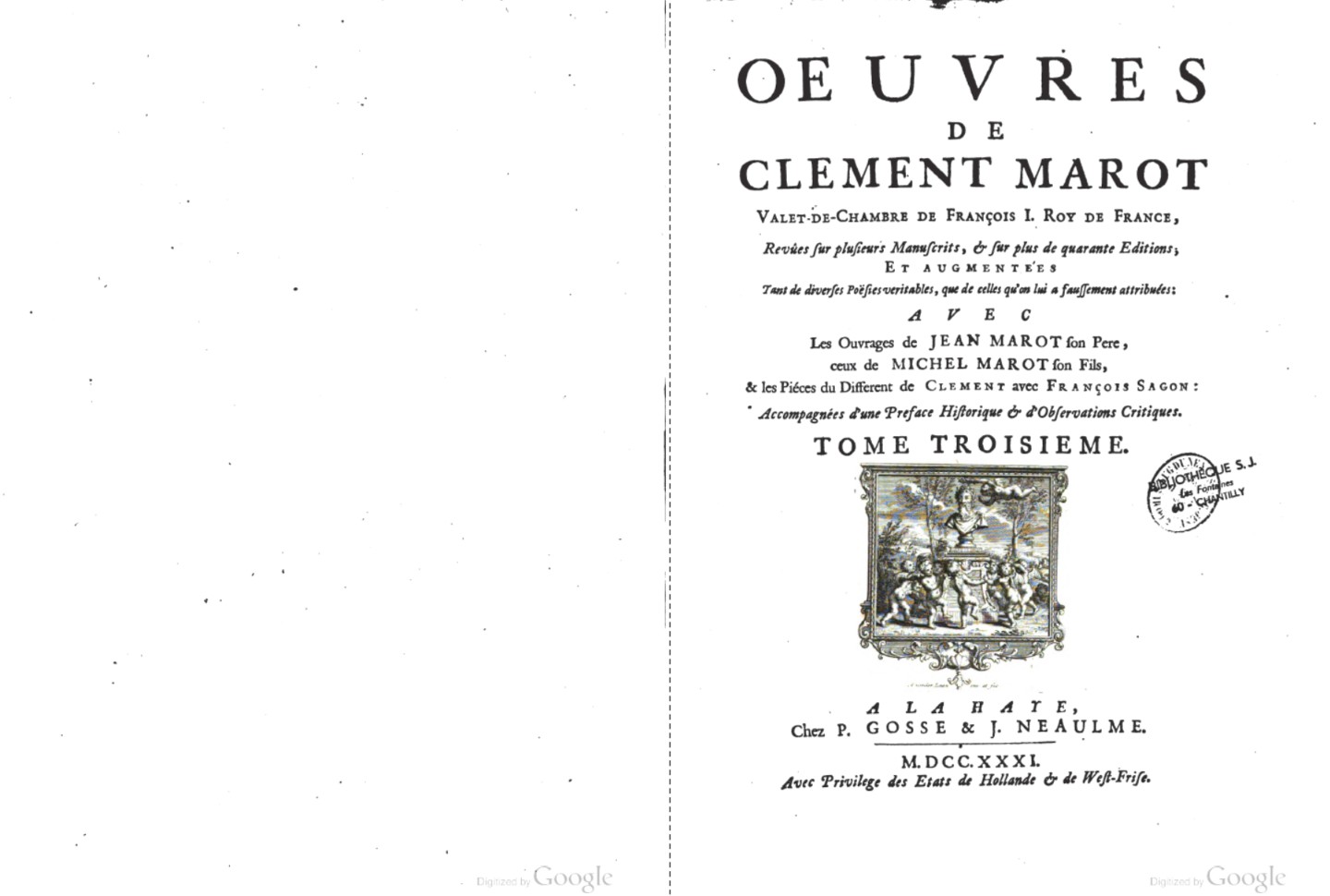
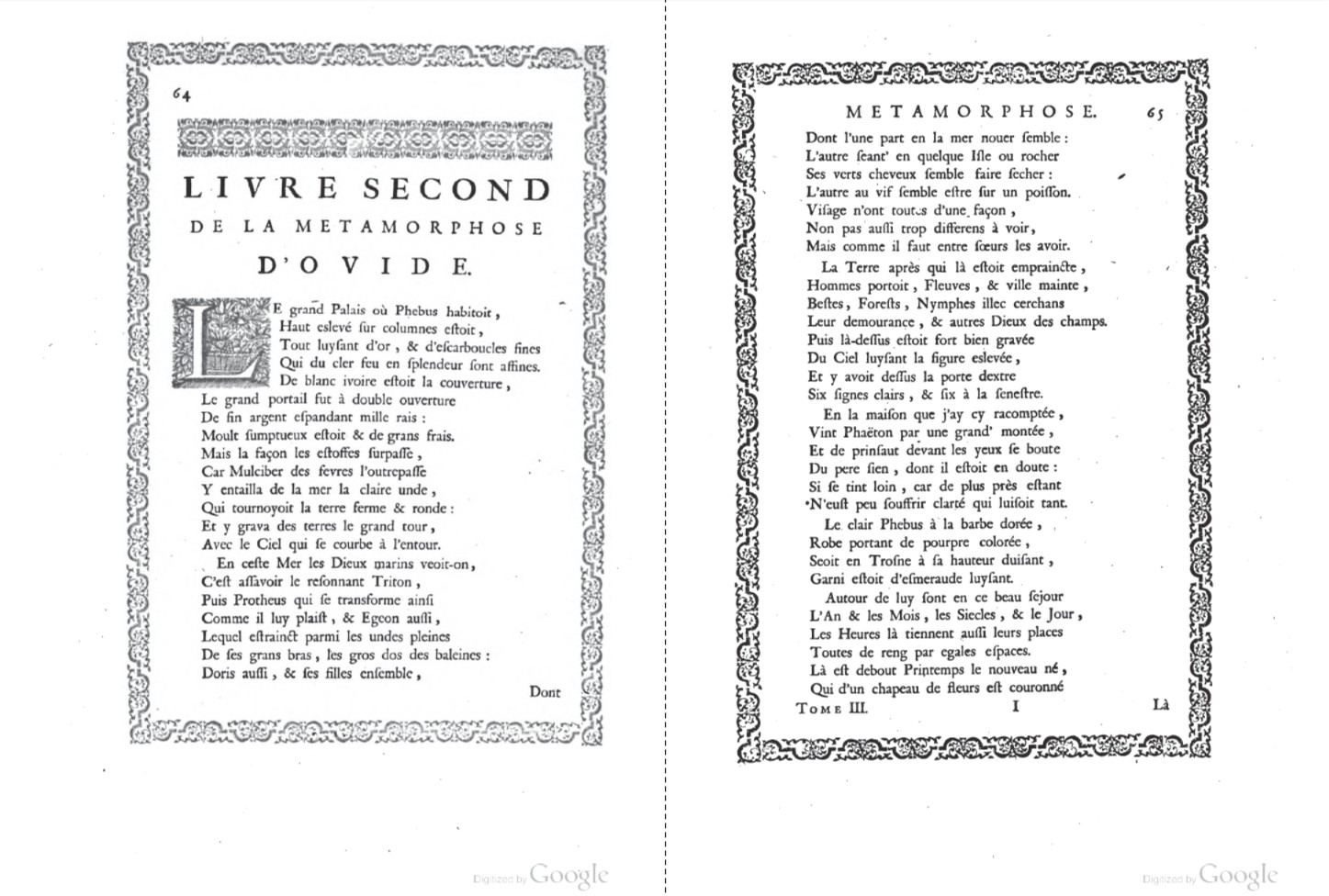
The bulk of his additions, however, is less reassuring. He printed
everything atributed to Marot in Groulleau's collection of French
translations from the Latin (Traductions de latin en françoys,
imitations et inventions nouvelles, tant de Clement Marot que
d'autres des plus excellens poètes de ce
temps (Paris, 1549), including many poems not by
Marot — 21 out of 40 (!) — and drew further on the anthology Vraye
poesie françoise of 1544, of which Lenglet imprudently
declared that it contained “guère que des poésies de Marot et de
son ami”. Villey's Tableau traced these additions one
by one. The result is an edition of great historical interest, and
little textual authority.
Its lasting damage, however, lies elsewhere. The Préface
historique (I, pp. 1–116) takes the form of a conversation
between three speakers named Aristippe, Eugène and Ménandre, and
with the help of variously interpreted passages in the poems it
constructs circumstantial histories of Marot's supposed love for Diane
de Poitiers (“Isabeau”) and for Marguerite de Navarre
(“Anne”). On Diane: “Il paroissoit bien que c'étoit plutôt la
douceur d'une amitié tendre que le plaisir séducteur de l'amour…”;
she is said eventually to have avenged herself for the rondeau De
l'inconstance de Ysabeau. As for Marguerite, her love ripens
slowly — “Cette soeur devint donc son amie; et cette amie devint
enfin sa maitresse” — while the precise nature of the
relationship is left suggestively uncertain. The Abrégé de la
vie that follows the preface (I, pp. 117–22) is identical with
the one in the Moetjens edition of 1700, pulls the same strings.
The point to retain is not the identifications as such, which were
questioned soon enough, but the underlying thesis: that Marot's
poems contain cycles inspired by successive mistresses. That
thesis (cf. Mizières in 1596), was accepted for two centuries even
by critics who dismissed the names Lenglet attached to it — Abel
Lefranc among them, and even Gérard Defaux succumbs to it (while
dedidcated to fighting autobiographic readings... so
tempting). Lenglet is also responsible for the image of a sensuous
Marguerite de Navarre, freely indulging in the sort of adventures
she describes in the Heptaméron. Like Douen on the psalms a
century and a half later, he produced a ground-breaking work that
simultaneously inaugurated a fundamental misconception of the life
and the poetry.
The nineteenth century
Through the nineteenth century, alongside the poems that continued to appear in anthologies, Marot was read chiefly in a succession of annotated reading editions directed at a cultivated public rather than at scholarship. These carried the biographical Marot of the eighteenth century forward and fixed his popular image. Each was typically prefaced by a life of the poet, and most depended textually on the corrected and enlarged tradition rather than on Marot's own editions.
The Romantic revival of interest in Renaissance literature produced two editions, that set out to revise and “improve” Lenglet Du Fresnoy: The first one edited by Pierre-René Auguis (Paris, 1823, 5 vols), who said to have corrected thousands of errors made by Lenglet, retaining Marot's sixteenth-century spelling. It looks old-fashioned indeed, but according to Lacroix/Barre (see below) it's more a 'reconstruction' than based on an actual edition. The apparatus is updated, a glossary is added, and a chronological table completes the work. The second edition was kind of a surprise. It was edited by Paul Lacroix (born 1806) (Paris, 1824, 3 vols), and published by Rapilly and Lefèvre (in the latter's Collection des classiques françois). Lacroix (then only 18 years old!) consciously opted for the transcription of the poems based on a physical copy of Les Oeuvres (a 1554 Paris edition, was the oldest he could lay his hand on (Veuve Maurice), comparing the text with Lenglet's, adding as many other editions he could find, in order to produce a true reproduction of Marot's original oeuvre (including its orthography). The arrangement is entirely his own. The Essai with which volume I opens, is signed by Lacroix (P.L.N. de St. H., the "N" referring to his father (from Niré), and "st.H" to his grandfather, originating from Saint Honore). Below the text is his own and other's commentary (mentioning his sources). Volume III closes with another essay, an overview of Marot editions from the 16th century untill 1823. It is signed P. B**** (another acronym of Paul Lacroix, I suppose), critical but indulgent with respect to Lenglet, severe for Auguis; Lacroix later became known as Le Bibliophile Jacob (literary pseudo), and ended his career as conservator of the Library L'Arsenal. His edition became a standard library edition for Romantic-era readers.
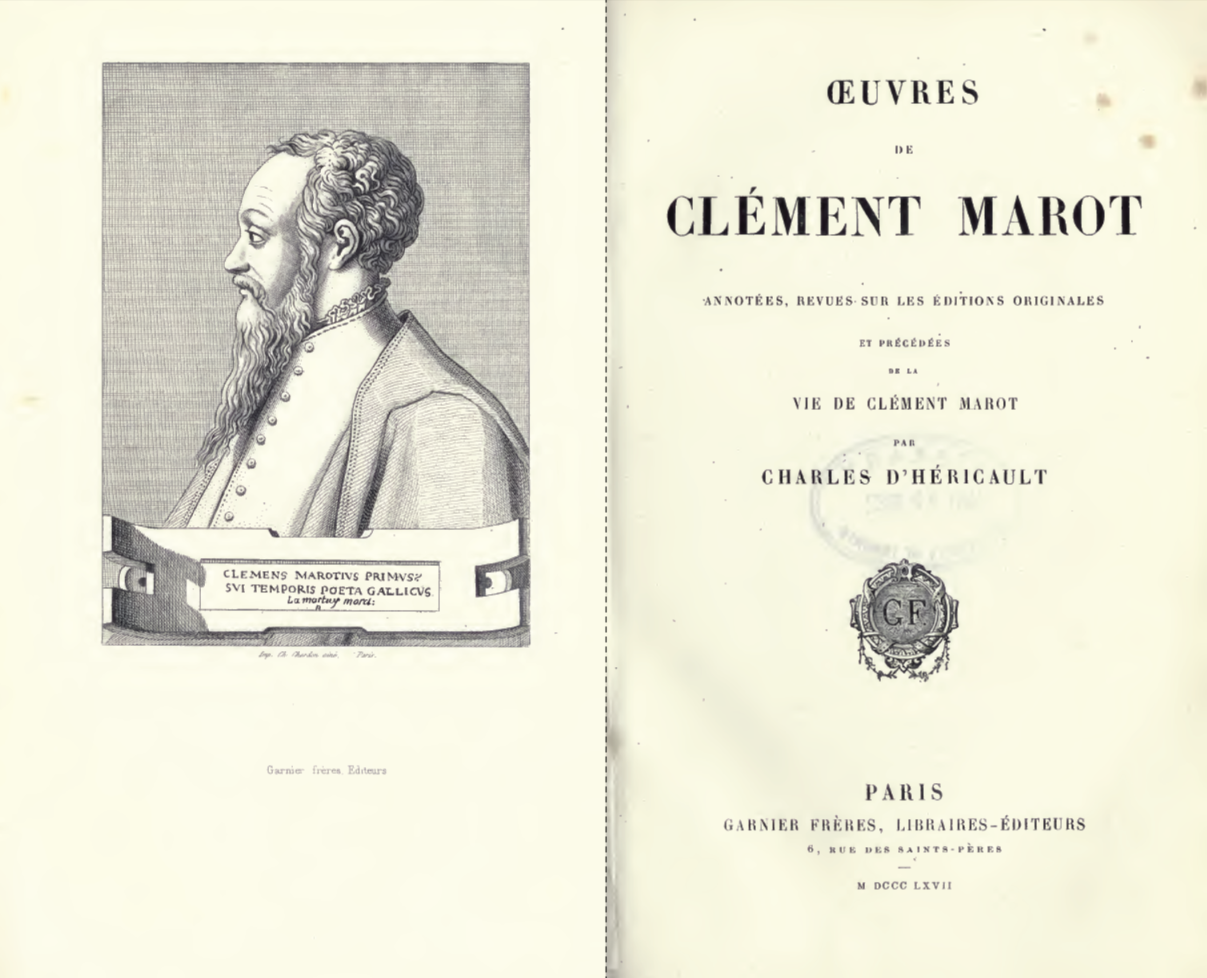
Later that century the firm of Garnier Frères issued Marot's works in its popular series in successive editions bearing much the same title. The one-volume edition of 1867, edited by Charles d'Héricault, is prefaced by over 100 pages Vie de Clément Marot — the first important modern biography, with a good description of court life and of the religious situation, and a well-balanced account of the life. Héricault is sceptical about Lenglet's theory of an affair with Diane de Poitiers and firmly rejects the liaison with Marguerite de Navarre. He was not the first to refute these conjectures — Niceron, Goujet and Campenon had preceded him — but his objections rest on far more telling arguments. His treatment of Marot's religious views is quite thin, and there is little critical appraisal of the poems. He took Dolet's 1538 Oeuvres as starting point, adding his selection of other poems to it from other 16th Century editions.
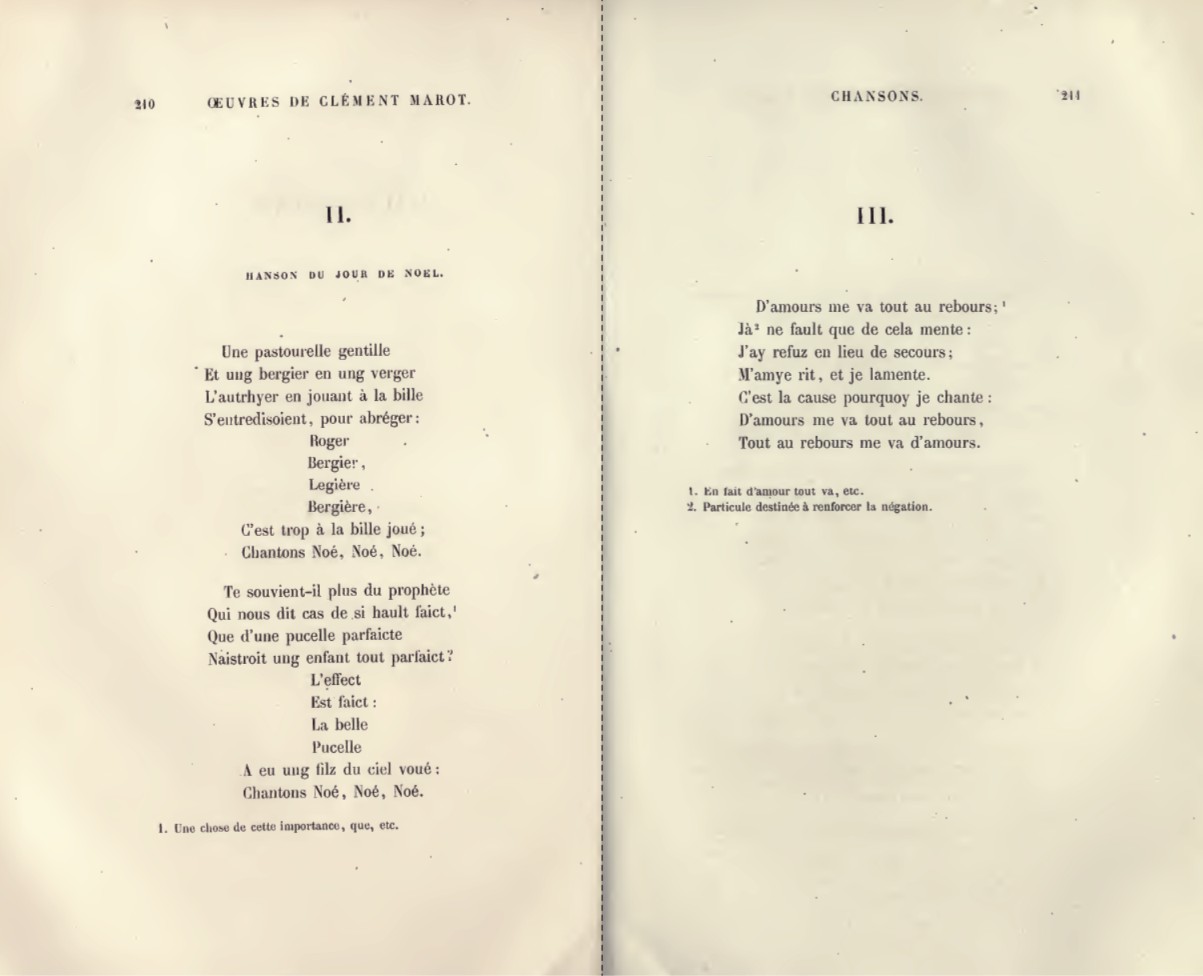
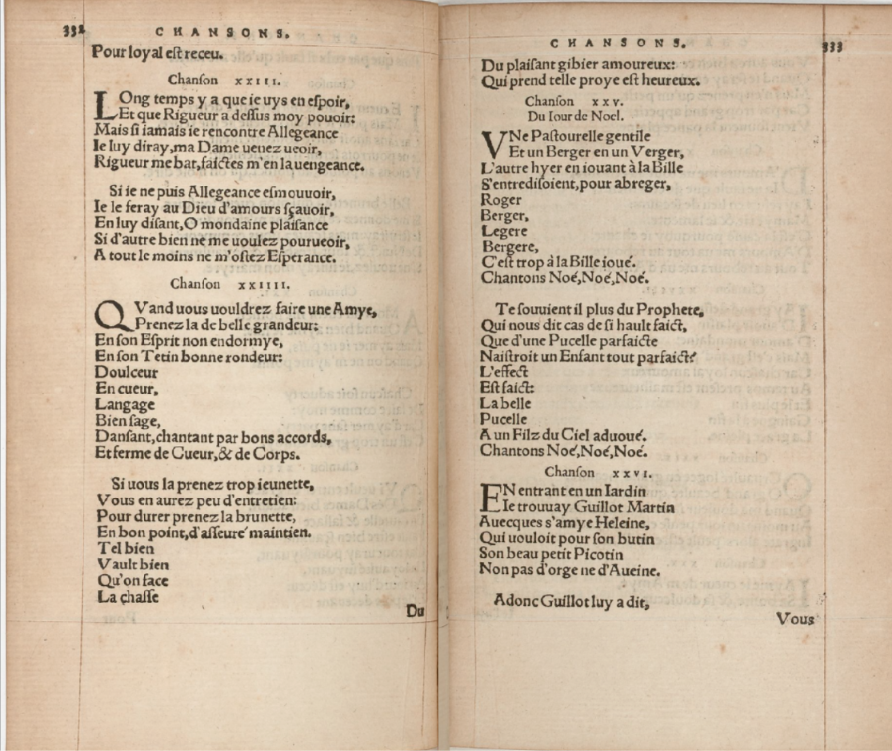
[notice the liberty taken in the arrangement of the poems. The
left one (chanson du jour de noel) is nr. II. In the original
editions this chanson has nr. XXV (Christmas day...), and follows
XXIV (of which it is a contrefact). Both elements are obscured.
The Garnier series was continued in 1879 by the two-volume edition of B. de Saint-Marc, whose biographical notice claims to be definitive and is not (it tells more about Saint-Marc than about Marot); he claims to have revised the text against sixteenth-century editions, modernised the punctuation, and expanded the glossary for students. The general reference until the first critical editions, however, was the edition of Pierre Jannet (Œuvres complètes de Clément Marot, Paris, Bibliothèque elzévirienne, four volumes, 1868–72). Jannet made a serious philological attempt to return to the early sixteenth-century printings, taking as a start (once more, alas!) the 1544 Constantin edition for all poems in it, adding other poems from elsewhere. A chronology and index-glossary completes the work. Jannet died before completing it; d'Héricault finished the work and prepared it for publication, adding an abridged version of his own biography — de facto, a concession/statement that it is hard to know anything about Marot's life, as a 'matter of fact'. In the early twentieth century, around 1920, followed the widely circulated edition of Abel Grenier, accessible and affordable but resting on no new research and retaining the apocryphal poems inherited from its predecessors, including the 'naive' outlook on the entwinement of events in Marot's life and his poems.
Excursus: The Protestant counter-legend and the Psalms (Douen)
The frivolous court poet of the Catholic and diplomatic reading
had a mirror image, and it was manufactured in the same century.
In 1871 Henry Morley devoted the first volume of his Clement
Marot and Other Studies (London, Chapman & Hall) to the
poet, giving much space to the historical background and paying
particular attention to poems “which would appear to English
readers nobly significant”. His aggressive Protestantism shows in
his reading of “Isabeau”, whom he identifies not with a woman but
with the French Church that Marot is said to have renounced for
its vice and inconstancy: “Even the choice of her name points
to the allegory, for that is a variation in form of Elizabeth,
which means God is my oath, or a Worshipper of God.” That
reading was received with enthusiasm by Orentin Douen,
whose Clément Marot et le psautier huguenot (Paris,
Imprimerie Nationale, two volumes, 1878–79) called it “cette
belle et importante découverte”. Douen's book remains
indispensable for one half of its subject: it offers a vast amount
of information about translations, translators, editions, music
and musicians, and reproduces many of the musical settings. Much
of that material is still valuable, even where his theories — on
the origins of the melodies, for instance — are no longer
accepted.
His presentation of the life and works is another matter. It is
constantly marred by overstatement and by a naive eagerness to
find evidence of overt Protestantism in the most unpropitious
situations. Marot is said to have displayed “un peu de
l'ardeur réformatrice du bouillant Farel” and to have become
“l'un des premiers propagateurs de l'Évangile”; his “constance
invincible” and “héroïques sacrifices” entitle him
to be regarded as a witness, a martyr, at least as much as Calvin
— who is portrayed here far less sympathetically. Douen accepts
Morley's Isabeau and dismisses the report of Marot's abjuration at
Lyon as an invention of Sagon's. A considerable scholarly
achievement, then, but excessively polemical and at times
tediously detailed.
It is worth noticing that the moral verdict on Marot, was not a Catholic invention that Protestants had to defend him against. It came from the Reformed side first. Théodore de Bèze included him among the illustrious men of his Icones (Geneva, 1580; translated by Simon Goulart as Les Vrais Pour-traits, 1581) precisely because of the psalms — “in Psalterii triente gallicis rythmis exprimendo” — while stating in the same breath that a life spent at court, “pessima pietatis et honestatis magistra”, had left his morals unreformed even in old age. The Histoire ecclésiastique (1580) attributes his departure from Geneva to his having been “tousjours nourry en une trés mauvaise escole, et ne pouvant assubjectir sa vie a la reformation de l'Evangile”. From the very beginning, in other words, both camps agreed that Marot had lived a worldly life; they differed only about what to conclude from it.
The nineteenth and early twentieth century: Guiffrey
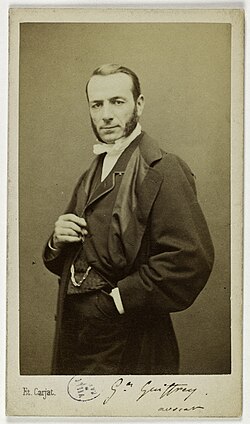
The Œuvres edited by the erudite advocate and politician Georges Guiffrey (1827-1887), and completed after his death in 1887 by Robert-Charles Yve-Plessis and Jean Plattard, appeared in five volumes between 1875 and 1931. It was the undertaking of a wealthy nineteenth-century érudit, produced over more than half a century. Its achievements are substantial: it was the first to collate several early versions rather than reprint an inherited text, it recovered a body of poems that had remained in manuscript, and it assembled much of the archival record of Marot's life. Its editorial method, however, remained tied to the 19th-century habit of treating poetic verse as direct autobiographical evidence, attempting to reconstruct Marot's life by dating poems based on subjective biographical assumptions.
Pierre Villey and the Methodological shift
Before the modern editions, one scholar altered what an edition of Marot could be. Pierre Villey, in his Tableau chronologique des publications de Marot, and Recherches sur la chronologie des oeuvres de Marot (1920-1923, first published serially, then published separately by Champion, and the study Marot et Rabelais (1923), reversed the direction of inference in dating the poems. Where earlier scholarship had dated poems from the biography, Villey dated them from the printed and manuscript record — the point at which a poem first appears, in what company, in which edition, and in what state — and allowed a chronology to emerge from that evidence. The early printed editions thereby became objects of study in their own right, attribution became a question with a method, and the biography contracted to what the documents support. Villey published no edition; his work is the foundation of those that followed.
Biographies of the twentieth century
The editions have their counterpart in a series of biographies, and the same shift is visible in them.
- Abel Lefranc, in “Le Roman d'amour de Clément Marot” (1913), proposed on the basis of the huitain “J'ay une lettre entre toutes eslite” a plausible identification of “Anne” with Anne d'Alençon, daughter of the illegitimate brother of Marguerite de Navarre's first husband. The identification has largely held; the reading of a whole “Anne cycle” built upon it has not, and Mayer among others rejected it — Defaux takes a different view. Lefranc, that is, discarded Lenglet's names while keeping his structure.
- Philipp August Becker's Clément Marot: Sein Leben und seine Dichtung (Munich, Kellerer, 1926) is a splendidly detailed biography, and most of its data have stood the test of later research — though some points have been challenged, among them the identity of “Monsieur Bouchart” (by C. A. Mayer, and by Wursten in 2008). Life and works are treated separately, but with a certain overlap, since Becker reads the poems primarily as reflections of Marot's feelings and experiences: an approach that is not without its dangers.
- In the same year Henry Guy devoted the second volume of his Histoire de la poésie française au XVIe siècle (Paris, Champion, 1926) to Marot and his school — a well-researched study, more concerned with the character and the ideas of the man than with the technique of the poet. Guy's Marot is worldly and independent, “le cas sans exemple d'un courtisan qui appartient à l'opposition”, hostile to constraint, impulsive, undisciplined, and lacking deep religious conviction — “ce qu'il approuve et goûte en la Réforme, c'est principalement le noir chagrin qu'elle cause à la Sorbonne” — but indomitable, facing adversity with an ironic quip and deeply attached to his country.
- Pierre Jourda's Marot: L'Homme et l'œuvre (Paris, Boivin, 1950; revised, Hatier, 1967) is a sound and competent introduction that summarises the known data, traces the poet's development, and assesses his religious views judiciously. And C. A. Mayer's Clément Marot (Paris, Nizet, 1972) remains the most informative and reliable biography we have. It divides the life into eight sections, each offering ample biographical data — and, where facts are lacking, very plausible suppositions — alongside a discussion of the literary output with extensive quotation. Its one conspicuous bias is the unrelenting denigration of the Rhétoriqueurs, in which Mayer follows Guy's destructive criticism of 1910 rather too readily.
Modern critical editions
C. A. Mayer (6 vols, 1958–1980) produced the first fully critical edition, arranged by genre across six volumes (London, Athlone Press, 1958–1970 for volumes I–V; Geneva, Slatkine, 1980 for volume VI): Les Épîtres, Œuvres satiriques, Œuvres lyriques, Œuvres diverses, Épigrammes, and Les Traductions. It was accompanied by a bibliography (1954, with a revised and expanded volume on the sixteenth-century editions in 1975). The edition sorts the corpus into its genres, weighs each poem's authenticity on Villey's principles, and prints an established text with a full apparatus of variants. It remains the standard tool for the text, the variants, and the question of authenticity argued rather than assumed. Its arrangement by genre is, however, the editor's, not Marot's.
Gérard Defaux (2 vols, 1990–1993; Psalms 1995) took the contrary approach in his Œuvres poétiques complètes (Classiques Garnier, two volumes, 1990 and 1993), restoring the collections Marot himself published or planned, on the argument that his books are compositions rather than containers, whose order carries meaning that a generic arrangement loses. The establishment of the text is less reliable than Mayer's, and for the poems Marot never published Defaux arranged the unpublished epigrams into a third and fourth book that never existed, extending the corpus in what he took to be Marot's own manner. The edition's introductions and notes substantially renewed the study of the poet, and are its principal value; for the psalms his separately edited Cinquante Pseaumes (Champion, 1995) is preferable to the poetic works.
Between these two editors the edition of the psalms became a point of open disagreement, and the disagreement was not only textual. Mayer preferred the Roffet edition of 1543, printed in Paris, over the Cinquante Pseaumes that appeared the same year at Geneva; and behind that choice lay a reading of Marot in which religion counted for rather little. Defaux edited the Cinquante Pseaumes separately (Champion, 1995) and insisted, against Mayer, that the religious dimension was central — though his command of the theological and liturgical material was not always equal to his conviction.
At this point I enter the field: Dick Wursten (Clément Marot and Religion. A Reassessment in the Light of his Psalm Paraphrases, 2010): It's a te-assessment of the debate between Mayer and Defaux, based on close reading of the poems, and reconstructing their genesis. I argue that the psalms are best read as what they announce themselves to be: a humanist translation project, undertaken with the same seriousness and by the same poetic means as his versions of Virgil and Ovid. The Hebrew Psalter was for Marot a classical text to be brought into French verse, not a confession of faith to be demonstrated. Their first destination was not the congregation but the closet: they were made for personal devotion, in and around the circle of Marguerite de Navarre, who was the muse of the whole undertaking. That Calvin took the result up and built a liturgy on it is a secondary effect — decisive for the history of the Reformed churches, but not the poet's design. Read this way, the psalms need neither Mayer's indifference nor Defaux's apologetics, and rather less of the biographical machinery that has surrounded them since the sixteenth century. The argument is set out in the introduction to the thesis; the reception of the psalms after Marot's death is followed in From Pious Poems to Protestant Hymns (Brill, 2023). .
Guillaume Berthon represents the current state of scholarship, continuing both predecessors while assessing each critically. His L'Intention du poète : Clément Marot « autheur » (Classiques Garnier, 2014) treats Marot as a self-conscious author shaping his public identity through print, while attending to the material realities that this account must accommodate: printer interference, pirated editions, and regional variation. His Bibliographie critique des éditions de Clément Marot (2019) corrects and extends Mayer's descriptions with the methods of modern analytical bibliography, and is now the point of departure for textual work on the poet. His edition of Les Épîtres (Gallimard, 2021, with J.-C. Monferran) adopts a generic grouping while restoring the historical publication chronology within it, and expands the corpus from Mayer's fifty-seven epistles to seventy.
Summary: Which Edition to Consult?
- For general reading and chronological evolution: François Rigolot (Flammarion) offers the most accessible text and layout.
- For literary analysis and historical commentary: Gérard Defaux (Classiques Garnier) provides the richest critical introductions.
- For textual variants and authenticity arguments: C. A. Mayer (Athlone/Slatkine) remains the standard tool.
- For the Epistles and bibliographical precision: Guillaume Berthon (Gallimard 2021; Droz 2019) represents the state of the art.
- For the Psalm paraphrases: Gérard Defaux (Champion, 1995) and Dick Wursten (Brill, 2010/2023) offer the necessary historical, textual, exegetical, and liturgical context.
And a general caution, which is really the point of this page: almost every colourful detail of Marot's life that circulates today — the loves, the cycles, the mistresses, the heroic Protestant witness and the dissolute courtier alike — can be traced to an editor rather than to a document. It entered the tradition in 1596, was elaborated in 1700 and 1731, and was defended from opposite sides in the nineteenth century. What survives the documents is a good deal quieter, and a good deal more interesting.
© 2026 Dick Wursten
Selected Bibliography
Critical Editions of Marot's works
- Œuvres complètes. Edited by C. A. Mayer. 6 vols. London: Athlone Press / Geneva: Slatkine, 1958–1980.
- Œuvres poétiques complètes. Edited by Gérard Defaux. 2 vols. Paris: Classiques Garnier, 1990–1993.
- Cinquante Pseaumes de David. Edited by Gérard Defaux. Paris: Champion, 1995.
- Œuvres complètes. Edited by François Rigolot. 2 vols. Paris: Flammarion (GF), 2007–2009.
- Les Épîtres. Edited by Guillaume Berthon and Jean-Charles Monferran. Paris: Gallimard (Folio classique), 2021.
Bibliographies & Reference Works
- Villey, Pierre. Tableau chronologique des
publications de Marot (1920-1922). Geneva: Slatkine
Reprints, 1973.
- Clive, H. Peter. Clément Marot: An Annotated Bibliography. London: Grant & Cutler, 1983.
- Mayer, C. A. Bibliographie des œuvres de Clément Marot. 2 vols. Geneva: Droz, 1954 (I: Manuscripts), 1975 (II: Printed editions).
- Berthon, Guillaume. Bibliographie critique des éditions de Clément Marot (ca 1521–1550). 2 vols. Geneva: Droz, 2019.
Critical Studies & Biographies
- Becker, Philipp August. Clément Marot: Sein Leben und seine Dichtung. Munich: Kellerer, 1926.
- Guy, Henry. Histoire de la poésie française au XVIe siècle. Tome II: Clément Marot et son école. Paris: Champion, 1926.
- Jourda, Pierre. Marot: L'Homme et l'œuvre. Paris: Boivin, 1950 (revised Hatier, 1967).
- Mayer, C. A. Clément Marot. Paris: Nizet, 1972.
- Wursten, Dick. Clément Marot and Religion: A Reassessment in the Light of his Psalm Paraphrases. Leiden: Brill, 2010.
- Berthon, Guillaume. L'Intention du poète : Clément Marot « autheur » (1521–1538). Paris: Classiques Garnier, 2014.
- Wursten, Dick. From Pious Poems to Protestant Hymns: The Reception of Marot's Psalms in the Sixteenth Century. Leiden: Brill, 2023.