Jean Visagier (Vulteius)
extract from an essay by I.D. MacFarlane, Literature and the Arts in the Reign of Francis I (Festschrift for C.A. Mayer, 1985), p. 114-117 (article Clément Marot and the World of Neo-Latin Poetry)
Visagier's
volumes of verse are as follows:
Epigrammatum libri duo
(Lyons: S. Gryphius, 1536);
Epigrammatum
libri IV (Lyons: J. Barbou, 1537);
Epigrammatum libri IV.
Eiusdem xenia (Lyons: Parmentier, 1537) [pagenumber references
are to this edition, labelled - E.];
Inscriptionum libri II...
Xeniorum libellus (Paris: S. de Colines, 1538) (the
Xenia
included
here are different from the 1537 collection);
Hendescayllaborum
Libri IIII (Paris: S. de Colines, 1538).
Biographical data
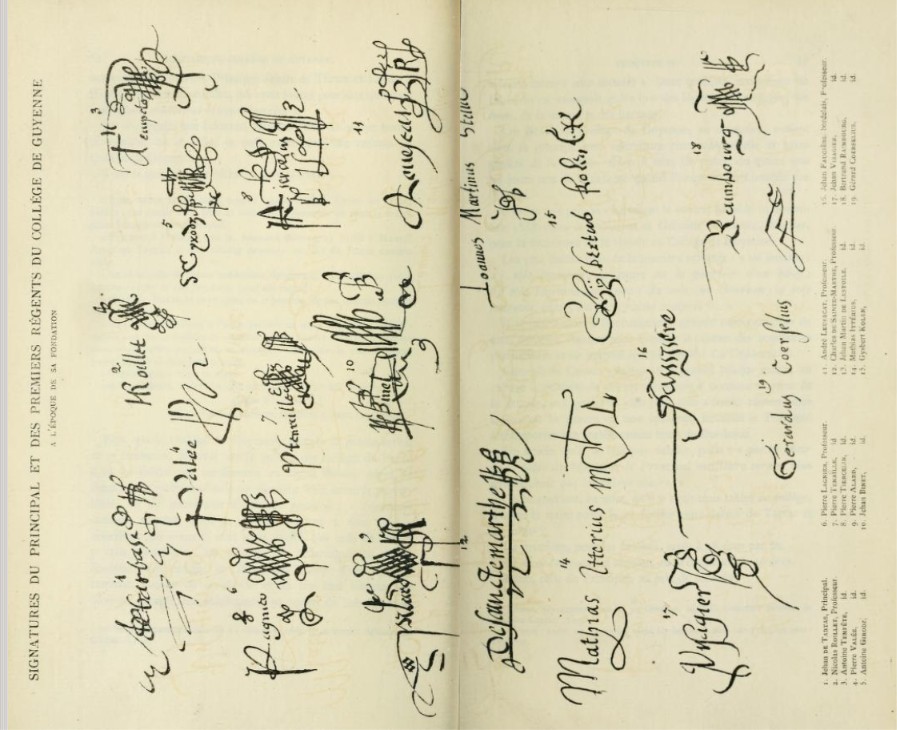
Though fanciful gallicisations have enjoyed currency (Faciot, Voulté), there should be no doubt about his real name: Jean Visagier. The poet took the trouble of revealing his name in an acrostich poem [Revue d'Histoire Littéraire de la France,1 (1894), 350, note], and in the first edition of the Nugae (1533, No. 555) Bourbon wrote him a poem: "Ad Ioannem Visagerium"; in Gaullieur's monography on the Collège de Guyenne there is a facsimile of the signatures of various persons who taught there,
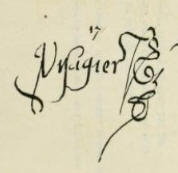 including Visagier
(click on image for source).
Originally from Vandy-sur-Aisne, although he styles himself Remensis
(from Reims), Visagier studied at the Collège de Sainte-Barbe,
found his way to Bordeaux where he taught for a spell, and eventually
turned up in Lyons. He died young, killed in 1540 by a man who had lost a
lawsuit against him [The date is sometimes given as 1542, but see Richard Cooper, "Antoine Arlier à Turin, 1539-43," Atti della Accademia delle Scienze di Torino, 104 (1969- 1970), 235-98 (especially p. 274, n. 3) for conclusive evidence that 1540 is the correct date].
He seems at one time to have harbored Erasmian sympathies, but by the time
of his death his friend Denys Faucher de Lérins assured a correspondent
that he had died in the odor of sanctity.
including Visagier
(click on image for source).
Originally from Vandy-sur-Aisne, although he styles himself Remensis
(from Reims), Visagier studied at the Collège de Sainte-Barbe,
found his way to Bordeaux where he taught for a spell, and eventually
turned up in Lyons. He died young, killed in 1540 by a man who had lost a
lawsuit against him [The date is sometimes given as 1542, but see Richard Cooper, "Antoine Arlier à Turin, 1539-43," Atti della Accademia delle Scienze di Torino, 104 (1969- 1970), 235-98 (especially p. 274, n. 3) for conclusive evidence that 1540 is the correct date].
He seems at one time to have harbored Erasmian sympathies, but by the time
of his death his friend Denys Faucher de Lérins assured a correspondent
that he had died in the odor of sanctity.
His poetic output is concentrated into three intense years (1536-1538) and the references to Marot are pretty frequent; one can also detect certain thematic parallels here and there. His Epigrammata follow the Neo-Latin pattern with a broad range of theme: the traditional satiric targets (the professions, the abuses of the church, monks, women, etc.), some religious verse, the lineaments of a love-cycle. Visagier is one of the first to express sympathy for Marot in exile: the first edition (1536) contains five poems on the subject, to which we can add an epigram on poets who write blasons du corps féminin. The first poem to Renée of Ferrara is a short piece lamenting the poet's exile (p. 115), but the second, addressed to Jean du Bellay seen as a possible ally, is very attractive in a literary sense (p. 120): written in the form of a prosopopoeia, it rather resembles a Marotic epistle in the plangent mode ("Hei mihi quam varios peperit fortuna dolores..."). Visagier, through Marot's voice, points out how various court figures and the King himself describe his poetry as "docta carmina, docta manu" and take note of his literary talents. The poem ends on a plea that Du Bellay intercede on his behalf. The poem to Francis I (p. 122) reiterates the belief that the poet has been falsely accused and that his absence is all the more regrettable as he has neglected his poetic activity during his exile. A shorter piece, also in the form of a prosopopoiea (p. 125), is addressed to the King, but is much less substantial, as is the "De eodem" on the same page. These very decent intercessions on Marot's behalf were amplified in the 1537 edition of the Epigrammata, which also contains some alterations. In part, these changes come about as a result of the souring of relations between Visagier and Bourbon, so that some poems originally addressed to Bourbon (who, it will be remembered, had gone into exile in England) were now transferred to Marot. Only a few variants were necessary, since Borbonius and Marotus are metrically interchangeable where a spondee is not de rigueur and since few biographical details were explicitly stated. There was considerable thematic overlap in the work of Marot and Bourbon, and the question of French or Latin was of no consequence (cf. pp. 11, 15, 24, 57 in the 1536 edition). One or two other references to Bourbon were switched to Dolet. But there were additions, because Marot had returned from Italy while Visagier was at work on the second edition (1537 edition: pp. 60, 182, 191-92 [2 poems], 230, 240 [4 poems], 244 [2 poems], 248, 249). There is talk of innocence being vindicated, but more important is the theme that Marot's return will revitalize the Muses. One poem elevates Clément well above his father.
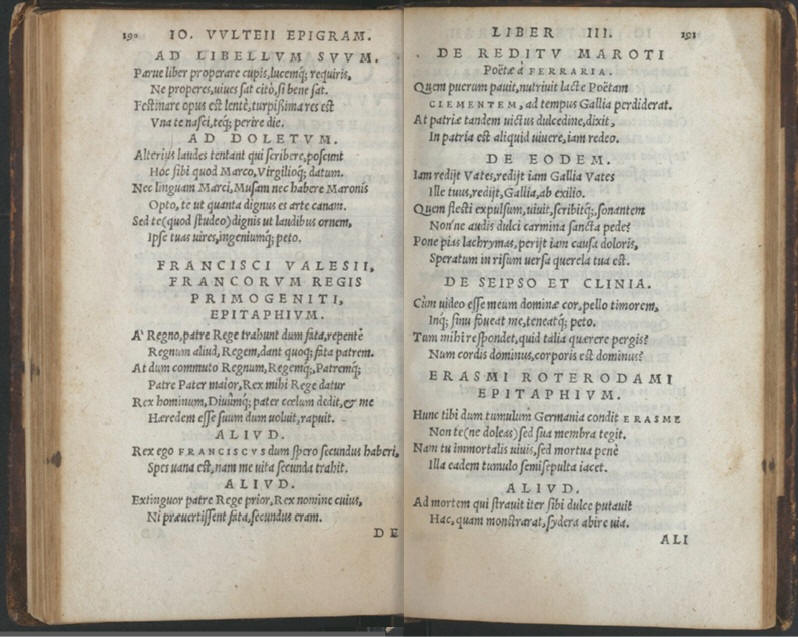
Visagier also includes [Latin] versions of Marot's poems: the first is an epigram written on the appearance of Dolet's Commentarii (vol. 1) (E, 264; Visagier, 1537, p. 250) and is given in two versions: here one might think that Dolet is being flattered as well. The other rendering is of a dialogue between mind and body (E, 127- 28); it is not addressed to the original dedicatee, Pierre Vuyard whom Visagier may not have known, but to Benoît Court, always remembered as the commentator of Martial d'Auvergne's Arrêts d'Amour. It may be of interest to place Visagier's version side by side with that published not so long after by Antoine de Gouvea:
Visagier, Ex vernaculo Maroti, Ad B. Curtium
Hoc corpus miserum petit salutem,
Frater chare mihi, sed hoc resolui, ut
Foedo a carcere, spiritus peroptat.
Mundum hoc somniat,his solutus esse.
Audire heu lachrymas graue est duorum.
Ah, sic (corpus ait) mori necesse est.
Ah, sic (spiritus) hic diu immorandum?
I,
te suauius opto (corpus inquit).
I, nos (spiritus) error urget idem.
Ast fiat Domini voluntas. (p. 242)
Gouvea, Epigrammata... 1540. Corpus et animi in morbo contentio
Poscit opem Corpus medicam: Mens solvere terra
Aestuat & medicas respuit usque manus.
Corpus humum, cognata leuis Mens suspicit astra.
Quam dirum, O Superi, terrificumque fremunt.
Mene ita, Corpus ait, tristi succumbere morbo?
Mens vero, invisas me trahere usque moras?
Caeca es ait Corpus. Mene contra, erramus uterque
Arbitrio summi stemus uterque Dei. (p. 23)
Visagier uses the hendecasyllable, whereas Gouvea contents himself with the elegiac couplet, which allows him to condense his version into eight lines. In spite of the quantitative difference in texture between Latin and French, quite a number of poets try to maintain the same number of lines in their renderings from the one language to the other. We shall find a sprinkling of translations in poets of this period, though not in the abundance to be found in the last third of the century (cf. Scévole de Sainte-Marthe, Jean de la Gessée, Florent Chrestien, etc.): by then certain principles were at hand in the Latin renderings, apart from virtuosity: Latin was still seen by some as more likely to last, for French was evolving it seemed almost too rapidly, and of course Latin was understood abroad: French had yet to acquire its diplomatic status as an international language. In the 1530s such considerations seem to have less force; one can understand renderings from Greek into Latin or French, because relatively few people were at home in the Greek language. Translations from French into Latin seem to be more a divertissement, involving technical skill, and also perhaps paying compliments to the author of the originals; there are in fact only a few vernacular poets who are overtly treated this way (Marot, Mellin de Saint-Gelais, Bouchet) and sometimes no clearer indication is given than ex vernaculo.
I am inclined to think that Visagier's example was not lost on Marot. The title Epigrammes (introduced by Marot in 1538) may owe something to him, but not exclusively so; he may nevertheless have encouraged Marot to exploit the Martialian formula more seriously. Visagier's own satiric epigrams are obviously indebted to Martial (though there are the complementary models of Ausonius and the Greek Anthology); and there are evident signs of his fondness for the Latin poet. He writes a poem to a friend from Arles, Veracius, originally penned on a copy of Martial (Hendecasyllabi, fol. 96 v); the satiric squibs against Dolet have a strong Mar- tialian flavor; the Inscriptiones contain a trifle "Ex inverso carmine Martialis, ad Salm. Macrinum" (fol. 83 v). The 1537 edition of the Epigrammata includes an "imitatio Martialis, ad Gyr. Ruffum" (p. 214 [= Girard Roussel, aumonier of Marguerite de Navarre]), and there is no need to look far for the source of "Quam nolit amicam" (p. 171). There is a further point: the 1537 Epigrammata were followed by a collection of Xenia, and the Inscriptiones likewise, though this collection was a different one. Could one not see a link between these collections and Marot's indulgence in étrennes c. 1541? The 1537 Xenia include two poems addressed to Marot, the first one of which reads: "Munere pro largo xeniorum nomine Musa / Mittet ad autorem carmina versa suum" (Xenia, E, p. 281). Given the closeness of relations between these poets, albeit over a short period, it is reasonable to suppose that Marot's Epigrammes faictz à l'imitation de Martial derive from this atmosphere and that the stimulus develops between Ducher, Bourbon, Visagier and Marot.
addendum: from E. Gaullieur, Histoire due Collège de Guyenne (Bordaeux, 1874), Signatures of professors etc. (between p. 60 and 61). Next to Saincte-Marthe, below to the left: Visagier, Jehan (nr. 17)