
Jean Visagier defending Marot during his exile
1534 Marot had to flee France (after the "Affaire des placards", protestant extremists posting pamphlets denunciating the Mass in shocking terms (title: "Articles véritables sur les horribles, grans et importables abuz de la messe papale, inventée directement contre la Sainte Cène de notre Seigneur, seul médiateur et seul Sauveur Jésus-Christ"). He found shelter in Ferrara (with Renée de France). Marguerite (the King's sister) and many other friends, pleaded for his return. A notable example is the Humanist scholar, and neo-Latin poet Jean Visagier (ca. 1505-1540, belonging to the so called 'Lyon sodalitium'). More on Visagier and Marot in an extract from an essay by I. D. McFarlane). In his first book of Epigrams we find some laudatory poems for Marot, the epigrams addressing Marot's exile and pleading for his return are gathered in Book II of this Epigrams. Below I copied the pages, transcribed the Latin texts, and translated them into English (with the help of Claude, thanks!)
-
p. 115 DE MAROTO POETA, concerning the poet Marot: "Donec erunt homines"
-
p. 121-122 AD DOMINAM RENATAM, to Renée de Ferrara: "Gallorum vates Gallis fugiebat"
-
p. 126-128 Letter to Cardinal Jean du Bellay,inducitur MAROTUS querens de exilio :
"Hei mihi quàm varios peperit" -
-
Ad Francisum Regem "Si revocer, videatque" | "De exilii Caussa"
-
-
p. 131-2 : To King Francis, concerning Marot: "Noster abest Clemens"
- "Quem puerum pavit" | "Iam rediît Vates"
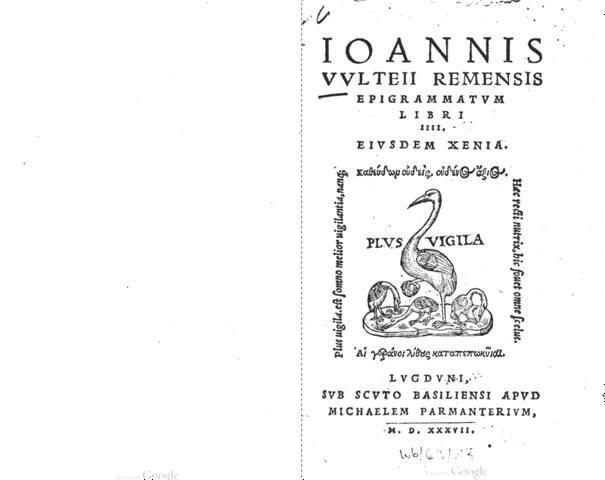
Latin epigrams (book II)
p. 115 concerning the poet Marot
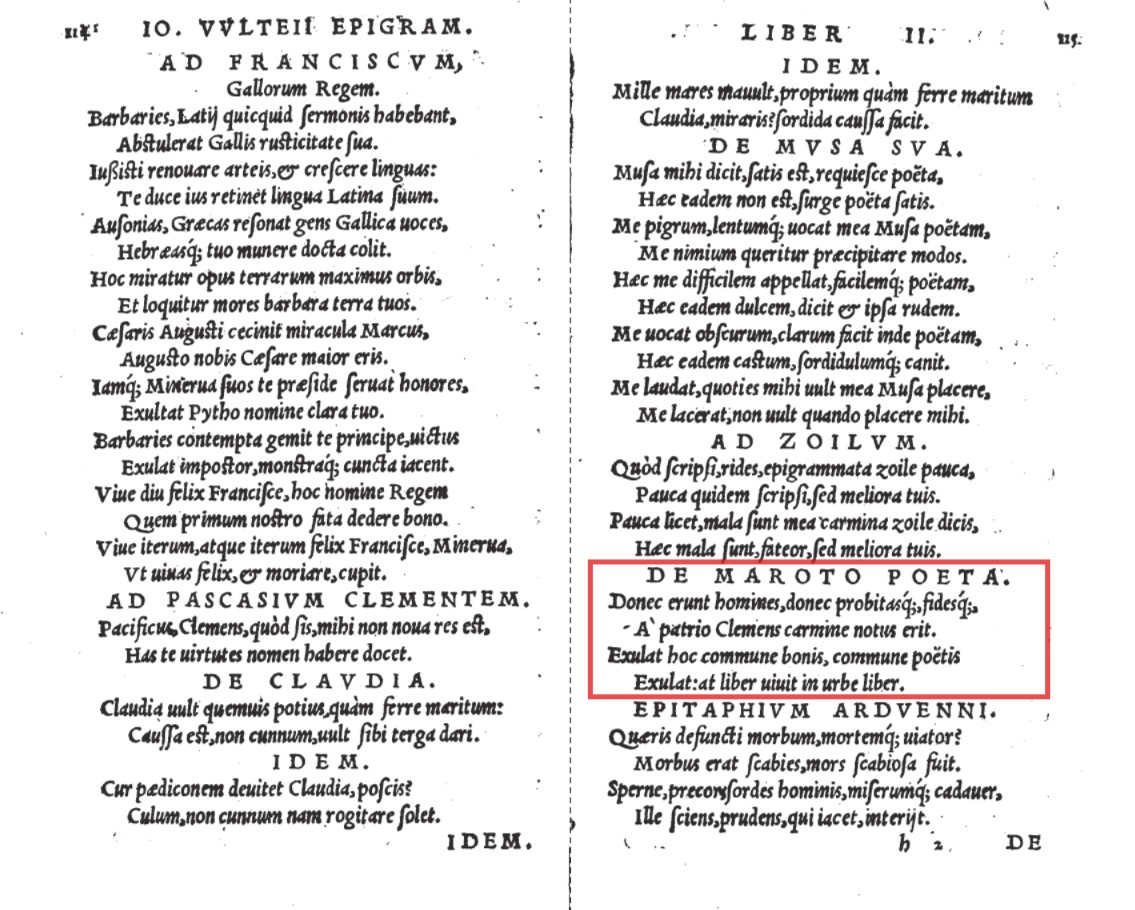
DE MAROTO POETA.
Donec erunt homines, donec probitasque, fidesque,
A patrio Clemens carmine notus erit.
Exulat hoc commune bonis, commune poetis
Exulat: at liber vivit in urbe liber.
ON
THE POET MAROT.
As long as there are men, as long as honesty and faith endure,
Clément will be renowned for his songs in the mother tongue.
This exile is one shared by good men, shared by poets —
an exile: yet his book lives on, in the
city, circulating freely.
NOTES:
The repeated Exulat at the start of line 4 picks up
and completes line 3:
- an exile common to good men:
many 'honorable' men were forced to live in exile, non only in France, after the Affaire
de placards but 'generally, thus universalising
Marot's fate.
- an exile common to poets
as well: A humanist scholar (the
'intended reader' of Visagier's epigrams) will immediately think of Ovidius
who was banned by his beloved Emperor.
The turn — at liber vivit in urbe
liber — with a liber
| liber pun ("free
man" / "book"): though exiled, he lives on free in the city, or his
book lives in the city. Both is possible. NB: "liber" can not be taken with "urbe"
(feminine, would be 'in urbe libera')
BTW: Marot's Epistles send from Ferrara to France, also often use this 'topos'. In it he translates/emulates Ovid's Latin exile-letters (Tristia, ex Ponto). The most famous: the 1535 Épître au roy, du temps de son exil à Ferrare (1535), a literary masterpiece, a brilliant plea to be allowed to return.
p. 121-122 to Renée de Ferrara
Marot found shelter at this Italian court (1534-december 1536).
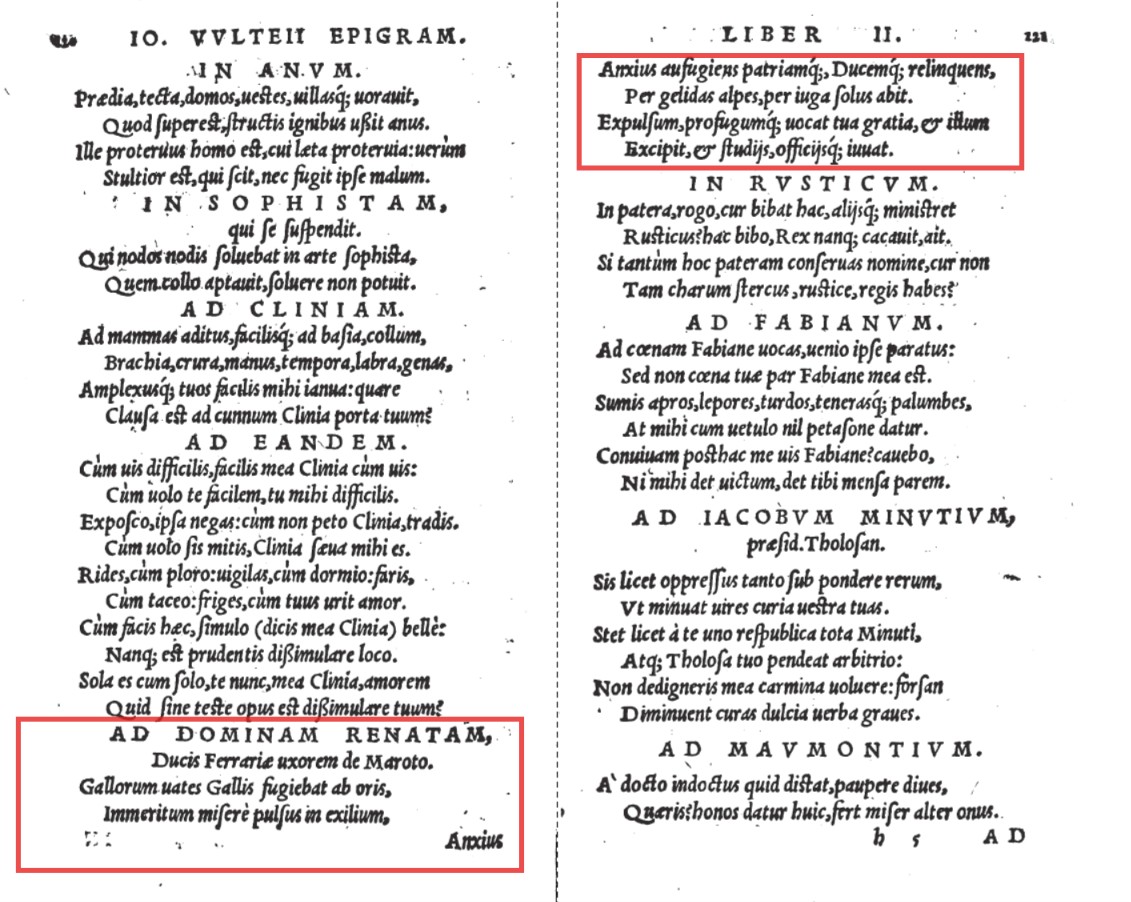
AD DOMINAM RENATAM,
Ducis Ferrariae uxorem de Maroto.
Gallorum vates Gallis fugiebat ab oris,
Immeritum misere pulsus in exilium,
Anxius aufugiens patriamque, Ducemque relinquens,
Per gelidas Alpes, per juga solus abit.
Expulsum, profugumque vocat tua gratia, et illum
Excipit, et studiis, officiisque juvat.
To My Lady Renée,
wife of the Duke of Ferrara, concerning Marot.
The bard of the Gauls was fleeing from the shores of Gaul,
driven, undeserving, wretchedly into exile;
anxiously fleeing, leaving behind both fatherland and Duke,
alone he departs over the frozen Alps, over the mountain ridges.
Him — cast out and a fugitive — your grace calls to you, and welcomes
him, and aids him with your zeal and your kind offices.
NOTES: "ab oris" (from the shores) evokes the beginning of Vergilius's Aeneaide (arma virumque cano, Troiae qui primus ab oris / Italiam, fato profugus..., " - sing of arms and the man, who first from the shores of Troy, exiled by fate, came to Italy...). King Francis is called 'Dux', evoking the 'Duke' of Ferrara'. In his own exile poetry, Marot suggests that serving Renée (and her husband) was not a break in his service to the King. The crossing of the Alps (remember Hannibal) also standard imagery to underline the heroic/epic character of a journey into Italy. The last line is factual.
p. 126-128 Letter to Cardinal Jean du Bellay (pleading Marot's case, including a Lament by Marot)
AD IOANNEM BELLAIUM, CARD. AMPLISS. inducitur MAROTUS querens de exilio.
Hei mihi quàm varios peperit fortuna dolores,
Quàm levis instabili vertitur illa gradu.
Ille ego, qui placido FRANCISCVM carmine Regem
Pascebam, insuetum cogor adire locum.
Nunc Dominum iubeor, patriámque relinquere vates,
Nunc iubeor
vitae taedia dura pati.
[...]
Translation:
Ah me, what varied griefs fortune has
brought forth,
how fickle she is, turning on her unsteady step.
I, that very man who once fed King Francis
with soothing song, am now forced to approach an unaccustomed place.
Now I, a poet, am ordered to leave my lord and my fatherland,
now I am ordered to endure the harsh weariness of life.
[...the poem continues for two pages]
Here too the literary frame is Ovidian
— this is Marot speaking in the voice of the exiled Ovid of the Tristia
and Ex Ponto, also perused by the 'real Marot' in his
Letters from exile (to Francis I), not only in
1535, but also during his second volontary (?) exile in 1543.
Ille ego qui is a famous tag (Odysseus/Aeneas), and the
self-identification "I, that man who once did X, am now reduced to Y"
is the characteristic exilic posture. Fortuna with her
turning, unstable step (instabili... gradu, the wheel/rota
Fortunae) and the litany of taedia and dolores are
pure Tristia-register: the poet who once enjoyed royal favor now
laments a reversal that has cast him into an alien place.
p. 128-129 two epigrams 'in voce Maroti'
After a short epigram (off-topic) Visagier returns pleading Marot's case, again introducing the 'viva vox Maroti'. - prosopopeia
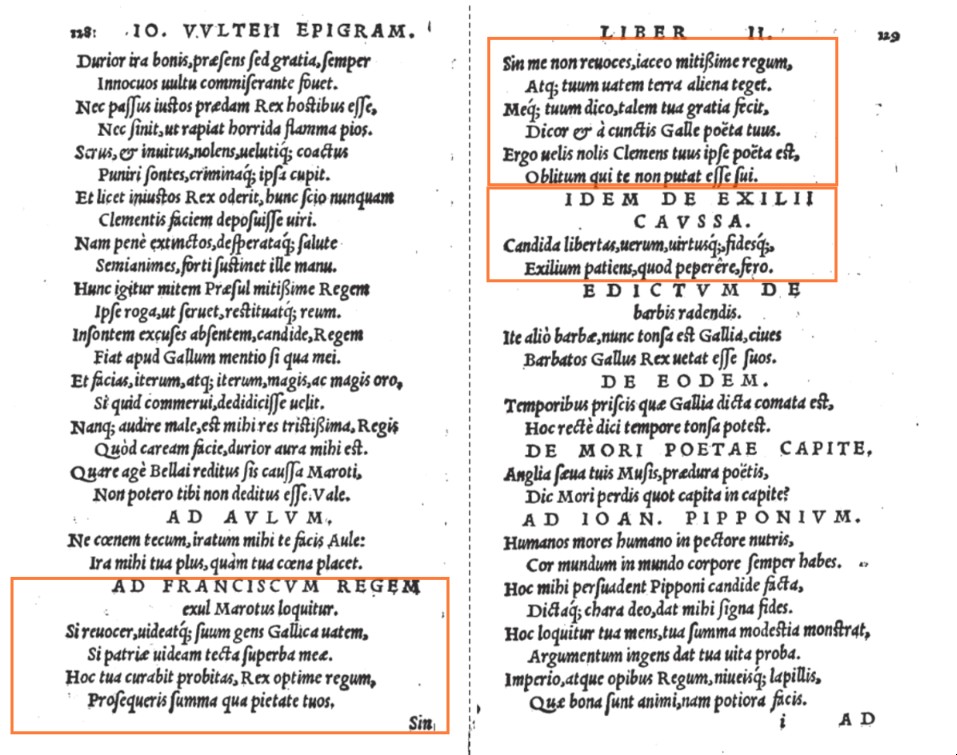
Translation:
AD FRANCISCVM REGEM, exul Marotus loquitur (Marot in exile speaks to King Francis)
Si revocer, videatque suum gens Gallica vatem,
Si patriæ videam tecta superba meæ.
Hoc tua curabit probitas, Rex optime regum,
Prosequeris summa qua pietate tuos,
Sin me non revoces, iaceo mitissime regum,
Atque tuum vatem terra aliena teget.
Meque tuum dico, talem tua gratia fecit,
Dicor & à cunctis Galle poëta tuus.
Ergo velis nolis Clemens tuus ipse poëta est,
Oblitum qui te non putat esse sui.
Translation:
If I should be recalled, so that I may
see my own people, the people of Gaul,
so that I may see my fatherland, the proud roofs of my home —
this your goodness will see to, O king, best of kings,
you who attend to your own with the highest devotion.
But if you do not recall me, I lie prostrate, gentlest of kings,
and a foreign land will cover your poet.
And I say "yours" — your grace has made me such;
by all men I am called the poet of Gaul.
Therefore, like it or not, Clément is your own poet —
he who will not believe that you've forgotten him.
IDEM DE EXILII CAVSSA (The same [poet], on the cause of his exile):
Candida libertas,
verum, virtusque, fidesque
Exilium patiens, quod peperêre, fero.
Translation:
Pure liberty,
truth, virtue, and faith —
I bear the exile which they brought forth.
The very qualities named in the first line are the cause of his banishment (cf. the first epigram). Most impressive, however, is his personal Epistle to the King
p. 131-2 To King Francis, concerning Marot
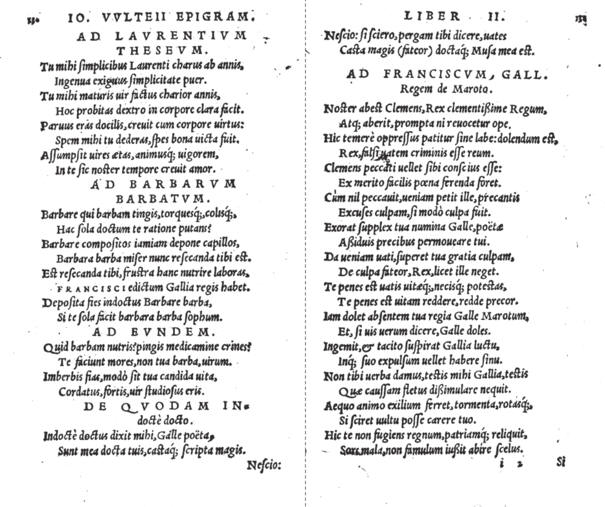
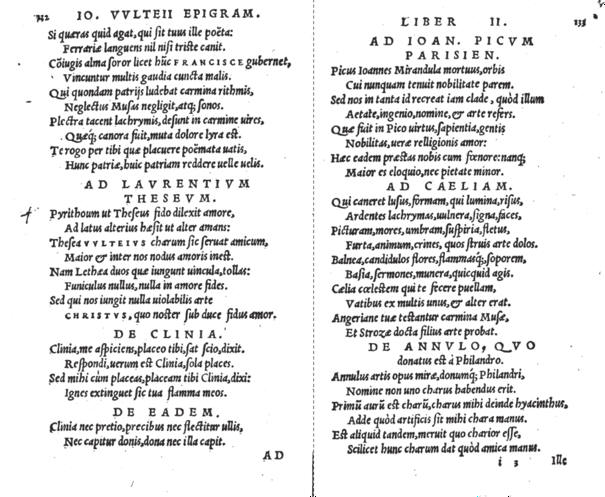
Unlike the previous poems where Visagier wrote in the voice of Marot, here Visagier speaks in his own voice, addressing King Francis I (Franciscus) directly to beg for his friend's royal pardon.
AD FRANCISCVM, GALL. Regem de Maroto.
Noster abest Clemens, Rex clementissime Regum,
Atque aberit, prompta ni reuocetur ope.
Hic temerè oppressus patitur sine labe: dolendum est,
Rex, falsi uatem criminis esse reum.
Clemens peccati uellet sibi conscius esse:
Ex merito facilis pœna ferenda foret.
Cùm nil peccauit, ueniam petit ille, precantis
Excuses culpam, si modò culpa fuit.
Exorat supplex tua numina Galle, poëta
Assiduis precibus permoueare tui.
Da ueniam uati, superet tua gratia culpam,
De culpa fateor, Rex, licet ille neget.
Te penes est uatis uitéque, necísque potestas,
Te penes est uitam reddere, redde precor.
Iam dolet absentem tua regia Galle Marotum,
Et, si uis uerum dicere, Galle doles.
Ingemit, & tacito suspirat Gallia luctu,
Inque suo expulsum uellet habere sinu.
Non tibi uerba damus, testis mihi Gallia, testis
Quæ caussam fletus dissimulare nequit.
Aequo animo exilium ferret, tormenta, rotásque,
Si sciret uultu posse carere tuo.
Hic te non fugiens regnum, patriámque reliquit,
Sors mala, non famulum iussit abire scelus.
Si quæras quid agat, qui sit tuus ille poëta:
Ferrariæ languens nil nisi triste canit.
Cõiugis alma soror licet hunc FRANCISCE gubernet,
Vincuntur multis gaudia cuncta malis.
Qui quondam patriis ludebat carmina rithmis,
Neglectus Musas negligit, atque sonos.
Plectra tacent lachrymis, desunt in carmine uires,
Quæque canora fuit, muta dolore lyra est.
Te rogo per tibi quæ placuere poëmata uatis,
Hunc patriæ, huic patriam reddere uelle uelis.
English Translation
To Francis, King of France, concerning Marot.
Our Clément is absent, O most clement King of kings, and he will remain absent unless he is recalled by your prompt help.
Rashly oppressed, he suffers without stain of guilt; it is a cause for grief, O King, that a poet stands accused of a false crime.
Clément would almost wish to be conscious of some sin, for then a light punishment would be easy to bear according to his desert.
Since he has sinned in nothing, he begs for pardon; may you excuse the fault of the petitioner, if indeed there even was a fault.
Suppliant, your French poet entreats your divine majesty, praying that you may be deeply moved by the constant prayers of your servant.
Grant pardon to the poet, let your grace overcome the fault—I myself confess to a fault, O King, even if he denies it.
Within your hands lies the power of the poet's life and death; within your hands it is to restore his life—restore it, I pray!
Already your royal court, O Frenchman, grieves for the absent Marot, and if you are willing to speak the truth, Sire, you yourself grieve.
France groans and sighs with silent mourning, and wishes she could hold the exiled man in her own bosom.
We are not deceiving you with words; France is my witness—a witness who cannot conceal the reason for her weeping.
With an equal mind he would bear exile, tortures, and the breaking wheels, if only he knew how to endure being deprived of your countenance.
He did not leave your kingdom and his fatherland in flight from you; a cruel fate, not a crime, ordered your servant to depart.
(page 132) If you should ask what he is doing, he who is your definitive poet: languishing in Ferrara, he sings of nothing but sorrow.
Although the nurturing sister of your wife [Renée de France], O Francis, protects him there, all joys are utterly overwhelmed by his many misfortunes.
He who once played with poetry in his native French meters, now neglected, neglects the Muses and his melodies.
His plectrums are silent because of tears, strength is lacking in his song, and the lyre that was once so tuneful is now mute with grief.
I beg you, by the poems of this poet which once pleased you: please choose to restore him to his fatherland, and his fatherland to him.
After Marot's return, new poems follow and celebrate his home-coming. We are in BOOK III now. Two examples (both on p. 192)
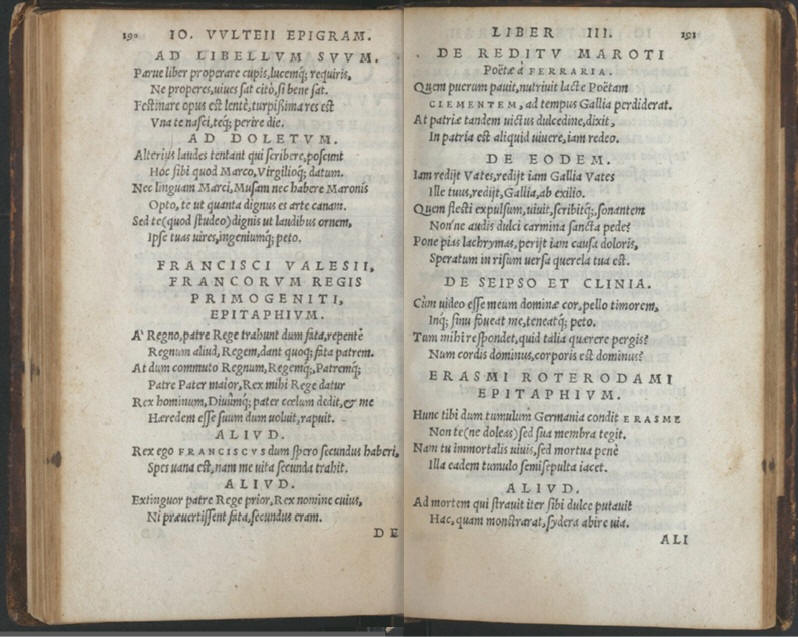
p. 192 DE REDITV MAROTI Poëtæ à Ferraria
Quem puerum pavit, nutrivit lacte Poëtam
CLEMENTEM, ad tempus Gallia perdiderat.
At patriæ tandem victus dulcedine, dixit,
In patria est aliquid vivere, iam redeo.
On the return of Marot, the poet, from Ferrara
Gaul had for a time lost Clement, whom she fed (pavit <
perf. pasco) as a boy and nourished as a poet with her
milk.
Yet, conquered at last by the sweetness of his fatherland, he said:
"There is something [worthwhile] in living in one's fatherland — now
I return."
DE EODEM
Iam rediît Vates, rediît iam Gallia Vates
Ille tuus, rediît, Gallia, ab exilio.
Quem flecti expulsum, vivit, scribitq́ue, sonantem
Nonne audis dulci carmina sancta pede?
Pone pias lachrymas, periît iam causa doloris,
Speratum in risum versa querela tua est.
On the same
Now the bard has returned, now that bard of yours, O Gaul, has
returned —
returned, Gaul, from exile.
He whom you wept over when he was driven out lives and writes;
do you not hear his sacred songs sounding on sweet metrical foot?
Set aside your devoted tears, the cause of grief has now perished,
your lament is turned into the laughter you hoped for.
A reference to Marot's Psalm poems (carmina sancta), at least that's how I hear this.
2026, Dick Wursten