Orphée / Orpheus / Apollinaire
Apollo's bard |Apollo's mythische zanger

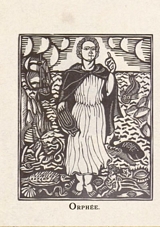
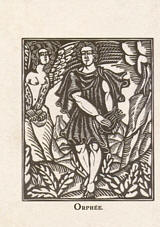
The Bestiaire ou Cortège d'Orphée (Bestiary, or Orpheus’ Parade) contains — next to 26 animal emblemata — four woodcuts of Orpheus. Typographically they are set apart: they are the only ones that get a page of their own, the poem printed on the facing page. Apollinaire was fascinated by the world of myths and legends—not in an antiquarian sense, but as a symbolic language that still has the potential to describe the human condition and the importance of art (as a transformative force). Orpheus himself introduces each of the four sections.

In Apollinaire’s le Bestiaire, ou Cortège d’Orphée staat Orpheus centraal, de mythische dichter die de natuur met zijn zang aan zich onderwerpt. Naast 26 dieren, zijn er ook vier gravures van Orpheus voorzien (elk met een eigen gedicht). Apollinaire was gefascineerd door de wereld van de mythen en sagen. Niet antiquarisch, maar als beeldtaal die nog steeds de potentie heeft om de condition humaine te beschrijven én het belang van de kunst (als transformerende kracht). Orpheus leidt zelf de vier secties in.
Orpheus’ parade
Apollinaire and Dufy's Le Bestiaire ou Cortège d'Orphée was published in 1911 as a luxury edition of 120 copies. It contains thirty poems: four on Orpheus and twenty-six 'animals', in four sections: land animals (11), insects (4), water creatures (5) and winged beings (6).
Each section is opened by Orpheus, with a full-page woodcut. In these poems Apollinaire confesses his ‘orphic’ view on the transformative potential of Art. The first Orpheus poem – in principio erat – refers to Hermes Trismegistus (the father of Hermetism). In the accompanying note Apollinaire pays tribute to the visual arts, where the 'light' has a voice, is the creative logos. The second Orpheus invites us to look at the swarming crowd of rotifers, mites, insects and microbes; then come caterpillar, fly, flea and grasshopper. The third goes fishing in the world of water, where he of course also meets Christ, ichtus. The fourth warns against the Sirens, accursed birds, and sets the guardian angels of paradise against them.
Beginning and end are telling. La Tortue, the first emblem, introduces the lyre, Orpheus' attribute par excellence, his magic wand. The last animal, Le Bœuf, is not an ox but the cherub who sings the praise of paradise. The parade thus leads from the lyre to heaven.
The arrangement is meaningful, not zoological: the sirens and the ox are placed among the winged. The animals are legendary; they are reading instructions for Apollinaire's poetry.
The title says as much: a cortège is a procession in a fixed order. Eighteen of the poems had already appeared in 1908 in the review La Phalange, as La Marchande des quatre saisons ou le bestiaire mondain. For the book of 1911 twelve were added, the marchande made way for Orpheus, and the whole received its title and its four Orpheus pages.
De stoet van Orpheus
Le Bestiaire ou Cortège d'Orphée van Apollinaire en Dufy verscheen in 1911 als luxe-uitgave in 120 exemplaren. Het telt dertig gedichten: vier over Orpheus en zesentwintig 'dieren', in vier afdelingen: landdieren (11), insecten (4), waterdieren (5) en gevleugelden (6).
Elke afdeling wordt geopend door Orpheus, met een paginagrote houtsnede. De eerste Orpheus roept - middels het er tegenover geplaatste gedicht - het corpus hermeticum op, waarin de beeldende kunst wordt gelijkgesteld met 'logos' die uit het eerste licht wordt geboren, waarna de 'schildpad' als orpharion wordt bezongen: de dood-overwinnende kracht van het lied/gedicht. De tweede Orpheus roept op te kijken naar het krioelende volkje van raderdiertjes, mijten, insecten en microben; daarna komen rups, vlieg, vlo en sprinkhaan. De derde gaat vissen in de waterwereld. De vierde waarschuwt voor de Sirenen, vervloekte vogels, en stelt daar de engelen van het paradijs tegenover.
Niet alleen het eerste dier (La Tortue, de lier, Orpheus' toverstaf), maar ook het laatste dier is veelzeggend: Le Bœuf. Geen os, maar de cherub, die het paradijs bezingt. De stoet schrijdt is dus een pilgrim's progress per poesia. De indeling is dus betekenisvol, niet zozeer zoölogisch, maar symbolisch: de sirenen en de os staan bij de gevleugelden. De dieren zijn legendarisch en met de gedichten erbij emblemata; leesaanwijzingen voor Apollinaire's visie op kunst in het algemeen, en (zijn) poëzie in het bijzonder.
De titel zegt het zelf: een cortège is een stoet in vaste volgorde. Achttien gedichten waren al in 1908 verschenen in het tijdschrift La Phalange, als La Marchande des quatre saisons ou le bestiaire mondain. Voor het boek van 1911 kwamen er twaalf bij, maakte de marchande plaats voor Orpheus, en kreeg het geheel zijn titel en zijn vier Orpheus-bladzijden.
See also: Noémie Delbecque, « Le Bestiaire ou Cortège d’Orphée de Guillaume Apollinaire. Une réécriture du mythe d’Orphée à travers un dialogue entre poésie et gravure », Folia Electronica Classica 44 (juillet-décembre 2022).