← Antwerp Polyglot · Nederlandse versie
Context · Plantin and religion
Plantin and the Genevan Psalter, 1564
In 1564 Plantin printed the complete psalter of Marot and
Bèze, with the Genevan melodies: Les Pseaumes de David, mis en rime
françoise. The edition had ecclesiastical approval (Schellinck)
and a printing privilege from the Council of Brabant. From October it
was on the market. All in order, then, but … within six weeks of the
start of sales the stock was withdrawn from the trade and burned.
Howard Slenk reconstructed the whole process in 1967 and
published the chronology from (and with) the sources, in particular
Plantin's ledger and journal (accessible in the Museum
Plantin-Moretus). A remarkable achievement, and fascinating: one can
follow the production almost day by day.
But Slenk also believed he had discovered two things. First,
that Plantin falsified his accounts (‘3000’ changed into ‘1500’) to
mislead the authorities, so that half of the print run stayed out of
sight and could be sold later after all. Second, that Plantin printed
the last sheet in two versions: one with a Latin index of first lines
and errata, for the general market, and one with the table of the
psalms as they were sung week by week in Geneva, for the Calvinist
buyer. Léon Voet already raised serious doubts about
this in 1980–1983 (The Plantin Press), but the story is still
going round.
Hence this page. We test both theses again, against
the sources. With thanks to the bibliographical research of Slenk, of
Léon Voet (now also revised online by Kristof Selleslach and Zanna Van
Loon of the Museum Plantin-Moretus), to the recent bibliography of all
French metrical psalters by Noailly, Candaux and Chambers (2022), and
to Denis Pallier's survey of Plantin's Paris network (2020). The Geneva
copy (in particular the table at the end) was examined and described
by Thierry Dubois (curator, Bibliothèque de Genève).
1. The book
- Title
- Les Pseaumes de David, mis en rime francoise. Antwerp: Christophe Plantin, 1564.
- Collation
- A–Z8 Aa–Ee8 []4; 228 leaves, pp. [1–456] (BPIVF); thus in all complete copies (see 4).
- Format
- 24°. BPIVF and USTC 15416 give 32°; the accounts (‘in 24’, 19 half-sheets of 12 leaves each) confirm 24° (Voet).
- Contents
- A1r: title; under the title the motto ‘Isaie XLII. Chantez au
Seigneur …’, printer's device, ‘avec privilege’.
A1v: Le contenu du Privilege (signed I. Fabri).
A2r: A tous chrestiens: De l'utilité des Pseaumes: two fragments from Marot's dedicatory poems in his psalm editions of 1541 and 1543, ‘O gentils cœurs, & ames amoureuses’ and ‘O bien-heureux qui voir pourra’.
A2v–Ee4r: the 150 psalms, each with Latin incipit, French summary (argument) and the melody with the first stanza; Ee4r ‘Fin des Pseaumes’.
Ee4v–Ee5v: Les commandemens de Dieu; Le cantique de Simeon.
Then the tables: French table, Latin index, errata, approbation on the recto of the last unnumbered page (see 4). - Print run
- 3,000 copies (see 3).
- Copies
- 9 (BPIVF): Antwerp, MPM, R 51.32 (variant A); Boston University, EBR uncat (formerly Zion Research Library, Brookline); Geneva, BGE, Cth 2156 (formerly Bb 667; variant D); The Hague, KB, 1 E 18 and 144 F 24 / 1785 E 5; Lincoln, Cathedral Chapter Library, B450; London, British Library, 3091.de.3 (variant B; Google Books); Paris, Bibliothèque de l'Arsenal, 8° T 939; Paris, BnF, Rés. A 6172. Slenk and Voet knew seven; Lincoln and the Arsenal are new. BPIVF did not see the Lincoln copy; the other copies BPIVF describes without deviation are complete (C).
- Descriptions
- Voet, no. 722; BPIVF 1564/03; Bovet I/63; Douen 132; Goovaerts 170; Pidoux 64/I; Bibles-Paris 2419; FB 4996–4999; USTC 15416 and 60968–60970 (after BPIVF). Voet also gives Ruelens–De Backer, p. 38 (1564, no. 12); Bibliotheca catholica Neerlandica impressa, no. 2900; Belgica typographica 5221. Full titles in the bibliography.
2. Chronology and context
Marot's psalm paraphrases were already very popular before the first official edition of the Trente Pseaulmes de David (Paris, Roffet, 1541). They circulated in manuscript and had already been printed in part clandestinely (among others in Antwerp, by Antoine des Gois, 1541). The texts were used as the basis for polyphonic chansons spirituelles. Via Strasbourg and Geneva they became at the same time the basis of the Genevan liturgical hymnbook, in which each psalm received its own melody. This psalter (the ‘Huguenot Psalter’) came into being in stages between 1543 and 1562, with a preliminary stage in 1539–1542. Until 1551 it contained only Marot's Cinquante Pseaumes. Then Théodore de Bèze added 34 (Pseaumes octantetrois), and later another six. These editions too were sold throughout France; their popularity transcended the rapidly growing confessional divide. In 1561 Bèze completed the paraphrase, and Maître Pierre (most probably magister Pierre Davantès) supplied the missing melodies (Pidoux; Wursten). With the permission of the Council of Geneva, Bèze and the printer Antoine Vincent sought to obtain a privilege to publish the complete psalter in France.
- 16 October 1561. During the political détente around the Colloquy of Poissy, Théodore de Bèze obtains for his paraphrase/translation of the last sixty psalms the approval of the Paris doctors of theology, followed by a royal printing privilege for ten years, ‘pour Antoine, fils d'Antoine Vincent, libraire de nostre ville de Lyon’ (Guillo, Pidoux).
- 18 December 1561. In the Low Countries: placard (Valenciennes) prohibiting the public singing of psalms.
- 1562. The complete French psalter appears, printed in
three centres under the Vincents' privilege (Guillo, Pidoux):
- Geneva: a ‘communion’ of more than fifteen printers, who pay 7% of their printing costs to the Bourse des Pauvres; more than twelve editions, together perhaps more than 30,000 copies, also for export to France and ‘les Flandres’.
- Paris: a communion on the same model, ‘sous les directives d'Antoine I Vincent’, brought together by Jacques Danès; the contract (26 February 1562; Minutier central LXXIII, 55) names nineteen Paris printers, who pay 8% of their printing costs for the poor relief of the Paris église réformée. Plantin's Paris associate Martin Le Jeune prints an edition ‘pour Anthoine Vincent’ (BPIVF 1562/34), but is not among the nineteen (Pidoux II, pp. 129–130).
- Lyon: some fifteen editions ‘pour A. Vincent’; a communion has not been demonstrated there.
- 1562–1563. Plantin lives in Paris, ‘in 1562 and part of 1563’ (Voet, no. 722, n. 3).
- 9 October 1563. Antoine Vincent declares in Antwerp that he has received 54 livres 1 sol 6 deniers, from the proceeds of the sale of Plantin's goods (1562) and as payment for books Plantin had bought from him in 1561 (Arch. XCVII, p. 104; Slenk, p. 228).
- May–June 1564. Plantin applies for a privilege for ‘alle
die salmen van David metten notelen’ (all the psalms of David with
the notes), in Dutch and in French, invoking earlier approvals (see
6). Schellinck approves the Dutch psalms in
May, the French on 16 June. Privilege of the Council of Brabant,
probably 26 June (see 5).
Plantin never published a Dutch psalter. What the Dutch approval referred to, the privilege does not say; as a precedent it cites the psalms with notes of Simon Cock (probably the Souterliedekens). It cannot be Datheen: his paraphrase was not yet finished (preface dated 25 March 1566, Frankenthal; first edition Heidelberg, Michael Schirat, 1566; in France Rouen, A. Clemence, 1567). The psalms of Jan Utenhove (of Ghent), then? By 1561, 100 of his psalms had appeared in print (in England).
- 24 June – 28 August 1564. The psalter is printed, sheets 1–19 (Grand livre). The censor's copy (A) has sheet 19 in this first printing.
- 10 September 1564. Plantin sells to Jehan Lescallier, bookseller in Mons, ‘6 Psalmes re bas in 24° Lyon’: six French psalters in 24mo from Lyon, bound in sheepskin (relié basane). Which edition, the entry does not say (Arch. XXXIX, fol. 18v; Slenk, n. 12).
- 2, 9 and 30 September 1564. Sheets 16 and 17, sheet 18 and sheet 19 (‘où est la table’) are printed again (Journal).
- 22 September 1564. Second approval by Schellinck, after reading the printed book (A).
- 1 October 1564. Sales begin. Up to 9 November, 481 copies in the register of sales to booksellers, on average 3 stuivers apiece; 25 to Pierre Haultin in Paris.
- 13 October 1564. 24 copies to Pierre de la Tombe, bookseller at the court in Brussels.
- Early November 1564. Margaret summons the chancellor of Brabant. He summons Plantin, forbids him to print and distribute the book and orders him to have all copies burned, including ‘tous exemplaires qu'il en pourroit encoires avoir envoyé et distribué’ (Margaret to Philip II, 30 November; Slenk, appendix G). In detail in 7.
- 6 November 1564. Margaret sends a copy to the theological faculty of Louvain, with Schellinck's written defence. The copies have by then already been removed from the printer: ‘qui nous a meu aussy de faire retirer de l'imprimeur tous les exemplaires’. Louvain is to say whether the text contains ‘aulcune erreur ou aultre chose contraire à la foy et religion catholicque’, ‘et si, en obmectant lesdicte notes, et sans avoir regard à l'autheur, il se pourroit admectre’ (Slenk, appendix E). The defence and Louvain's answer have not been found.
- 15 November 1564. Viglius van Aytta van Zuichem, president of the Privy Council, to Cardinal Granvelle, who had left the Low Countries in March: ‘l'on a fait retirer et brûler tous les exemplaires restans, et escript aux villes’ (Slenk, appendix F).
- 30 November 1564. Margaret explains to Philip II how she has acted (Slenk, appendix G). 3 February 1565: Philip approves, including ‘l'office que vous avez fait faire en cecy devers le chancellier de Brabant’: ‘le principal venin se sème par Anvers’ (Slenk, n. 36).
Aftermath, 1566–1578
- 2 February 1566. Margaret instructs the margrave of Antwerp to search the bookshops for ‘les psaulmes reveu et corrigé par Theodorius Beza’.
- 1570. Plantin, as architypographus regius, prints the Antwerp index, which includes his own publication: ‘Les Psalmes du Roy et Prophete David en rithme, par Theodore de Beze, & Clement Marot: avec les chants’.
- 21 June 1578. Shipment from Frankfurt to England with psalters (according to Slenk French ones). Slenk reads the entry as ‘Psalmes plantin’, Voet as ‘Psalmes David’. The identification with the psalter of 1564, fourteen years earlier, is doubtful.
3. Printing and print run
3,000 copies were printed. The psalter was printed ‘par demyes feilles, deux ensemble’ (half-sheet imposition). Each sheet of paper was cut in two after printing; the two halves went to two different copies. A ‘sheet’ in the accounts thus yields 12 leaves per copy, and 19 sheets yield the 228 leaves of the psalter. Three reams of paper were used per sheet:
19 sheets × 1,500 sheets of paper = 28,500 sheets
28,500 sheets × 24 leaves (24°) = 684,000 leaves
684,000 leaves ÷ 228 leaves per copy = 3,000 copies
Without half-sheet imposition each copy would have 456 leaves, twice the actual number.
The conclusion of the cost calculation in the Grand livre (Arch. IV, fol. 70; Slenk, appendix C) reads:
Les Pseaumes en 24 imprimes en nombre de 1500 [corrected from 3000] coustent 20 L 13 st 10 d de gros qui sont 124 fl 3 patt. Parquoy me revient la piece piece [sic] a 1 patt mais couste plus de ¾ de 13 fl. sur le tout.
Grand livre, Arch. IV, fol. 70
How ‘3000’ was changed into ‘1500’, Slenk describes in two ways:
In Le grand livre a heavier hand has superimposed the digits 1 and 5 over the first two digits of the original figure, which was 3,000.
Slenk, main text
3000 is crossed out and 1500 written over it.
Slenk, n. 50
Voet says only ‘corrected from 3000’. On fol. 70r the first digit is a thick blot of ink, evidently written over another digit; the 5 is in the same heavier ink, the zeros are lighter. The number is not struck through, but underlined. This fits Slenk's first description, not note 50. What lies under the 1 cannot be read on the photograph.

Slenk read the change as a deliberate falsification to mislead the authorities. Voet sees a mistake:
When correcting, Plantin must have overseen the fact that not the usual method for printing an in 24mo had been used but the ‘imposition by half-sheet’.
Voet, no. 722, n. 6
Who is right: see 8.
The reprint of September
Each ‘sheet’ covers 24 pages per copy: sheet 1 is ‘A et ½ B’, sheet 16 pp. 361–384, sheet 19 pp. 433–456 (Ee8 and []4). According to the Grand livre the book was printed by 28 August, sheet 19 included, still without tables. The Journal then records sheets 16 and 17 (2 September), sheet 18 (9 September) and sheet 19 ‘où est la table’ (30 September). Pp. 361–456 were therefore reset. Why is not known. Slenk thought the reprint concerned one sheet, sheet 19 with the tables.
Voet gives the reprinted sheets as pp. 385–448 and calls gathering Ff a twentieth half-sheet ‘not entered in the accounts’. That is not correct. It is the unsigned gathering []4, the second part of sheet 19; all copies have 228 leaves, exactly the 19 sheets of the accounts.
4. The final gathering: the censor's copy and the definitive printing
Sheet 19 covers pages 433–456: gathering Ee8 (pp. 433–448) and the unsigned gathering []4 (pp. 449–456). It was printed twice: at the end of August without tables, and on 30 September with the table (‘où est la table’, singular). Voet distinguishes four variants (A–D). In fact these are two stages of the printing process: the censor's copy (A), with sheet 19 from the first printing of late August, and the definitive printing (C). Of the definitive printing there are complete copies and copies in which something is missing (London, B) or has been replaced (Geneva, D). Whether the first printing of sheet 19 was a full run or only a proof, the accounts do not say.
| Leaf | Pages | A: censor, August (MPM) | C: definitive printing, September (BnF, Arsenal, KB, Boston) | B: London | D: Geneva |
|---|---|---|---|---|---|
| Ee1–Ee4r | 433–439 | Ps. 147 (end) – Ps. 150; ‘Fin des Pseaumes’ (Ee4r) | |||
| Ee4v–Ee5r | 440–441 | Les commandemens de Dieu | |||
| Ee5v | 442 | Le cantique de Simeon | |||
| Ee6–Ee8 | 443–448 | blank¹ | French table²; ‘FIN.’ on Ee8v | ||
| []1–[]3 | 449–454 | blank | Latin index and errata (pp. [449–451]) | missing | Genevan table³ |
| []4 | 455–456 | blank | printed approbation (p. [455]) | as C | |
¹ On p. [443] Schellinck's handwritten approbation.
² Table des Pseaumes selon l'ordre de l'alphabet: alphabetical
table of the French first lines, with psalm number.
³ Leaves from another psalter; see D under ‘Interpretation’.
Sources for the table: BPIVF 1564/03; Voet; for B also the London copy itself (Google Books: Ee1r signed ‘Ee’, Ee2r–Ee4r ‘Ee 2’ to ‘Ee 4’, Ee5–Ee8 unsigned, after ‘FIN.’ only endleaves); for D see below. Voet gives pp. [449–451] for Latin index and errata together; where one ends and the other begins, none of the descriptions says.
Interpretation
- A is the copy the censor received, with sheet 19 from the first printing. After Le cantique de Simeon the leaves for the tables are blank: Ee6–8 and []1–4, together the ‘seven blank folios’ Slenk saw.
- C is the definitive printing of 30 September, with French table, Latin index, errata and printed approbation. This psalter was sold, in Antwerp and to booksellers elsewhere.
- B is a copy of C without the last gathering (BPIVF: ‘inc. du cahier []’). Ee8 and []4 come from the same half-sheet of twelve leaves: the larger part became gathering Ee, the cut-off piece of four leaves became []4. Elsewhere in the book two such pieces together form one gathering (sheet 1 is ‘A et ½ B’); here it remained on its own and unsigned. Such a loose little gathering at the end could be lost in binding without the book looking incomplete: in B it ends with ‘FIN.’ on Ee8v. Slenk called the copy incomplete.
- D (Geneva, BGE, Cth 2156, formerly Bb 667) is a copy of C
in which []1–3, with the Latin index and the errata, have been
replaced by leaves from another psalter. The descriptions differ:
inc. des f. []1-3, remplacés par 6 p. imprimées signées Y6v-X1r
BPIVF 1564/03
Thierry Dubois (BGE) re-examined the copy:ont été collés 4 feuillets
Pidoux II, p. 140
His description and photographs (e-mails of 16 and 18 November 2026):Le relieur a inséré un cahier de 4 feuillets entre 2 feuillets blancs en collant le premier et le dernier feuillets de ce cahier de 4 à ces deux feuillets blancs.
Th. Dubois, e-mail, 18 November 2026
- Ee8v: end of the French table, ‘FIN.’, as in all other copies.
- [1]: blank leaf, unnumbered. Paper remains of [2]r° adhere to the verso.
- [2]–X[1]: a gathering of four leaves from another psalter. The
binder placed it between two blank leaves and pasted the first
and the last leaf to them.
- [2]r°: Le cantique de Simeon, heading ‘LVC II. CL. MA.’, with melody and second stanza. The leaf was later detached from [1] and is therefore thin, with a tear halfway down; on the fore-edge side the two still stick together.
- [2]v°–X[1]r°, six pages: Table pour trouuer les Pseaumes selon l'ordre qu'on les chante en l'Eglise de Geneue, tant le Dimanche au matin & soir, que le Ieudi, with the lists for Sunday morning, Sunday evening and Thursday, each ‘après le second coup de la cloche’ and ‘au presche’. Signature ‘X’ on X[1]r°; there are no other signatures.
- X[1]v°: ‘TABLES DES // PSEAUMES DE // David.’, legible only against the light, because a blank leaf is pasted to it. The source psalter thus continued after the Table pour trouuer with the tables.
- []4r°: Plantin's printed approbation (‘Faict à Brusselles le 22. Iour de Septembre 1564 […] I.Schellinc.’); the verso is blank. No stub of []1 is visible.
- A single guard holds the whole together: the first part lies loose at Ee8v/[1], the second is pasted to the endleaf.
Only the approbation, then, belongs to Plantin's book. Someone removed the Latin index and the errata and had the end of another psalter bound in their place, with Plantin's last leaf (the approbation) as support. On Slenk's reading of this copy: see 8.
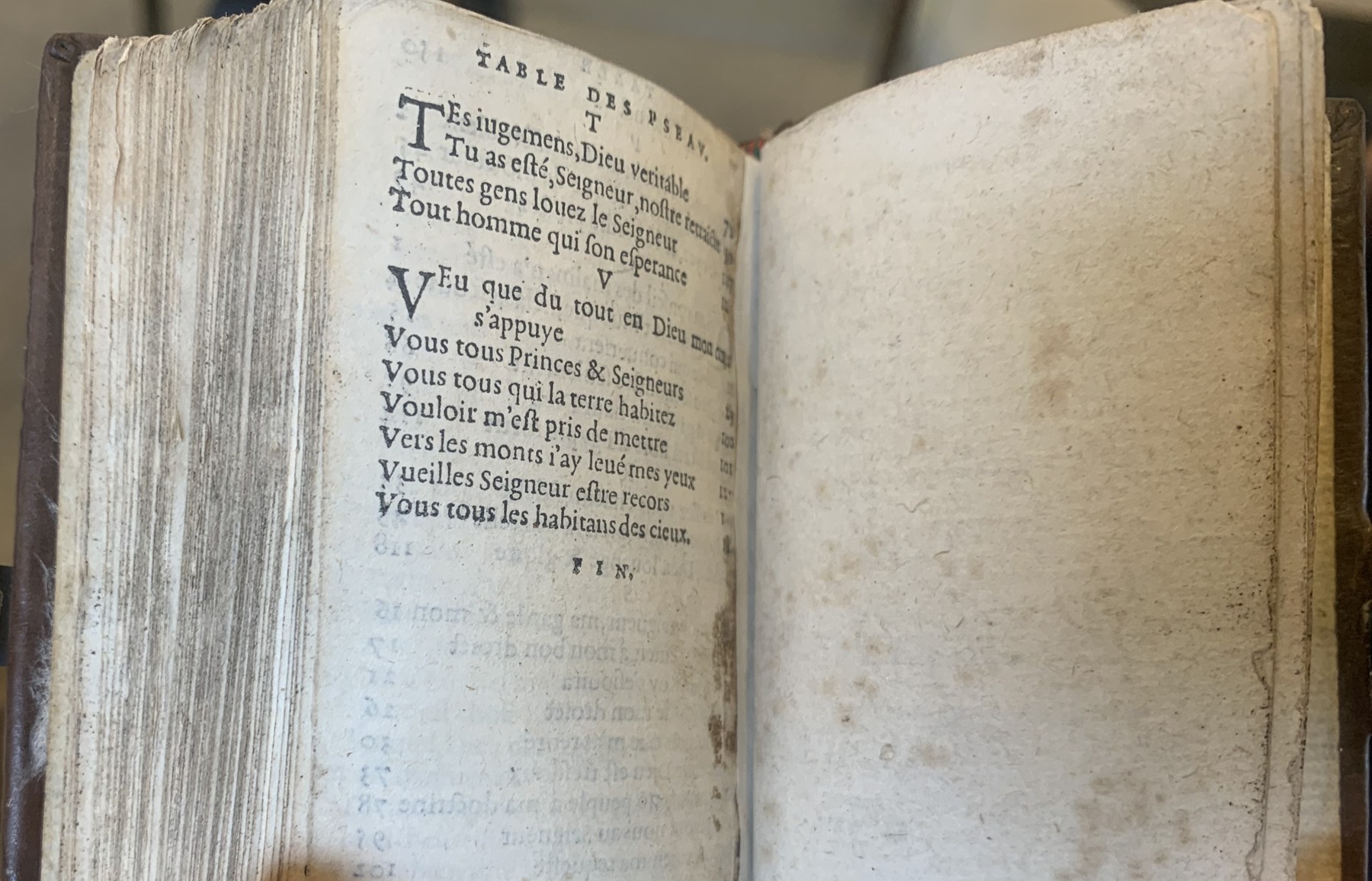
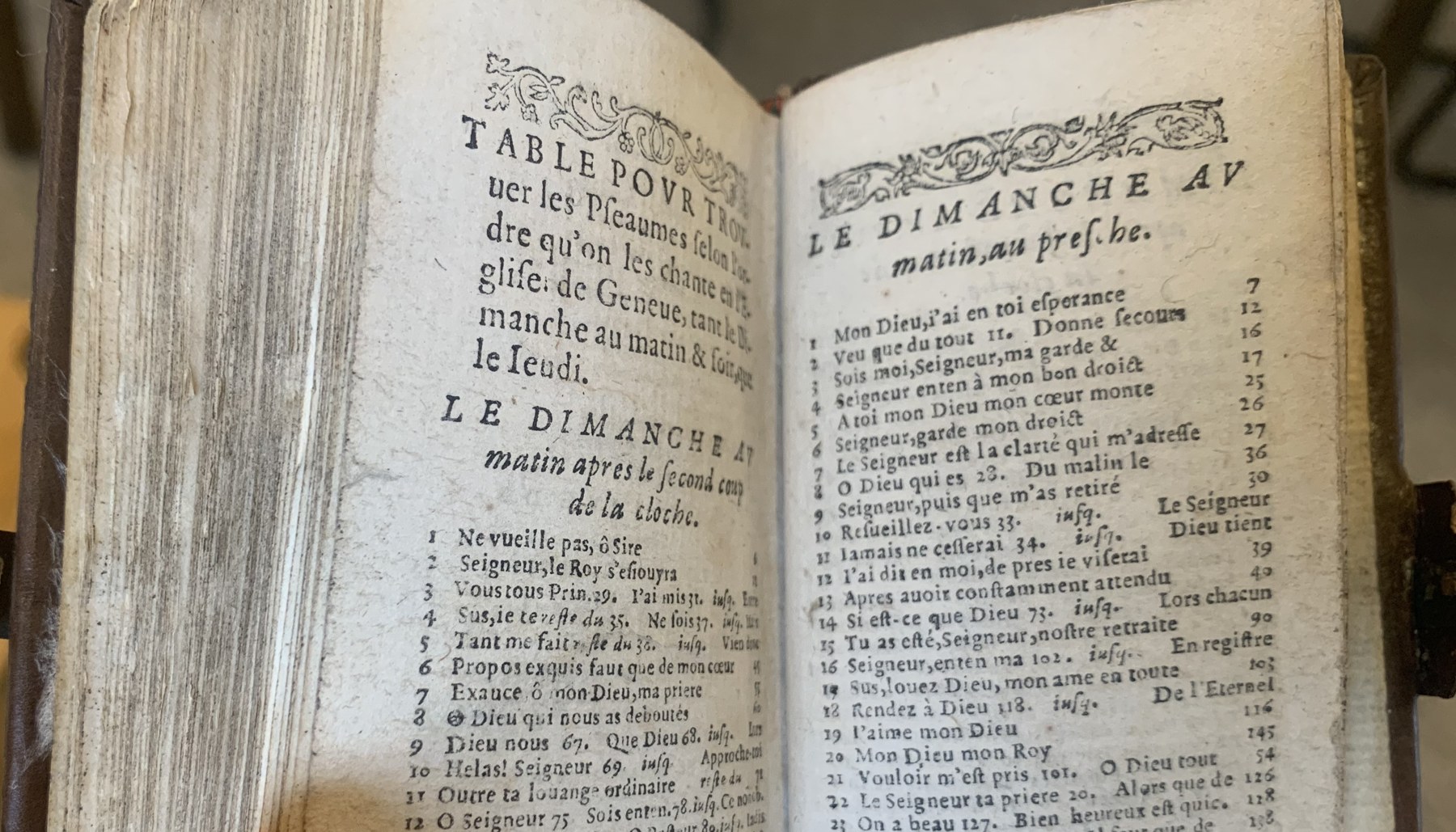
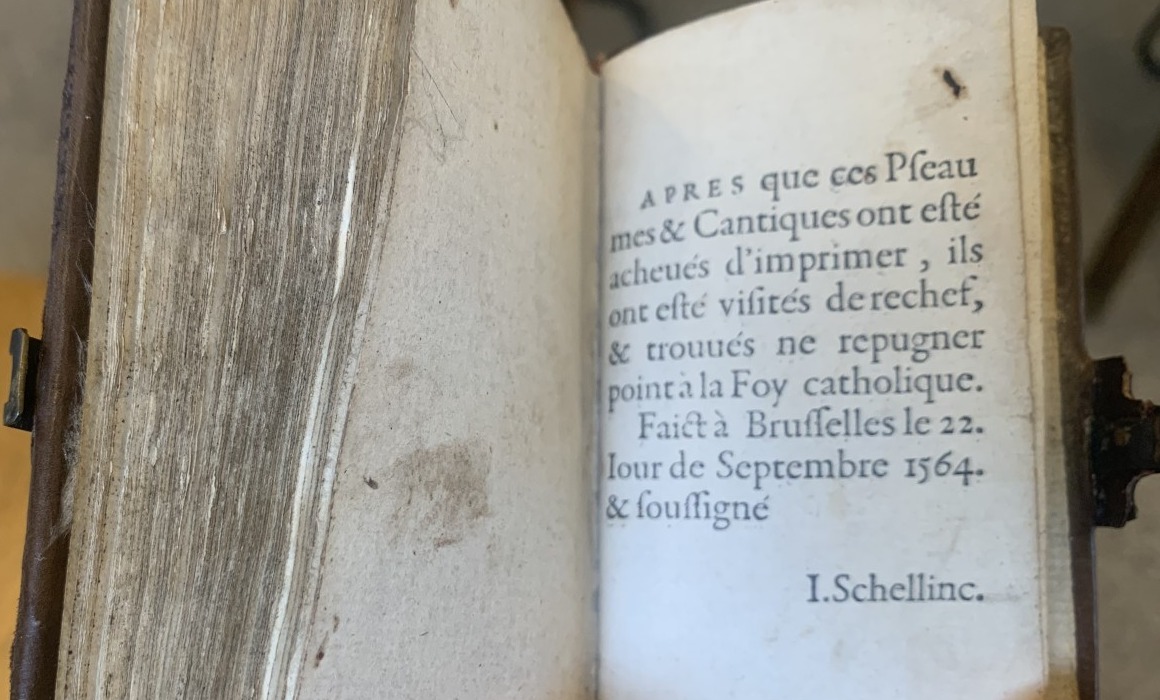
Geneva, Bibliothèque de Genève, Cth 2156. Photographs: Th. Dubois (BGE).
Voet's four variants describe copies, not printings.
5. Plantin's precautions
As described above, the French psalm paraphrases were in great demand in the 1560s, in all layers of society, also in the Low Countries. In France the printing and possession of the psalter had been permitted by church and state in 1562 (approval of the Paris theologians and a royal privilege). In many places in France there were also églises réformées, tolerated or even recognised depending on region and period. They mostly used the Genevan psalter as their liturgical songbook. NB: not always and not everywhere: before 1562 there were already complete French psalters in circulation which had completed the Cinquante Pseaumes independently of Geneva (the forgotten psalters of Paris, Poitiers and Lyon, in Dutch).
In the Low Countries things were quite different. The strict religious placards of 1550 were still in force; there was no room at all for any form of worship other than the Roman Catholic. The Antwerp magistrates preferred to keep the persecution of dissenters moderate, out of sympathy (no doubt) and for the sake of trade (certainly), but open Protestant worship was not tolerated. On 4 October 1564 the former Carmelite Christoffel Smit (Fabricius) was still executed in Antwerp; characteristic of the atmosphere: a riot broke out at the execution. Cardinal Granvelle had left in March 1564, after which the nobles in the Council of State pressed for moderation of the placards. Philip, however, had the decrees of Trent introduced in 1564–65 and in October 1565 refused any relaxation. In short: printing a French psalter in the Low Countries was obvious and at the same time not: there was a market for it, certainly, but the risk was very great.
What was permitted in France had no force of law in the Low Countries. Marot's psalms, as text and as songbook, were still on the index (Wursten, p. 154). And Plantin printed on ‘Brabant soil’ and not for Antoine Vincent. So he had to cover himself.
What is known about Plantin and Vincent (see the chronology, 1561–1563) points to a business relationship between a printer and a supplier. An agreement about the psalter is not known, nor was one necessary: the Vincents' privilege applied in France, not in Brabant, and Plantin applied for and obtained a privilege of his own. Which Antoine Vincent was in Antwerp in 1563, father or son, cannot be said: according to Guillo they used the identical name interchangeably in their business, and the father stayed in Geneva until the spring of 1563. Voet also mentions a possible role for Plantin's Calvinist partners, the Van Bomberghens.
A licence from Vincent
What a licence from Vincent looked like is shown by the deed of 9 July 1563 (Geneva, notary Ragueau): Antoine Vincent the son allows Jehan Darras to print the psalms, only in Metz, with one press, for eight years, without adding or omitting anything, in return for 6⅔% of the costs for the poor of Geneva and a share for those of Metz (Pidoux II, p. 137). For Plantin nothing comparable is known.
How did Plantin cover himself?
- Approval and privilege. Approval by the official censor (16 June), privilege of the Council of Brabant, and a declaration by secular commissioners that the book contained nothing against the Christian faith.
- A notarial copy of the privilege (Arch. CXVI). The original is lost. The copy is dated 26 May 1564, the extract in the psalter 16 June. According to Voet 26 June is the correct date: the notary wrote May for June, and the extract took over the date of the approval. In the MPM copy ‘16’ has been corrected in ink to ‘26’.
- No names. Marot, Bèze and Geneva are named nowhere. As far as I can establish, this is unique: other editions of the time give the names on the title page (‘mis en rime françoise par Clément Marot et Théodore de Bèze’, with variants) and often give above each psalm the name of the versifier, abbreviated, in varying form: CL.MA. or TH.BE.
- A different title motto. Isa. 42:10, ‘Chantez au Seigneur nouueau cantique …’, instead of the usual Ps. 9, ‘Chantez au Seigneur qui habite en Sion …’ (Pidoux II, pp. 139–140). It sounds familiar to the one reader and is unsuspicious to the other.
- No preface by Calvin, no dedicatory poems. From 1542 two lines of editions run side by side. Editions for the French market in general almost always open with Marot's two dedicatory poems, to the king and to the Dames de France, and a dizain to the king. In the liturgical editions, always with the melodies, these are replaced by Calvin's preface, in its definitive version from 1543 in every psalter (Wursten, p. 157). Plantin's edition belongs through the melodies to the liturgical line, but has no preface by Calvin and no dedicatory poems. One remnant is left: after the privilege, under the heading A tous chrestiens: De l'utilité des Pseaumes, which alludes to the title of Calvin's preface, stand two fragments from Marot's dedicatory poems, without attribution.
- A second approval of the printed book, with corrections and a dated approbation at the end.
- Tables also for the catholic (= Christian) reader: a French and a Latin index of first lines, errata and a printed approbation.
6. The censor: Josse Schellinck
Josse Schellinck was ‘portionarius’ of the church of St Nicholas in Brussels. Margaret and Viglius call him ‘curé de Sainct-Nicolas’, Voet ‘prebendary’. He had been appointed by the Council of Brabant to examine books: the Dutch privilege calls him ‘onse ghedeputeerde heeren Joosen Schellinck’, the French extract ‘deputé par le Conseil de Brabant’. He did this work for a long time. According to the privilege he had already approved psalms with notes in 1550: Dutch ones, printed by Simon Cock (probably the Souterliedekens), and French ones, printed by Maarten Nuyts (no copy known). Plantin's application invokes these: such approved texts could be printed by any sworn printer. In 1572 he was still signing an approbation of a Dutch translation of Verepaeus' Enchiridion (Antwerp, Geeraert Smidts, 1574): ‘I. Schellinck Pas. S. Nicolai’ (Het Boek, 2nd series, 30, 1949). He was thus active from at least 1550 to 1572, and remained so after the affair of 1564.
For Plantin's psalter he gave his approval twice: the text on 16 June 1564, and the printed book in September. In his copy (variant A, MPM R 51.32) he wrote on p. [443], the first of the blank leaves:
Visité de rechief et trouvé non repugnant à la foy catholique. I. M. Schellinc
MPM R 51.32, p. [443] (Slenk)
The Grand livre records the gift he received from Plantin, worth 12 guilders:
Item pour present au visitateur 1 Opera Ambrosii et Psalmi in 8° latine Paris et Consideratio in Valdesso
Grand livre, Arch. IV, fol. 70 (Voet)
These are the works of Ambrose, a Latin psalter in 8° and the Considerationi of Juan de Valdés.
In the same copy he made four corrections. Three are in the errata of C; the fourth (Ps. 80) was forgotten there. Nothing was changed in the text itself: sheet 16, with p. [364], had already been reprinted on 2 September, and sheet 19, with the errata, was only printed after the approval.
| Place | Printed (= Geneva 1562) | Correction | Vulgate |
|---|---|---|---|
| p. [238]: Ps. 80 (Vg. 79:5) | Contre la pierre des tiens | Contre la priere des tiens | super orationem servi tui |
| p. [317]: Ps. 106, stanza 16 (v. 29; Vg. 105:29) | Piqué par leurs devotions | Piqué par leurs inventions | in adinventionibus suis |
| p. [354]: Ps. 119, stanza 11, Gimel (v. 21; Vg. 118:21) | Tous orgueilleux tu traites rudement | Tous orgueilleux tu tances rudement | increpasti superbos |
| p. [364]: Ps. 119, stanza 57, Samech (v. 114; Vg. 118:114) | En t'attendant en toute patience | Et ta promesse attens en patience | in verbum tuum supersperavi |
The corrections in Ps. 119 are Bèze's own original readings of 1551. Schellinck may therefore have had to hand an edition of the Genevan psalter of 1551, 1553 or later (Pseaumes octantetrois), or the edition of Bèze's 34 psalms without music recorded by Brunet (Crespin, 1551; no copy known). See also Beza and his psalms on the psalm site (in Dutch).
The correction in Ps. 106 is Schellinck's own (see the PS).
7. The ban
The authorities' objection concerned the melodies, not the text. That is Slenk's most important finding, and the sources leave no doubt about it:
Et, combien que la traduction pourroit estre saine, si a-il semblé que, tant pour les notes de chant y estans adjoustées par ceulx qui se sont séparez de l'Eglise, et que ladicte traduction semble procéder des mesmes autheurs, l'on nous avoit remonstré de point les debvoir tollérer […].
Margaret of Parma to the theological faculty of Louvain, 6 November 1564
[…] le curé de S. Nicolas de ceste ville qui les a visité, et sustient la translation estre bonne, mais des notes dist ne savoir parler.
Viglius to Granvelle, 15 November 1564
Et encoires que ledict curé de St. Nicolas veuille dire n'avoir en ladicte traduction chose d'hérésie […], et combien qu'il n'y eust du mal en icelle, si ne convient-il que l'on use en ce du chant et notes des sectaires.
Margaret of Parma to Philip II, 30 November 1564
Margaret refers in this connection to Tournai and Valenciennes, where people had begun to use ‘desdictes chanteries’. Louvain was also to say whether the book could be admitted without the melodies: ‘en obmectant lesdicte notes, et sans avoir regard à l'autheur’ (6 November).
Plantin's precautions were aimed at the text, and there they held. Against the melody as a confessional marker they were of no help. Plantin suffered a loss, but according to Voet his good faith was never called into question. Schellinck, too, remained in office.
Removal and burning: what the sources say
On the execution of the ban the three letters say the following (see the chronology):
- Who acted. Margaret summoned the chancellor of Brabant; he summoned Plantin (30 November). The order thus went through the chancellor to Plantin himself. According to Viglius the privilege had been granted by councillors ‘sur le rolle’, without the chancellor.
- What was ordered. No more printing and distributing, and ‘faire brusler tous exemplaires qu'il en pourroit encoires avoir envoyé et distribué’ (30 November). According to Margaret's letter, Plantin himself had to have the copies burned, including those already sent. Viglius writes impersonally ‘l'on a fait retirer et brûler’, Philip ‘d'avoir fait brusler’, as if the authorities had done it. Who actually burned the copies, and where, none of the three says. On 6 November the copies had already been ‘retiré de l'imprimeur’. On 15 November Viglius speaks of ‘tous les exemplaires restans’.
- How far the control reached. Letters were written ‘aux villes’; Viglius sent Granvelle a copy of that letter, which has not been found. Philip praises ‘l'office que vous avez fait faire en cecy devers le chancellier de Brabant et ailleurs’. On 2 February 1566 the margrave of Antwerp had to search the bookshops for Bèze's psalms; whether this concerned Plantin's edition, the letter does not say.
One thing is unexplained. The last sale in the register is dated 9 November (Slenk mentions the date, but draws no conclusion from it). On 6 November Margaret wrote that the copies had already been removed from the printer. Either the entry of 9 November is a later booking of an earlier delivery, or Plantin was still selling after the order.
Compare Plantin's censored Vatable Bible (in Dutch).
8. Slenk's two theses
Slenk links two theses. They rest on different evidence and are tested separately here.
8.1 ‘3000’ and ‘1500’: a hidden half of the print run?
Plantin's journal was ‘corrected’ to mislead the authorities into believing that only 1,500 copies of Les Pseaumes de David were printed instead of 3,000. The remaining 1,500 could then be distributed in secret, or hidden until hostility to the book disappeared.
Slenk, conclusion, point 4
Voet is right (see 3):
- ‘1500’ is what you get if you count the reams and reckon one sheet per copy.
- The total cost is 124 guilders 3 stuivers (2,483 stuivers). On the same page stands the price per copy: ‘1 patt’ (1 stuiver). That fits 3,000 copies (0.83 stuiver), not 1,500 (1.65 stuiver). The price was thus calculated when ‘3000’ was written; whoever later wrote ‘1500’ did not adjust it.
- The cost calculation was made afterwards, and the same page mentions the half-sheet imposition and the paper consumption. Anyone reading the page could easily reconstruct the print run. As a way of misleading an inspector the change would achieve little.
Moreover, the thesis presupposes a control that does not occur in the sources (see 7):
- No source gives a number: neither how many were printed, nor how many were burned.
- No source speaks of an examination of Plantin's accounts or of a count of his stock. Slenk writes ‘ordered to destroy his entire production’ and ‘seized and burned’; the letters speak of ‘les exemplaires restans’ and of an order to the printer himself.
There is thus no question of deception, and no 1,500 copies ‘disappeared from the accounts’.
The copies that escaped. Slenk counts 481 copies sold and a shipment of 400 to Lucas I Breyer in Paris: 881 in all. Breyer was, with Martin Le Jeune, Plantin's regular partner in Paris (Le Jeune in the Université, Breyer in the Cité) and before 1566 his intermediary there (Pallier, pp. 19, 99). Slenk concludes: ‘Since 881 copies were sold and 1,500 could have been safely hidden, it seems reasonable to assume that the majority of Plantin's output was not burned.’ The shipment to Breyer is doubtful:
- The sales register has ‘400 Psalterium in 24to’ (Arch. XXXIX; Slenk, n. 37). On the same account, on 4 October, stand ‘24 Pseaumes’ and ‘1 Pseaulmes re[lié] bas[ane]’: the clerk distinguishes Pseaumes from Psalterium, and a Psalterium without indication of language is a Latin psalter. Slenk's counter-example (‘Psalterium flameng’) rather confirms the rule.
- The price proves little: Plantin had a Latin psalter in the same format (Slenk, n. 38).
- The entry bears the year 1565, the previous one does not: ‘Du 25 d'octobre 1565, 400 Psalterium in 24to’. In a running account this points to a new year, a year after the ban. The register Libraires et autres 1564 also contains entries from 1565 elsewhere, for example fol. 86v, 12 April 1565 (Pallier, p. 118, n. 15). Slenk dates the shipment in his text to 25 October 1564 and writes: ‘Perhaps as early as 25 October Plantin heard rumblings of criticism’. There is no source for this.
- Slenk devotes a note (40) to Breyer's Protestantism and names it as his third argument: ‘Lucas Brayer was a Protestant.’ That argument only makes sense if the copies were meant for Calvinists. Thus Slenk links the shipment, without saying so, to his second thesis (8.2). Then they would have had to be 400 copies with the Genevan table. Of that there is no trace.
Slenk's only other evidence for a hidden stock is the entry ‘Psalmes plantin’ in a shipment from Frankfurt to England of 21 June 1578, which Voet reads as ‘Psalmes David’. The identification with the psalter of 1564, fourteen years earlier, is doubtful.
To be checked in the MPM: the entries of October and November in Libraires et autres 1564 (Arch. XXXIX), especially that of 9 November; Breyer's account; and whether the Grand livre or the Journal records the loss after November 1564.
8.2 Two final gatherings for two kinds of buyer?
This last sheet must have been run off with varying contents for the final pages – the Genevan index for Calvinist purchasers, the Latin index for Catholic.
Slenk, main text
Slenk himself saw that the Genevan table had been pasted in (‘True, the index is glued into the book, suggesting later insertion’), but because Schellinck's approbation followed it, he held both indexes to be Plantin prints, on the authority of Hendrik Vervliet:
The make-up and type of the two indices are the same. Mr. H. Vervliet, deputy curator of the Museum Plantin-Moretus and an expert on Plantin types, kindly examined photographs of the Genevan index and assured me that it is a Plantin print.
Slenk, n. 28
(In view of the findings in Geneva I suspect that Vervliet only said that the approbation on the last leaf was Plantin's.)
Voet already doubted it: the leaves were
to all probability […] printed at Geneva, and not at Antwerp.
Voet, no. 722, n. 8
He points to the fleurons and the three small woodcuts, which do not occur in other Plantin prints of those years. The copy itself settles the matter (see 4, D):
- The inserted gathering begins with its own Cantique de Simeon, with ‘CL. MA.’ in the heading. Plantin's Simeon (Ee5v) has only ‘LVC II.’, and Plantin names Marot and Bèze nowhere.
- The gathering was placed by a binder between two blank leaves and fixed into the book with a guard. Only the approbation belongs to Plantin's printing.
- The Journal records the reprint of sheet 19 once: ‘où est la table’, singular.
- None of the described copies contains a Genevan table by Plantin.
On such a table and Genevan singing practice: the Table pour trouver les Pseaumes of 1562 on the psalm site (in Dutch).
Plantin thus put one psalter on the market, with an ending that was neutral and plural at the same time: a French table and an index of the Latin incipits. Readers and singers who were not Protestant-minded, and the authorities, could hardly object to that. Nor did the Latin incipits bother Protestants: Marot put them above the psalms (they were in effect the ‘name’ of the psalm: one said the De profundis or the Miserere), and they disappeared only after the definitive edition. In 1562 editions with and without incipits occur, also in Geneva (e.g. Thomas Courteau, e-rara).
Slenk, Voet and BPIVF compared
| Slenk 1967 | Voet, no. 722 | BPIVF 2022 | |
|---|---|---|---|
| Print run | 3,000 | 3,000 | – |
| ‘3000’ changed into ‘1500’ | deliberate falsification | mistake | – |
| Reprint in September | one sheet | sheets 16–19 | – |
| Format | in 24 (Grand livre) | 24° | 32° |
| Copies | seven | seven | nine (with Lincoln and Arsenal) |
| London copy (B) | incomplete | separate variant | without []4 |
| Genevan table (D) | printed by Plantin (Vervliet) | probably printed in Geneva and added (confirmed: Simeon with ‘CL. MA.’) | []1–3 replaced (Y6v–X1r from another psalter) |
| Censor's copy (A) | ‘seven blank folios’ | ends with Ee6 | Ee6–8 and []1–4 unprinted |
| Fourth correction | not mentioned | Ps. 80, ‘pierre’ → ‘priere’ | – |
| Shipment to Breyer | 400 copies (see 8.1) | not mentioned | – |
| Frankfurt 1578 | ‘Psalmes plantin’; the hidden stock | ‘Psalmes David’; uncertain | – |
| Date of privilege | probably 26 June | 26 June | – |
A dash: not discussed.
Notes
- The references to Arch. XXXIX. Slenk and Pallier refer to the same foliation of the register Libraires et autres 1564 (e.g. fols. 80r–173r).
- Schellinck's copy. Slenk speaks of ‘seven blank folios’ in place of the tables, Voet has the copy end with Ee6. Slenk is right: according to BPIVF Ee6–8 and []1–4 are present and unprinted, seven leaves in all.
- USTC. The USTC has four records for this one edition (15416, 60968, 60969, 60970), with varying descriptions, formats (24° and 32°) and copies listed more than once. They go back to different bibliographies and describe the same edition; BPIVF refers to all four.
- USTC news item. ‘A Prohibited Pocket-Book: Christophe Plantin’s 1564 Genevan Psalter’ (ustc.ac.uk), on the KB copy (1 E 18). The item does not adopt Slenk's thesis on the print run, but contains some inaccuracies: it mentions three surviving copies (KB, BnF, Brookline) where nine are known; a ‘royal privilege’ where the privilege came from the Council of Brabant; and ‘Authorities seized and burned copies in Brussels’, whereas the letters only mention an order to Plantin and name no place.
- Candaux 1986. In his list of printers of the ‘intégrale’ of 1562 Candaux also names ‘Plantin, Christophe (Anvers)’. That is incorrect: there is no Plantin printing of 1562, Plantin is not in Danès's contract, and BPIVF (2022), of which Candaux is co-author, knows only the 1564 edition by Plantin.
- Minor slips in Slenk. He first writes ‘Psalm 108’, later ‘Psalm 106’; it is Ps. 106. In his conclusion (point 4) he names the Journal where the Grand livre is meant.
PS: Schellinck's corrections, exegetically
The three textual corrections set beside the Hebrew, the Septuagint and the Vulgate. For Ps. 119 Bèze's first version (1551) is also given.
1. Ps. 106 (Vg. 105), stanza 16, verses 28–29
A Baal-Peor neantmoins
Tout apres leurs coeurs furent joints
Pour manger des morts les offrandes
Dont en ses indignations
Dieu les frappa de plaies grandes
Piqué par leurs devotions.
| Hebrew | וַיַּכְעִיסוּ בְּמַעַלְלֵיהֶם (‘they provoked him with their deeds’) |
| Septuagint | καὶ παρώξυναν αὐτὸν ἐν τοῖς ἐπιτηδεύμασιν αὐτῶν |
| Vulgate | et irritaverunt eum in adinventionibus suis |
| Bèze 1562 | Piqué par leurs devotions |
| Schellinck | Piqué par leurs inventions |
The Hebrew מַעֲלָלִים means ‘deeds, practices’; the Septuagint has ἐπιτηδεύματα (‘habits, pursuits’), the Vulgate adinventiones (‘inventions, contrivances’). Inventions is the Vulgate word. Bèze's devotions translates from the context, the sacrificial meals for Baal-Peor: cultic acts. In 1564 a Catholic reader could also hear his own piety in the word.
2. Ps. 119 (Vg. 118), stanza 11 (Gimel), verse 21
| Hebrew | גָּעַרְתָּ זֵדִים אֲרוּרִים (‘you rebuke the proud, the accursed’) |
| Septuagint | ἐπετίμησας ὑπερηφάνοις |
| Vulgate | increpasti superbos |
| Bèze 1551 = Schellinck | Tous orgueilleux tu tances rudement |
| Bèze 1562 | Tous orgueilleux tu traites rudement |
גָּעַר, ἐπιτιμάω and increpare mean ‘to rebuke’. That is tancer. Traiter rudement (‘to treat harshly’) is more general.
3. Ps. 119 (Vg. 118), stanza 57 (Samech), verse 114
| Hebrew | סִתְרִי וּמָגִנִּי אָתָּה לִדְבָרְךָ יִחָלְתִּי (‘you are my hiding place and my shield; I wait for your word’) |
| Septuagint | εἰς τὸν λόγον σου ἐπήλπισα |
| Vulgate | in verbum tuum supersperavi |
| Bèze 1551 = Schellinck | Et ta promesse attens en patience |
| Bèze 1562 | En t'attendant en toute patience |
יִחֵל is ‘to wait, to hope’; the object is דְּבָרְךָ, ‘your word’, here the promise. The reading of 1551 renders both. In 1562 God himself is the object of the waiting, and the word disappears.
4. Ps. 80 (Vg. 79), verse 5
A misprint: ‘pierre’ for ‘priere’ (Vulgate super orationem servi tui; Hebrew בִּתְפִלַּת עַמֶּךָ, ‘against the prayer of your people’).
Summary
- The three textual corrections bring the paraphrase closer to the Vulgate.
- In Ps. 119 the Vulgate coincides with the Hebrew. There Schellinck chooses Bèze's own earlier reading.
- In Ps. 106 he replaces Bèze's word with the word of the Vulgate.
- No stanza and no thought disappears: three words or half-lines. That fits Schellinck's judgement that the paraphrase was sound.
Bibliography and archives
- Slenk
- Howard Slenk, ‘Christophe Plantin and the Genevan Psalter’, Tijdschrift van de Vereniging voor Nederlandse Muziekgeschiedenis 20/4 (1967), pp. 226–248 (JSTOR). A spin-off of his dissertation The Huguenot Psalter in the Low Countries: A Study of Its Monophonic and Polyphonic Manifestations in the Sixteenth Century (Ohio State University, 1965). With extensive extracts from the Plantin archives.
- Voet
- Léon Voet, The Plantin Press (1555–1589) (Amsterdam 1980–1983), no. 722. Revised in The Plantin Press Online, ed. Kristof Selleslach and Zanna Van Loon (Brill, open access), record cp013530, last updated 16 June 2025: https://doi.org/10.1163/9789004525863_CPO_cp013530. Copy of the record (12 November 2026).
- BPIVF
- Jean-Michel Noailly, Jean-Daniel Candaux and Bettye Chambers, Bibliographie des psautiers imprimés en vers français (1521–1900) (2022), no. 1564/03.
- Pidoux
- Pierre Pidoux, Le Psautier huguenot du XVIe siècle, II (Bâle 1962), p. 140: description of Plantin's psalter, with the Geneva copy.
- Guillo
- Laurent Guillo, Les éditions musicales de la Renaissance lyonnaise (Paris 1991), pp. 83–86: the distribution of the Genevan psalter in 1562 and the Vincents' privilege.
- Wursten
- Dick Wursten, ‘From Pious Poems to Protestant Hymns: Cult, Culture and the Psalms of Clément Marot’, in Music and Religious Education in Early Modern Europe (Leiden: Brill, 2023), pp. 143–168: https://doi.org/10.1163/9789004470392_008 (also on ResearchGate).
- Archives
- Museum Plantin-Moretus: Grand livre des affaires (Arch. IV, fol. 69v–70r: cost calculation after the fact); Journal des affaires (Arch. III, fol. 14r–18r: daily entries); sales register Libraires et autres 1564 (Arch. XXXIX; DAMS); notarial copy of the privilege (Arch. CXVI, pp. 41–45). Cited after Slenk and Voet.
- Pallier
- Denis Pallier, ‘“À Paris, au Compas d'or, Rue Sainct Jacques”: la succursale parisienne de Plantin. Première partie: sources, organisation, approvisionnement, réseau’, in Nina Lamal and J. Christopher Warner (eds.), Christophe Plantin 1520–2020: Studies of the Officina Plantiniana at the Quincentennial of Plantin's Birth, De Gulden Passer 98/2 (2020), pp. 17–128.
- Geneva
- Bibliothèque de Genève, Cth 2156 (formerly Bb 667): description and photographs of the final leaves, e-mails from Thierry Dubois, 16 and 18 November 2026.