The Comma Johanneum
What is it, and how did it get into the Bible?
The Comma Johanneum (1 John 5:7-8) is a piece of text in the Bible that is in fact a later addition to the biblical text. It comes from the Latin tradition – the church of the West – and in the sixteenth century it strayed into the Greek text of the New Testament published by Erasmus, which served as the base text for virtually all Bible translations of that century (and long afterwards).
The passage in question contains an explicit reference to the Trinity, which thereby appears to be stated in the Bible itself. The story behind it follows below.
1. What is it about?
The term comma means 'clause, short piece of text'. It refers to the words in brackets in the First Epistle of John, chapter 5:7-8.
“For there are three that bear record [in heaven, the Father, the Word, and the Holy Ghost: and these three are one. And there are three that bear witness in earth], the Spirit, and the water, and the blood: and these three agree in one.”
In a modern translation you will usually not find it in the running text, though often in a footnote. If you want to check for yourself: take a King James Version (or a New King James) and you will see it there. And of course in all Roman Catholic Bible editions, Latin and translations alike... until 1979 – for that is when Rome, too, established that this clause is not genuine biblical text.
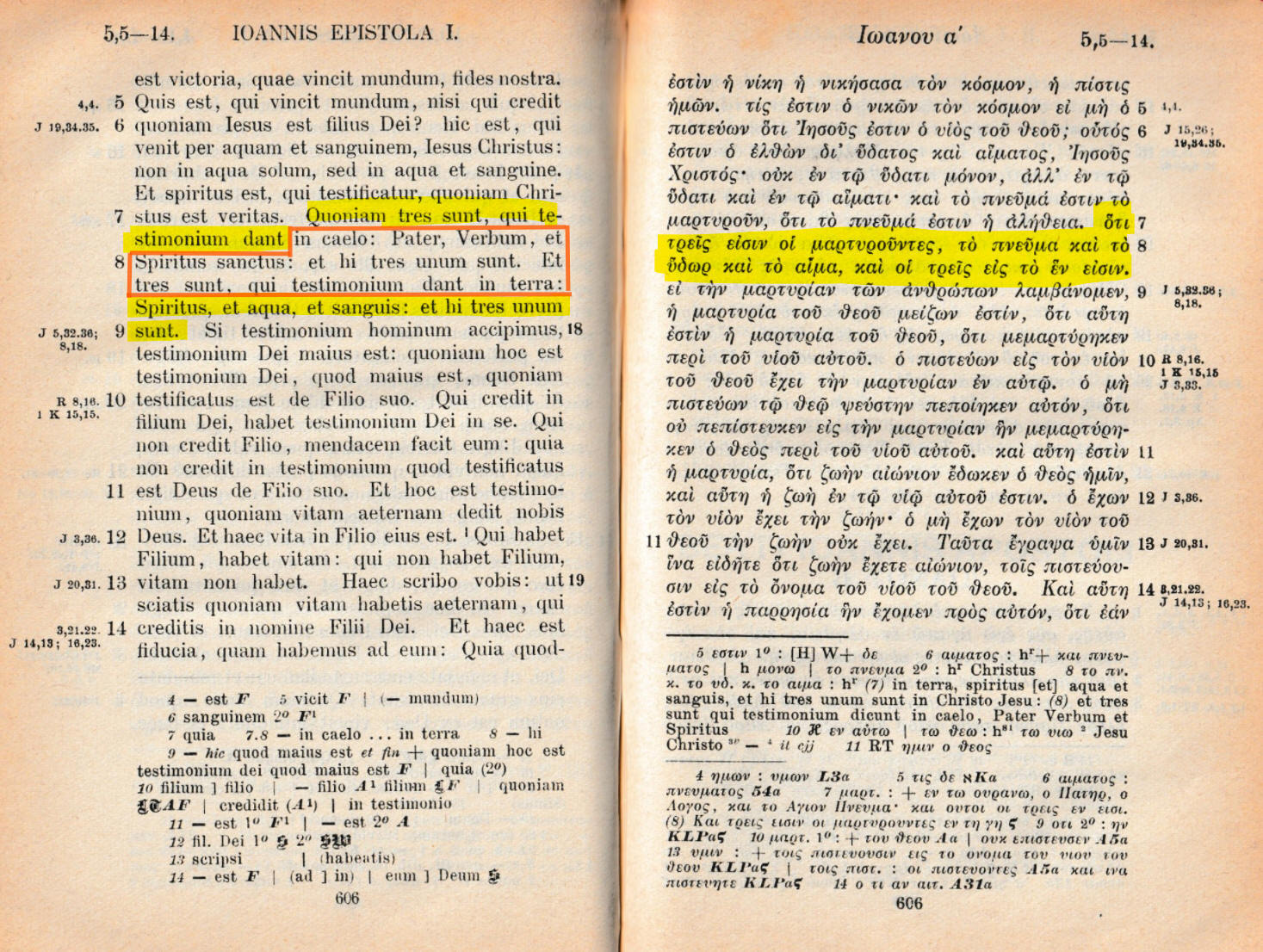
2. The comma in the Latin Bible (Vulgate)
In the original version of the Latin Bible – translated from Greek into Latin by Jerome at the end of the fourth century – the comma does not appear. Hardly surprising, since the passage had not yet been written.
From the seventh and eighth centuries onwards the comma begins to turn up in a number of Latin Bible manuscripts in Spain and North Africa. How did that happen? We do not know, but it may have gone like this: first, perhaps, there was a marginal note (a gloss) by a reader who linked the three witnesses of the biblical text – spirit, water, blood – to the Trinity. A snippet of sermon or meditation in the margin, as it were. And the connection had indeed been made, by many a Church Father. Later copyists must have thought that this marginal note was a lost part of the biblical text itself, which ought therefore to be 'restored' when copying. And so they did.
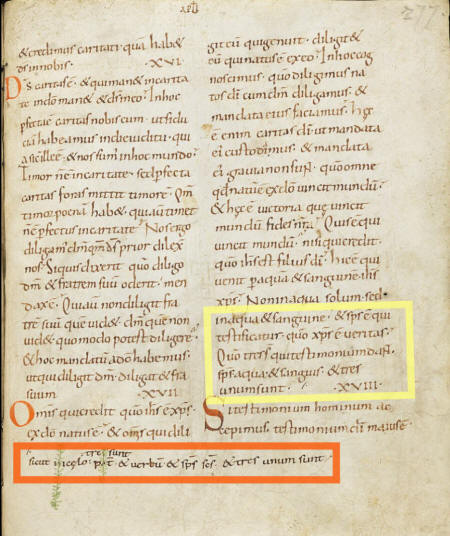
The result: by the end of the Middle Ages the comma stands in almost every Latin manuscript. Which means that every Christian in the late Middle Ages and the early modern period believed that this passage simply stood in the Bible. God is triune — no council thought that up; God himself revealed it. Look, here it is.
3. Erasmus: how it got into the Greek text
The Novum Instrumentum (1516) is the first modern edition of the – better: a – Greek text of the New Testament. Instrumentum = tool, charter, deed: a legal term (Gr. 'diatheke'). With it Erasmus was already trying to offer an alternative to that other dusty notarial term that was (and is) usually used: novum testamentum. In his translation, incidentally, he opts for yet another variant: Novum Pactum (the New Covenant), for instance in the words of institution of the Lord's Supper (in Dutch).
Erasmus compiled the Greek text on the basis of the limited number of manuscripts at his disposal – all but one of them from the Byzantine text tradition. Read more here about the transmission of the biblical manuscripts (in Dutch).
It was a race against the clock, for in Spain, too, work was under way. The printer Froben in Basel wanted to be first. The text is printed in two columns: the Greek text on the left, a Latin translation beside it. What mattered to Erasmus was... the Latin translation. That was his attempt to bring the gospel to the people, in fresh, unfusty Latin.
An aside: the tree and the book
The end of the book of Revelation (the last verses of the Bible) was missing from the only (rather battered) Greek manuscript he had been able to lay hands on. Under pressure of time he decided simply to translate those last verses from Latin into Greek... and to pass that off as the 'original Greek text'. When the Spanish competitors – the Complutensian Polyglot – bring their text onto the market, he sees that he has occasionally missed the mark, and corrects a number of errors, but leaves some standing. That is why there is a howler in Revelation 22:19. Erasmus had a Latin text in front of him that was in fact wrong, and translated it back into Greek:
“And if any man shall take away from the words of the book of this prophecy, God shall take away his part out of the book (in the Greek: the tree) of life, and out of the holy city, and from the things which are written in this book.”
Erasmus read in his Vulgate de libro vitae, and rendered that into Greek. The Greek, however, had apo tou xylou tès zoès (from the 'wood/tree' of life). The whole story is here (in Dutch).
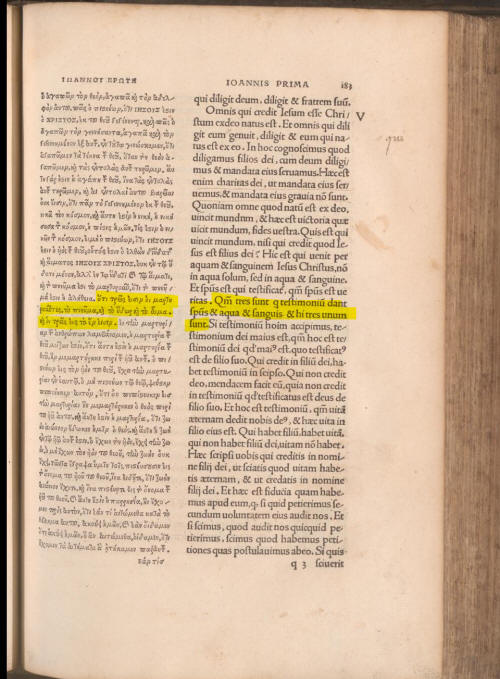
But all this by the way. Erasmus had not seen the Comma Johanneum in any of the Greek manuscripts of the First Epistle of John, and so he did not translate it either. An overview:
- Edition 1 (1516) and edition 2 (1519)
- No comma, because it was not to be found in any Greek manuscript. This caused a storm of criticism from the church – people really believed it was there, so understandably. Erasmus stood his ground. He had seen the manuscripts, and it really was not there. In response, a very tiresome English theologian, Edward Lee, began to accuse him of 'heresy'. That is tiresome, and dangerous, in any case, but Erasmus was used to it. On the other hand: by now Luther had been condemned, and Erasmus and Luther were increasingly being lumped together. So a threat like that did begin to carry weight.
While Erasmus was working on a revision in 1521, he was presented with a new manuscript from England in which the comma Johanneum does appear in Greek. (After its owner, that manuscript is now called the Codex Montfortianus.)
Where did that manuscript suddenly come from? Well, in all likelihood it was produced in England specially to legitimise the comma. On the basis of the handwriting and the paper used, the manuscript can be dated: c. 1520. And I have also read that the Greek manuscript from which the scribe made his copy has been identified. In that manuscript (his Vorlage, then) the comma does... not appear. So that clause was translated from Latin into Greek for the occasion: a little wooden, even – no articles, for instance (quite normal in Latin, odd in Greek).
- Edition 3 (1522)
- Erasmus includes the comma in the third edition of his Instrumentum – which since the second edition, incidentally, had simply been called Novum Testamentum again. He does add a long note, however, in which he says that the Greek text looks to him like a translation of the Latin Vulgate. That way he saves his scholarly honour, ... and his life, which is not unimportant either. In the Roman tradition, by the way, the Vulgate was the 'real Bible'; so with this remark he was by no means discrediting the Greek text. Quite the contrary.
Voilà: that is how a Latin gloss from the seventh or eighth century ended up in the first Greek edition of the New Testament of modern times.
An aside: how it then ended up in the Complutensian and the Antwerp Polyglot is another story. You can read it here.
4. Consequences: the textus receptus
That had its consequences, for Erasmus' Greek edition became the standard text for almost all Protestant Bible translations, which were 'translated out of the original tongues' and based on the 'Hebrew and Greek original texts'.
In the sixteenth and seventeenth centuries, then, hardly anyone still doubts the validity of that Greek text, apart from a few seasoned philologists who continue research into the manuscripts in their ivory towers (i.e. at the universities), but who, given the dangerous times they live in, prefer to keep the discussion behind closed doors. The exception, of course, is Hugo Grotius, who in his Annotationes has the nerve to say it straight out (unverfroren).
Besides that – and by now this is clear enough – appearances are mainly kept up, that is to say: people act as if they are working scientifically – the original text above all – but in reality doctrine rules.
Thus Theodore de Bèze (Beza), Hellenist, lecturer at Lausanne, later Calvin's successor in Geneva, published from 1565 onwards a whole series of editions of the Greek New Testament, with or without a Latin translation. Although he himself owned an ancient Greek codex (the 'Codex Bezae', now in Cambridge), he did hardly any research, but based himself on the edition of the French printer Robert Estienne (Stephanus), who in his turn essentially reproduced Erasmus in his running text (variants are listed in the margin, though, including at 1 John 5:7). The suggestion that Beza successively made improvements – as I read everywhere – may well be true, but even the last edition he supervised (1604) still contains the comma Johanneum, and in the apparatus of notes: nothing at all. This edition matters, because the translators who had to render the Bible into English by order of King James chose Beza's edition as their working text. Surely that could be trusted, they thought.
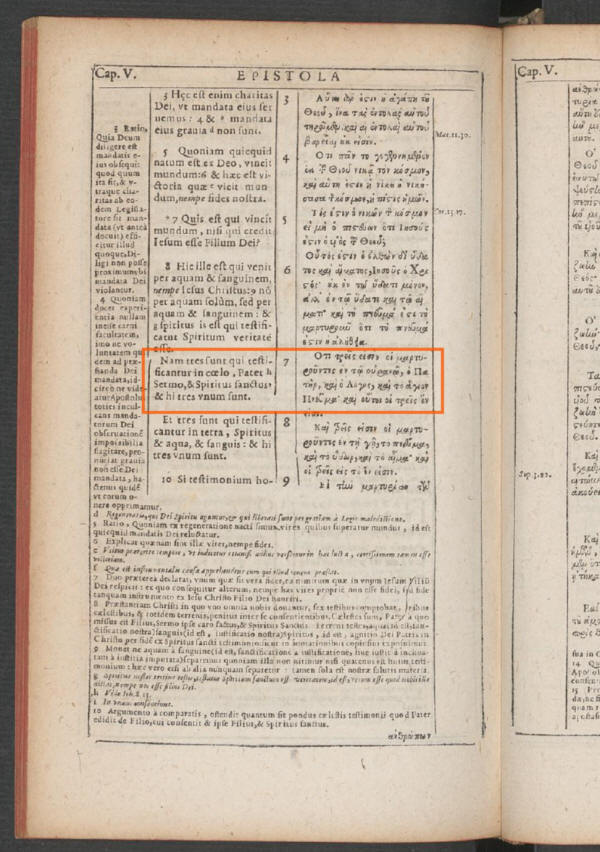
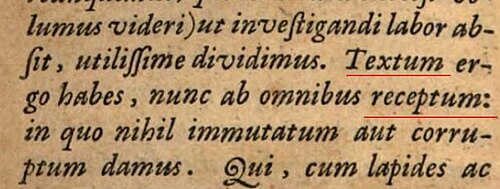
Also somewhat painful, or ironic, is that this Greek text compiled by Erasmus, additions included, was proclaimed the original text of the New Testament, which would bring us closer than any other text to the true Word of God. The publishers Elzevier (Elzevir) call this Greek edition, in the preface to their edition of 1633, “the text now received by all” — textus receptus — and commend their own work by saying that they have printed that text “unaltered and uncorrupted”. I dare say. But it does not change the matter. A correctly printed error is still an error.
5. The exception: Luther
There is one notable exception to this. Luther began his translation of the New Testament before the third edition of Erasmus' text had appeared. So... he did not translate the comma Johanneum. But he also never felt the need to add that sentence afterwards – the definitive version of his translation dates from 1545.
He evidently took the slogan ad fontes seriously: textual research had to be done properly, that is, philologically. In his commentary on the Epistle of John he writes at this point:
Graeca exemplaria non habent. Videtur autem a piis additum esse propter Arianos, sed non satis apposite.
“The Greek copies do not have these words. It seems that they were inserted by pious people on account of the Arians, but not very aptly.”
In that last phrase, non satis apposite, I also hear his feel for language: with this insertion the sentence really does run very badly.
The irony here is that the open, scholarly approach to the Bible that gave the Reformation its wings was soon stifled after Luther's death (1546) by a doctrinal power struggle, accompanied by a fierce campaign against all kinds of heresies – among them Socinianism, a rather free-thinking group of Polish-German origin that wanted only articles of faith directly derivable from the Bible as its basis, and therefore put question marks against the Trinity. The comma became a sword.
1574 — in Frankfurt the comma is inserted into a German Bible (ed. Feyerabend) presented as a 'Luther Bible'. Loud protest: the Luther Bible was not to be tampered with.
1581 — another Frankfurt printer (Zephelius) adds the text again. The protest is already weaker.
After 1590 — nearly all new printings of the Luther Bible contain the comma, sometimes in smaller type. The Wittenberg printers held out longest.
Lutheran orthodoxy could well use a 'hard', unambiguous Bible text to defend the doctrine of the Trinity against those accursed Socinians, who called the divinity of Christ into question. In the end the theological usefulness of a fake Bible text as an argument in a dogmatic dispute was deemed more important than the reliability of the biblical text itself. Luther would turn in his grave if he knew.
Incidentally: the Zurich Bible (Zwingli-Froschauer) also followed Erasmus' first version at the start, but from 1531 the comma was inserted there too. And not by chance: there, too, people were zealously fighting free-thinking heretics.
Not an aside
This is not harmless: it cost Michael Servetus his head. His thesis was: the Trinity is not a biblical doctrine but a church dogma, so I may question it. Rome branded him a heretic, Calvin lit the stake.
6. Where things stand today
Bible translations are produced by Bible societies and publishers that depend for their funding on the church – that is, on believers who buy Bibles or give money for translation and distribution work. At the same time they want to deliver scholarly sound work. When things get tense, however, the latter loses out to the former, I note.
Modern translations: NIV, ESV and others
Practically all modern English translations – from the Revised Version (1881) and the American Standard Version (1901) to the NRSV, the ESV and the NIV – leave the comma Johanneum out of the running text. That is as it should be. Some put it in a footnote, which is fine too – if only so that one can still 'read' a tradition (and place Monteverdi's splendid text and music Duo Seraphim in the Vespers of 1610). The questions can then be answered briefly and firmly: 'It is not there, but it used to be'.
The NIV (2011) shows that a footnote can say exactly that. It does not hide behind 'other manuscripts', but names the source: the Latin.
5:8 Late manuscripts of the Vulgate testify in heaven: the Father, the Word and the Holy Spirit, and these three are one. 8 And there are three that testify on earth: the (not found in any Greek manuscript before the fourteenth century)
footnote in the NIV
The ESV and the NRSV do not mention the matter at all. Scholarly, no doubt, but the reader who has a King James lying next to it is left to wonder where verse 7 went.
And one more thing (about the translation itself): the Greek does not say 'and these three are one', but [literally] 'these three are into one' (eis to hen). That sounds odd in English, but is simply Greek for: these three tend towards the same thing, agree, reinforce each other, which makes perfect sense given the context: Most translations translate in verse 8: 'and these three agree in one'. The King James included!
King James Version and New King James Version
The King James Version, of course, still has the comma in the main text, without any note: Beza's 1598 text, faithfully translated. Every reprint repeats it to this day. But the New King James Version (1982) goes one better. It is a modern revision, which could have taken the opportunity to clean up – and yet it leaves the comma Johanneum in the main text. A strange form of faithfulness to Scripture: according to the very constituency of this translation, the main text is “God's own Word”. If you see it that way, you cannot leave an evident gloss standing in it! There is a footnote, to be fair. And it is honest, though technical:
NU-Text and M-Text omit the words from in heaven (verse 7) through on earth (verse 8). Only four or five very late manuscripts contain these words in Greek.
footnote in the NKJV
Read that carefully. NU is the modern critical text (Nestle-Alande, United Bible Societies); the 'M-Text' is the Majority Text (the text of the great mass of Byzantine manuscripts) – the very tradition on which the textus receptus claims to rest. Even that tradition does not have it. Four or five very late manuscripts – the Codex Montfortianus and a few other Greek manuscripts influenced by the Vulgate – against all the other Greek witnesses, Alexandrian, Western and Byzantine. The translators knew it, they wrote it down... and left the words in the text all the same. Sola Scriptura or Sacra Doctrina?
Dick Wursten, 2026
Tips for further reading
- Greek manuscripts of the Gospels (in Dutch)
- Erasmus and the last verses of the Apocalypse (in Dutch)
- H.J. de Jonge, Erasmus and the comma Johanneum. On Erasmus' motives and the conflict with Edward Lee; also discusses and refutes the myths surrounding them.
P.S. — 1 John 5:1-8: what is it actually about?
In all the commotion we have forgotten to read the text in its
context.
The writer states that whoever believes that Jesus is the Messiah is a
child of God. God loves his children (there is no doubt about that).
And so they love one another. Just as self-evident. And not difficult
at all, provided you have overcome the world. And you have! For you
trust in Jesus. That is now confirmed — and here we are at
verses 5-7 — by the 'Spirit of truth', by means of 'water and blood'.
They say the same thing. I hear in this a reference to baptism and the
Lord's Supper? But judge for yourself. Here is the whole passage (vv.
1-8):
Whosoever believeth that Jesus is the Christ is born of God: and every one that loveth him that begat loveth him also that is begotten of him. By this we know that we love the children of God, when we love God, and keep his commandments. For this is the love of God, that we keep his commandments: and his commandments are not grievous. 4 For whatsoever is born of God overcometh the world: and this is the victory that overcometh the world, even our faith. 5 Who is he that overcometh the world, but he that believeth that Jesus is the Son of God? 6 This is he that came by water and blood, even Jesus Christ; not by water only, but by water and blood. And it is the Spirit that beareth witness, because the Spirit is truth. 7 For there are three that bear record [in heaven, the Father, the Word, and the Holy Ghost: and these three are one. And there are three that bear witness in earth], the Spirit, and the water, and the blood: and these three agree in one.